Unlimited OCR, claim by claim
On October 10, 2026, a post by Brooks Whale X (444,000 views) announced that Baidu had open-sourced Unlimited OCR: a 3B model that reads a 100-page PDF in one continuous pass, scores 93 percent on the standard parsing benchmark, runs free on your own machine while cloud OCR charges 1.50 to 15 dollars per thousand pages, and had racked up 1.9 million downloads. This primer checks every claim against Baidu's paper, its model card, and the providers' own pricing pages. The short version: the model is real and the core claims are true, because the post is largely Baidu's own June 2026 launch copy. Three claims are inflated, and the paper itself disowns the word "unlimited."
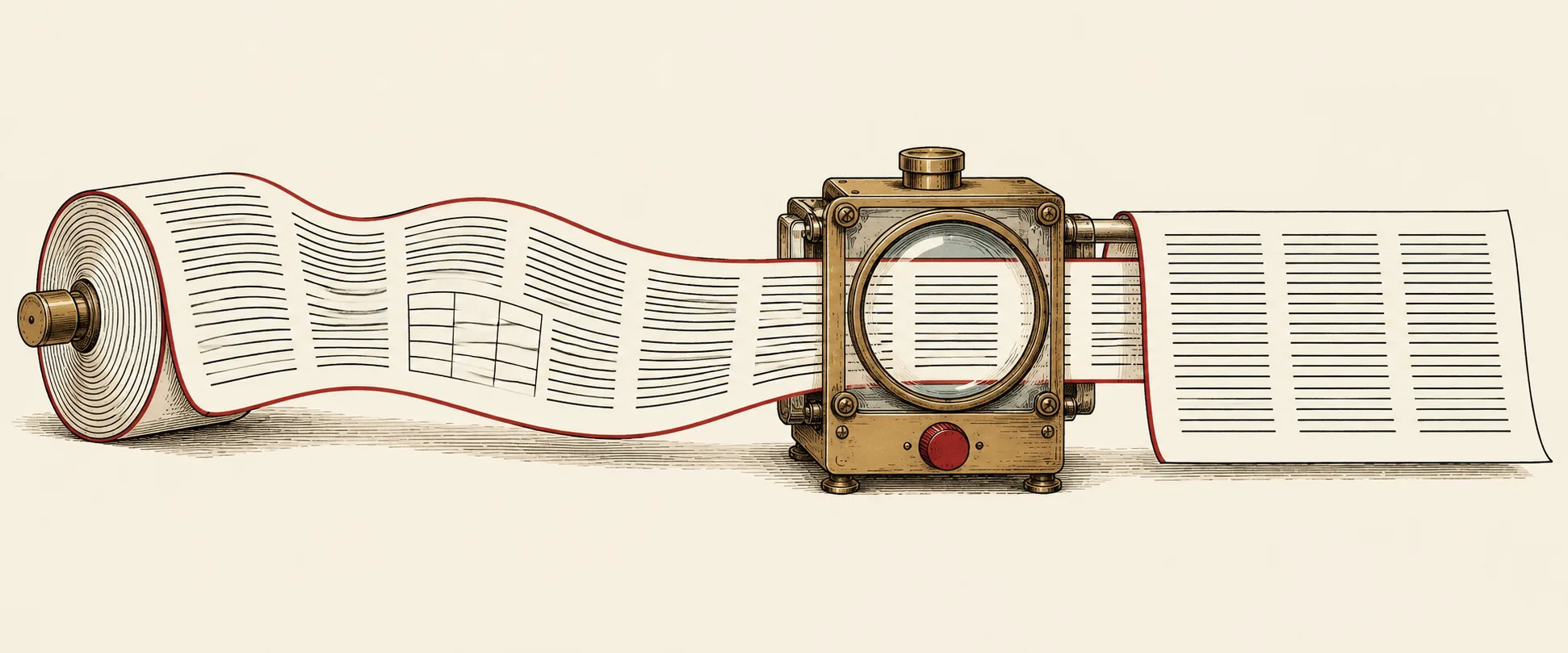
How it works
Five mechanisms, and one honest limitation
Unlimited OCR (paper title: "Unlimited OCR Works") was released by Baidu on June 22, 2026 under the MIT license. It inherits its eyes from DeepSeek-OCR and replaces how it writes. Start with the claim check, then open the mechanism cards.
Fifteen claims, grouped into five steps. Verdicts come from the model card, the paper (arXiv:2606.23050), and the cloud providers' pricing pages, all linked in Sources. Step through them.
The "standard parsing benchmark" is OmniDocBench, and 93 is not a percentage of pages read correctly. The overall score averages three sub-scores: text accuracy (from edit distance), formula recognition, and table structure. The table below is Baidu's own, and it compares end-to-end models only: pipeline systems were left out.
The part the launch left out: on the newer v1.6 benchmark with pipelines included, the top scores by October 2026 belong to pipeline systems: PaddleOCR-VL-1.6 at 96.33 (from Baidu's own other team), MinerU2.5-Pro at 95.75, GLM-OCR at 95.22. Unlimited OCR scores 93.92 there, two hundredths of a point ahead of Baidu's Qianfan-OCR. Best end-to-end model in June was a fair claim. Best document parser is no longer one.
The post contrasts local (free) with cloud at 1.50 to 15 dollars per 1,000 pages. Here is the same comparison at a real workload: 100,000 pages a month where you need the structure out, tables and fields, not just raw text. Prices from the providers' own pages, October 2026.
AWS Textract Detect or Azure Read at 1.50 dollars per 1,000 pages. Not comparable output: no tables, no fields, no structure.
4 dollars per 1,000 pages, launched June 23, 2026, the day after Unlimited OCR. Adds bounding boxes and per-word confidence scores, the audit trail a generative parser usually cannot give you.
Azure Document Intelligence Prebuilt at 10 dollars per 1,000 pages. The closest cloud analogue to what Unlimited OCR outputs.
AWS Textract at full structured pricing, 65 dollars per 1,000 pages. The top of the ladder the viral range stopped halfway up.
Our arithmetic, labelled as such: at roughly 3 pages a minute on a 450-watt system, 100,000 pages is about 560 GPU-hours, or 40 to 90 dollars of electricity. Electricity is not the local cost story.
A 24 GB GPU you own (a 4090-class card, or roughly 0.40 to 1.00 dollars an hour rented), plus the engineering: the official stack ships a custom SGLang wheel, a custom repetition-guard logit processor, PDF rendering, and output cleanup, and the serving guidance changed three times in the first month. Below roughly ten thousand pages a month, the cloud wins once your time is priced. Above a hundred thousand structured pages a month, local pays back fast, if its accuracy on your documents matches. That last clause is an empirical question, not a benchmark one.
Timeline
Twenty years from character templates to whole books
OCR spent decades as a pipeline of specialists. The end-to-end takeover happened in about four years. Step through it.
Key voices
Who built it, who tested it, who is selling against it
The Baidu authors are unusually candid about their own limits. The practitioners who ran the model mostly confirm the mechanism and discount the marketing. One competitor launched the day after.
Youyang Yin, Huanhuan Liu, and the Baidu team
"Unlimited OCR Works," arXiv:2606.23050, June 2026
Their framing: DeepSeek-OCR solved the input side of document AI by compressing pages into few tokens; the unsolved side was the output, where a normal decoder's memory grows with every word it writes, which is why everyone fell back to parsing page by page. Their fix is Reference Sliding Window Attention, and their limitations section then says the quiet part plainly: truly unlimited parsing is not possible under a finite 32K context, because the page images themselves consume more of that context with every page added. The roadmap they name is 128K training and a prefill pool. A launch paper that refutes its own product name is worth trusting on the rest.
Haoran Wei and the DeepSeek team
DeepSeek-OCR, October 20, 2025
DeepSeek never framed its model as an OCR product. The paper treats OCR as a probe: render text as an image, compress it optically, and study how much language a vision encoder can carry, about 97 percent decoding precision at under 10x compression, about 60 percent at 20x. Their chosen comparisons were tokens per page: 100 tokens beating GOT-OCR2.0's 256, under 800 beating MinerU's roughly 6,000 to 7,000. Unlimited OCR is the direct descendant: same encoder, same decoder family, continue-trained from DeepSeek-OCR's checkpoint with the encoder frozen. One small independent replication of DeepSeek-OCR 2 measured far lower decode accuracy (about 54 percent at roughly 10x compression on 15 pages), a flag that the compression curve is test-set-sensitive, not a refutation.
Pawel, on an A100
Medium, June 29, 2026; introduction read, full text paywalled to this research
Pawel set out to test exactly the headline claim, whether the constant memory really holds, on a Colab A100, and concluded that it does, with one caveat the hype skips: the prefill growth. That is the paper's own caveat, confirmed from outside. His detailed numbers sit beyond the fetchable part of the article, so this primer quotes the conclusion, not the measurements.
cast42, on a MacBook
Running the model on Apple Silicon, July 19, 2026
cast42 ran the original checkpoint on a 24 GB M4 MacBook Pro through MLX-VLM and built a PDF-to-Markdown converter on it, evidence that "runs locally" is real beyond NVIDIA. His cautions are the useful part: the v1.6 lead over Qianfan-OCR (93.92 to 93.90) should not be overstated, and the long-document test set behind the 0.11 figure is Baidu-internal. Both cautions match this primer's verdicts.
Joss82, founder of Parseur
Top comment in the Hacker News launch thread, June 23, 2026, as paraphrased in coverage
The launch thread's most-upvoted skepticism came from a man who sells document parsing: OCR, in his verdict, still performs badly in 2026 on the cases that matter commercially, handwriting, degraded scans, and dense formulas (paraphrase from TechTimes' summary of the thread; his company sells a competing parser, so weigh the interest). The benchmark record partly backs him: on the Allen Institute's olmOCR-Bench, every system tested scores between 29 and 48 on old scans. The same thread, though, carried practitioners reporting real wins, including a 200-page Japanese grammar PDF parsed in about an hour on a single RTX 4090, and praise for Baidu crediting DeepSeek and PaddleOCR by name in the card, called a class act by more than one commenter.
Mistral AI
Mistral OCR 4, June 23, 2026
One day after Unlimited OCR shipped, Mistral launched its counter-position: a hosted parser at 4 dollars per 1,000 pages selling the two things the open model does not document, auditability (bounding boxes, block types, per-word confidence scores) and language breadth (170 languages claimed, against Unlimited OCR's unspecified "multilingual" tag). The split is the market in miniature: free weights and your own engineering, against a metered API that shows its working.
Where leaders think this goes
Agreement on the mechanism, a split on the architecture
Positions as published through October 2026.
Where they agree: specialists beat generalists at parsing, per dollar
The OmniDocBench numbers are not close. GPT-4o scores 75.02 on v1.5; Qwen's 235B flagship scores 89.15; a 3B specialist scores 93.23. Nobody in the field, including the generalist labs, disputes that a small dedicated parser is the cost-effective way to turn pages into text today. The argument is about what happens next, not about the present.
Where they also agree: "unlimited" is a direction, not a description
Baidu's own limitations section, Pawel's A100 test, and cast42's write-up all land on the same sentence: the decode memory is solved; the input budget is not. Until context grows or the prefill pool idea ships, one pass means dozens of pages, and honest marketing would say so.
Split one: end-to-end models versus pipelines
Side A: One model, page in, document out
DeepSeek and the Unlimited OCR team: a single vision-language model avoids the pipeline's cascading errors, where a missed layout block is never read at all, and lets the language model's priors repair ambiguous characters and infer structure.
Side B: The leaderboard, as of October 2026
OpenDataLab's MinerU and Baidu's own PaddleOCR team hold the top of the fuller v1.6 table (96.33 and 95.75) with pipeline and hybrid designs whose stages can be inspected, swapped, and improved independently. The ironic state of play: Baidu owns both crowns, one per architecture.
Split two: dedicated parsers versus frontier models that also understand
Side A: Transcription is a commodity job
A 3B open model on one GPU beats a rented frontier model at turning pages into Markdown, at a fraction of the cost, and can run inside your own walls. Parsing is infrastructure; buy it like infrastructure.
Side B: The gap is closing, and transcription is not the job
Gemini-3 Pro already scores about 92.91 on v1.6 in secondary leaderboard summaries, and a frontier model does not merely transcribe a contract, it can flag the clause that matters. If your pipeline ends in understanding anyway, one model that does both is a real architecture, not a luxury.
Split three: free weights versus metered certainty
Side A: Open and local
Baidu, DeepSeek, and the Allen Institute ship MIT or open weights: no per-page meter, no documents leaving your network, and electricity costs measured in cents per thousand pages. The catch is yours to engineer: custom serving wheels, repetition guards, and churn.
Side B: Cloud, with receipts
Mistral, Azure, and AWS sell what a generative parser structurally lacks: confidence scores, bounding boxes, service guarantees, and 170-language claims with a vendor behind them. When a misread digit costs more than the API bill, the meter is the cheap part.
One benchmark everyone should keep: the hard tail
Whatever architecture wins, the Allen Institute's olmOCR-Bench is the standing embarrassment: on old scans, the best system tested (olmOCR itself, 47.7) and the worst (Mistral's API, 29.3) are all failing grades, with MinerU, DeepSeek-OCR, and Marker clustered in the low 30s. Joss82's skepticism has a table behind it. The next real leap in document AI is not another point on clean born-digital PDFs; it is the archive boxes.
The build question
Could you ship an app on this? What about live camera OCR?
The three questions this model raises for anyone who builds software, answered from the same sources as the rest of the page.
The pieces are public and permissive: MIT weights, an official repo, documented serving paths. The core loop is short: render each PDF page to an image (the card's examples use PyMuPDF at 300 DPI), hand the pages to the multi-page entry point, strip the grounding tags from the output, and show clean Markdown. A competent developer has that demo running on a rented GPU in a weekend. The product work is everything around it: the official SGLang path needs a bundled custom wheel and a custom repetition-guard logit processor, long documents are serial by design (a practitioner parsed a 200-page PDF in about an hour on one RTX 4090, so real apps need a job queue and progress states, not a spinner), and accuracy on your own documents has to be measured yourself, because every published score is Baidu's.
No, and the reason is architectural. Nothing in the model or its official stack ingests video: it consumes still page images at 1024 by 1024 in its document mode and writes its answer out token by token, at practitioner speeds of roughly 3 pages a minute on a high-end consumer card, so one page takes on the order of 20 seconds. What does work is the scanner pattern: point the camera, capture one sharp page, parse it, repeat, with batching on a server GPU cutting the wait. A true live overlay, words recognized as the camera moves, wants a small streaming recognizer instead, and this model's one-pass memory buys a camera nothing, because a camera frame has no 40-page past to remember. On-device is possible through community ports (MLX runs the original checkpoint on Apple Silicon; GGUF builds run quantized in about 2 GB of weights), carrying the quality caveats from Fig 1.
Development costs a rented 4090-class GPU at roughly 0.40 to 1.00 dollars an hour, or nothing if you own a 24 GB card; the weights are 6.67 GB, and the vLLM recipe is reported to start at 8 GB of VRAM, with 24 GB the practical card for long multi-page work (deployment guide in Sources). In production the meter splits three ways: electricity is nearly free at about 0.40 to 0.90 dollars per 1,000 pages (labelled arithmetic, Fig 3), an always-on rented GPU runs roughly 300 to 700 dollars a month whether or not pages arrive, and an API charges 4 dollars (Mistral) to 10-65 dollars (cloud structured tiers) per 1,000 pages with no operations at all. The crossover is utilization: a busy or owned GPU wins at volume, an API wins until the volume is real, and either way the scarcest input is the engineering time in the first row.
Takeaways
What to actually remember
Unlimited OCR is a real, MIT-licensed, 3B model from Baidu that does the thing at the center of the viral post: it parses long documents in one pass, because its writing memory never grows. The post around it is June launch copy recirculated in October, and its three selling numbers (100 pages, 1.9 million downloads, cloud at 1.50 to 15 dollars) are a tested-to-40 claim stretched, a monthly figure mislabeled, and a price ladder quoted halfway. Meanwhile the field moved: by the time the post went viral, pipeline systems, including one from Baidu's own other team, already sat above it on the fuller benchmark.
- The invention is on the output side. DeepSeek-OCR compressed the input (a page becomes 256 tokens). Unlimited OCR bounds the output: pin the pages as a permanent reference, keep a sliding window of the last 128 generated tokens, and decode memory stays flat at any document length.
- "Unlimited" is bounded by the way in. Every page still costs about 256 tokens of a 32K budget in prefill. The paper tests to 40+ pages, says "dozens," and states plainly that truly unlimited parsing is impossible under a finite context. The 100-page figure exists only in secondary hype.
- 93 is a composite, in a curated table. OmniDocBench v1.5 overall 93.23 averages text, formula, and table scores, among end-to-end models only. On v1.6 with pipelines included, PaddleOCR-VL-1.6 (96.33) and MinerU2.5-Pro (95.75) lead, and Unlimited's margin over Baidu's own Qianfan-OCR is 0.02.
- Price the whole ladder. 1.50 dollars per 1,000 pages buys plain text. Structured extraction comparable to this model's output runs 10 to 65 dollars per 1,000 in the cloud, and 4 dollars at Mistral. Locally, electricity is 40 to 90 dollars per 100,000 pages; the real local costs are the GPU and your engineering hours.
- Downloads are a rolling window. Hugging Face shows last-month downloads, not a lifetime total: about 1.99 million in mid-July 2026 trackers, 1,205,646 when checked on October 12, 2026. Any "X million downloads" claim about any model deserves the same question: as of when, over what window?
- Generative parsers fail fluently. A pipeline OCR engine fails loudly, with garbage characters. A vision-language parser can substitute a plausible wrong word, or loop, which is why the official stack ships a repetition guard. And on old scans, every system in olmOCR-Bench scores under 48: the hard tail is still unsolved, by anyone.
Keep exploring
Related primers
The Only Moats Left
Another viral claim from the same weekend, checked the same way: what still defends a startup.
How Inference Works
Prefill, decode, and the KV cache: the machinery this primer's trick is made of.
Where LLM Data Comes From
Parsed documents at industrial scale are how models get fed; DeepSeek built its parser partly as a data factory.
How AI Remembers
Context windows, sliding windows, and the other ways models hold onto the past.
Sources
Primary sources
Read October 2026. Practitioner reports are flagged as such; the Azure figures come from Microsoft's own pricing pages as indexed, noted where used.
Brooks Whale X post, October 10, 2026
Baidu: Unlimited-OCR on Hugging Face
Yin et al.: Unlimited OCR Works (arXiv:2606.23050)
GitHub: baidu/Unlimited-OCR
Wei et al.: DeepSeek-OCR, Contexts Optical Compression (arXiv:2510.18234)
OmniDocBench (OpenDataLab)
PaddleOCR-VL-1.6 report (arXiv:2606.03264)
olmOCR and olmOCR-Bench (Allen Institute)
AWS Textract pricing
Google Cloud Vision pricing
Azure Document Intelligence pricing
cast42: Running Unlimited OCR on Apple Silicon
Pawel: Unlimited OCR on an A100
Hacker News launch thread digest, June 23, 2026
ComputeLeap: Unlimited OCR vs Mistral OCR 4
Tesseract history
Hugging Face download trackers, July 2026
Community deployment guide for Unlimited OCR