Where LLM Data Comes From
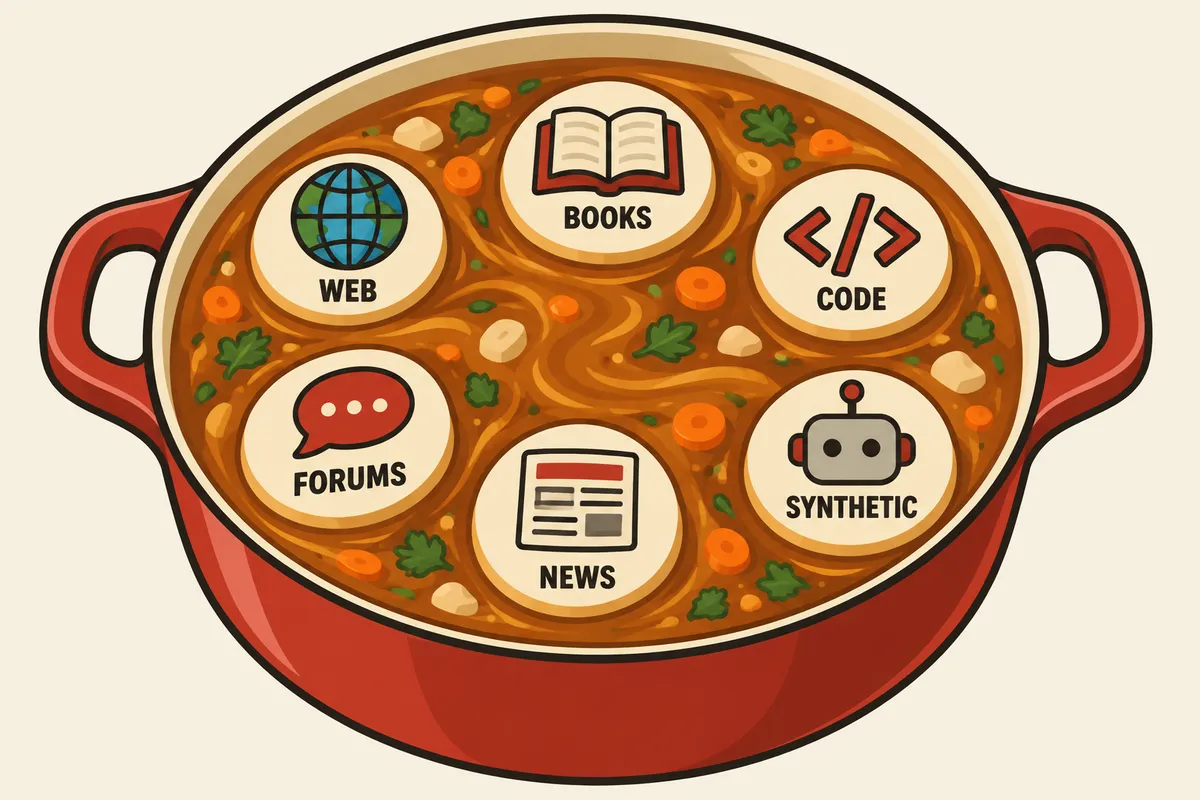
Every large language model is a soup made from the public internet, and the recipe keeps changing. The easy ingredients are running low, the copyrighted ones are getting expensive, and the newest ones are cooked up by the models themselves.
1. The brief
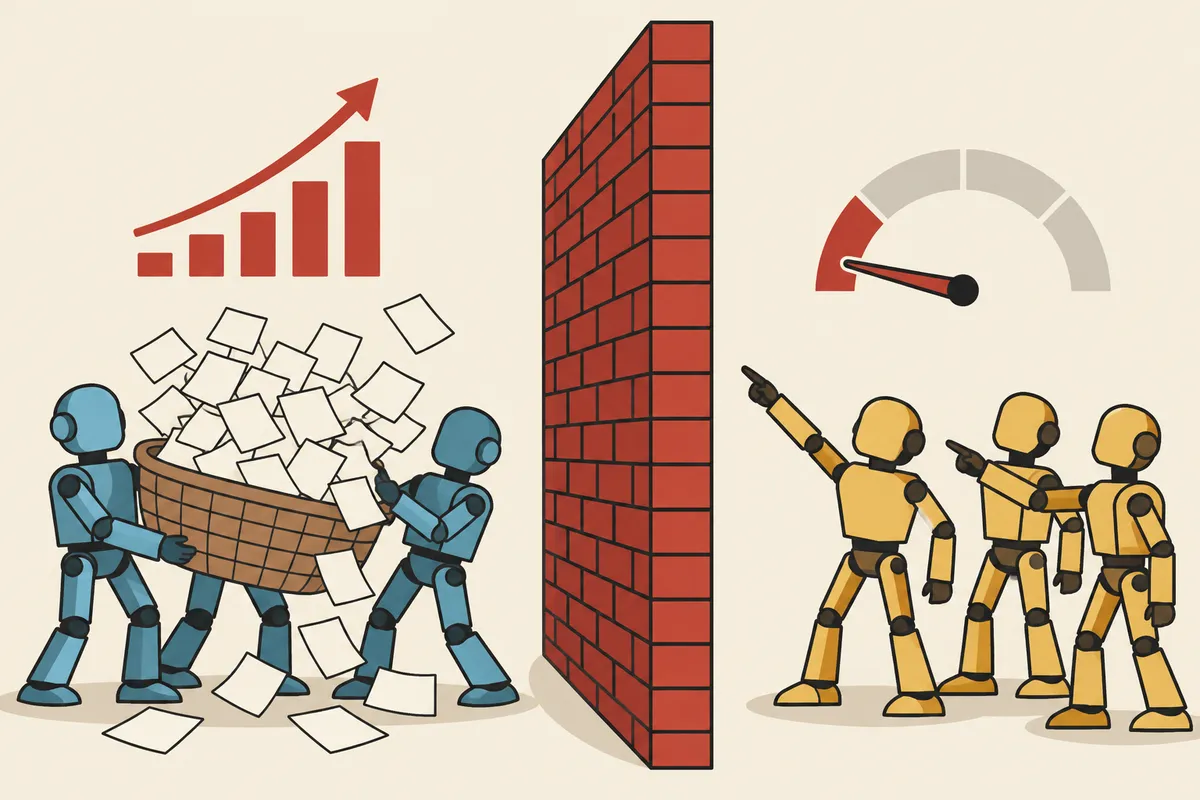
A training corpus is the pile of text a language model reads during training. For a decade the recipe was simple: crawl the web, add books, code, and forums, stir. Now every ingredient is contested. Web crawls carry copyrighted news. Book datasets got taken down. Reddit shut the free tap and started charging. Wikipedia banned LLM-written articles. And the research on whether we are running out of quality text, Epoch AI's 2022 study revised in 2024, says the stock of usable human text runs out somewhere between 2026 and 2032.
Remember this: the model is what it ate, web crawls, books, code, papers, forums, and increasingly, other models.
2. How it works
The Pile, EleutherAI's 2020 open dataset, is the last fully public look at a complete recipe. Tap the bar to see the shares.
The Soup: what is in The Pile
825 GiB of text across 22 sources, shares rounded. Web crawls are the base; everything else is seasoning. Tap a segment.
Component sizes from the Pile datasheet and component table, in GB (885 GB is about 824 GiB, matching the 825 GiB total above). Books3 was later removed over copyright; the weights above are the original 2020 mix.
The pipeline, worked
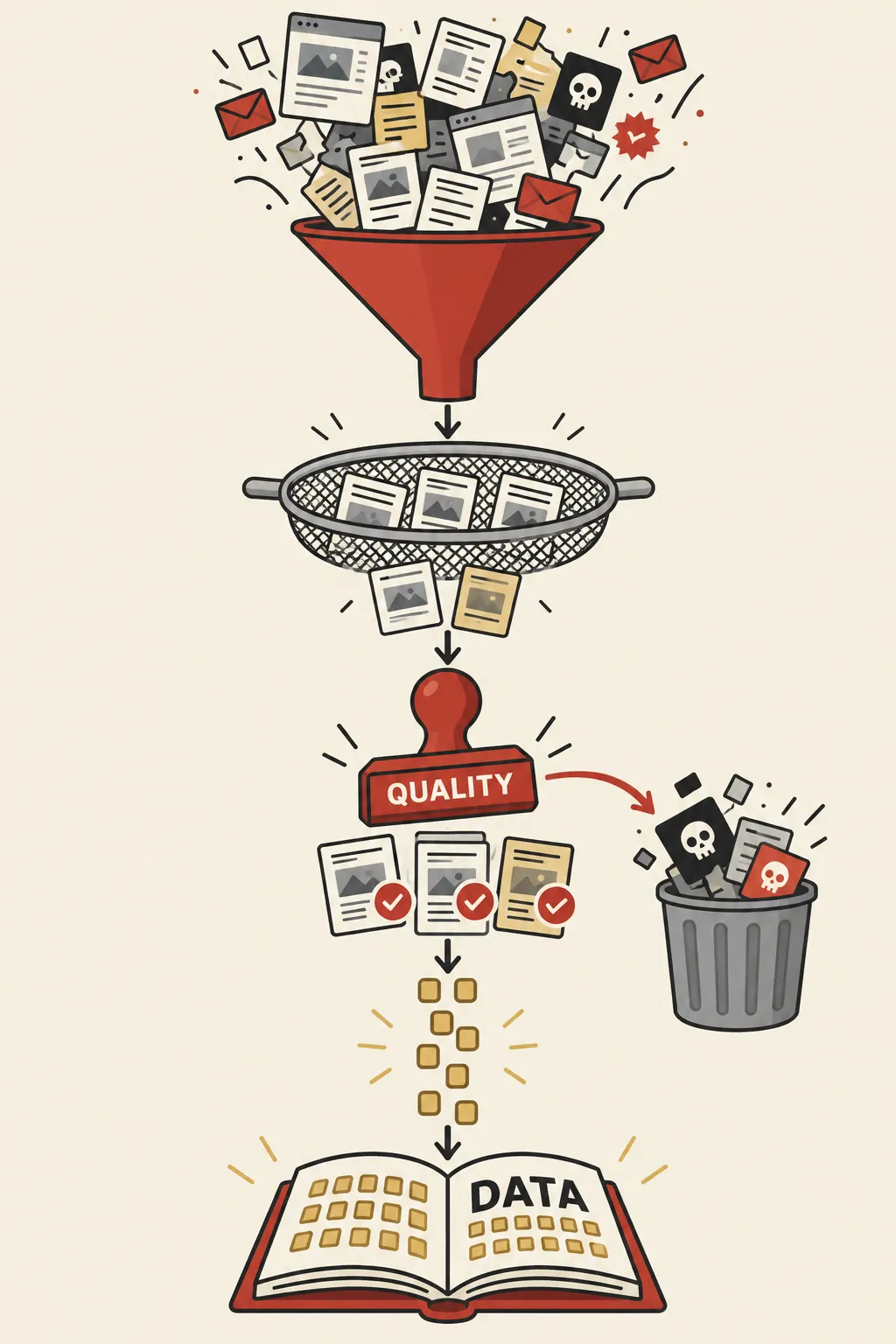
Raw web text never goes straight into a model. Here is one fully documented filtering run, from the FineWeb-Edu dataset card, with the actual numbers.
Worked example: FineWeb-Edu
Start with FineWeb, about 15 trillion tokens of filtered Common Crawl from 2013 to 2024. Then:
- 1Score. Llama3-70B-Instruct grades 500,000 sample pages for educational quality on a 0 to 5 scale. The prompt aims at grade-school and middle-school level knowledge, so it does not just favor dense arXiv pages.
- 2Distill. Those 500k synthetic labels train a smaller Bert-like regression classifier. At the keep-or-drop threshold of 3, it hits an F1 of 82%.
- 3Filter. Run the classifier over all 15 trillion tokens. That took about 6,000 H100 GPU hours. Keep only pages scoring 3 or higher.
92% of the web removed by one quality classifier. The surviving 1.3 trillion tokens beat unfiltered FineWeb on benchmarks, and the classifier, its code, and the labels were all released open. Numbers from the Hugging Face dataset card and the FineWeb-Edu paper. This is the modern answer to raw scale: better data, not just more data.
3. Timeline
How the corpus got built, sued, filtered, and rethought. One tap per step.
4. Key voices
The people behind the datasets and the data-wall debate, in their own attributed words. The disagreement at the bottom is the point.
5. Where leaders think this goes
Date-stamped October 2026. Each item names who said it, where, and when. No anonymous consensus.
Where they agree
Sutskever and Villalobos agree: the field's named escapes are synthetic data, reinforcement learning, and better data efficiency. Sutskever's NeurIPS 2024 talk listed agentic AI, synthetic data, and inference-time computing as the next evolutions. The Epoch paper's own abstract names synthetic data generation, transfer learning from data-rich domains, and data efficiency improvements as the ways forward when human text stops scaling.
Besiroglu, Amodei, and Bubeck agree: the scarcity is about quality text, not bytes. Nobody in this debate claims the internet is small. The fight is over the usable fraction after deduplication and quality filtering, and whether new techniques can expand it.
Where they split
Besiroglu's Epoch modeling puts the quality-adjusted stock of public human text at about 300 trillion tokens, fully used between 2026 and 2032, a "literal gold rush" that depletes a finite resource. Sutskever says pre-training as we know it will end because "we have but one internet" and data is "the fossil fuel of AI". Shumailov warns that training on model-generated data causes model collapse: tails vanish, and by the ninth generation a model writing about medieval architecture lists jackrabbits instead.
Amodei told the Financial Times in April 2026 that "there's no end to the rainbow" and "we don't see anything slowing down". Bubeck's phi line proved a 1.3B model trained partly on GPT-3.5-generated textbooks can hit 50.6% on HumanEval. NVIDIA's Nemotron-4 340B used over 98% synthetic data in alignment, and its HelpSteer2 pipeline matched Llama-3-70B-Instruct with about 1% of the human-annotated data.
Sutskever's single-leader bet from the same NeurIPS talk: with pre-training flattening, progress moves to agentic AI and models that think longer at inference time, which he predicted would lead toward superintelligence. Not a camp, one person's bet.
6. Takeaways
The story of LLM data is the story of an industry learning that its raw material is finite, contested, and increasingly manufactured. The open web built the first models; lawsuits and paywalls are fencing it; quality classifiers and synthetic generation are the new refineries. Nothing in this primer is settled, but the direction is: the corpus of the future will be licensed, filtered, and partly written by machines.
- The web is the base, not the recipe. Every major corpus starts from Common Crawl and keeps under a tenth of it. C4 kept ~750GB from one month; FineWeb-Edu kept 1.3T of 15T.
- Filtering is the product. The biggest recent leaps came from classifiers and heuristics, not bigger crawls. RefinedWeb beat curated corpora with web data alone; FineWeb-Edu's classifier deleted 92% of the web and won.
- Books became the legal front line. From BookCorpus to Books3's takedown to Anthropic's $1.5B settlement, the book pipeline is where copyright law is being written in real time.
- Synthetic data is both the answer and the warning. Phi and Nemotron show it works when engineered; Shumailov's collapse work shows it rots when looped carelessly. Provenance, knowing what a model ate, is becoming a first-class concern.
- Humans still label, but the mix is shifting. From Sama's Kenyan labelers to HelpSteer2's 1% human data, the trend is machines generating, humans verifying.
The model is what it ate. Watch the ingredients, not just the chef.
7. Keep exploring
8. Sources
Every number and attributed claim on this page traces to one of these. Primary sources, exact pages.
- arXiv paper The Pile: An 800GB Dataset of Diverse Text for Language Modeling
- Dataset datasheet Datasheet for the Pile
- Org page Common Crawl: Gil Elbaz, Chairman
- Company blog How Common Crawl and AWS Open Data built the foundation for the AI revolution
- arXiv paper Exploring the Limits of Transfer Learning with a Unified Text-to-Text Transformer
- arXiv paper The RefinedWeb Dataset for Falcon LLM
- arXiv paper The FineWeb Datasets: Decanting the Web for the Finest Text Data at Scale
- Dataset card FineWeb-Edu dataset card
- Dataset card The Stack v2 dataset card
- arXiv paper LAION-5B: An open large-scale dataset for training next generation image-text models
- arXiv paper Textbooks Are All You Need
- arXiv paper Will We Run Out of Data? Limits of LLM Scaling Based on Human-Generated Data
- News report AI 'gold rush' for chatbot training data could run out of human-written text
- Journal paper AI models collapse when trained on recursively generated data
- arXiv paper The Common Pile v0.1: An 8TB Dataset of Public Domain and Openly Licensed Text
- arXiv paper Skip-Thought Vectors
- Conference paper Addressing "Documentation Debt" in Machine Learning: A Retrospective Datasheet for BookCorpus
- Press release Rights Alliance removes the illegal Books3 dataset used to train artificial intelligence
- Reference AI-generated content on Wikipedia
- Interview Wikipedia won't let AI edit articles: co-founder Jimmy Wales
- Reference New user trends on Wikipedia
- News report News generative AI deals revealed: Who is suing, who is signing?
- News report Anthropic's $1.5B copyright settlement approved
- News report Seattle Times, Newsday lawsuit targets OpenAI and Microsoft over scraped journalism
- News report Reddit is cutting off free API and RSS access while keeping Google and OpenAI paying
- News report Exclusive: Reddit in AI content licensing deal with Google
- News report Workers filtered toxic content for ChatGPT for $2 an hour
- Company blog Leverage the Latest Open Models for Synthetic Data Generation with NVIDIA Nemotron-4-340B
- Dataset card Common Voice Scripted Speech v27.0 release notes
- News report EleutherAI releases massive AI training dataset of licensed and open domain text
- Talk Sutskever's NeurIPS 2024 Test of Time talk (full recording)
- Interview Anthropic chief Dario Amodei: 'I don't want AI turned on our own people'