How AI Remembers: Context and Compacting
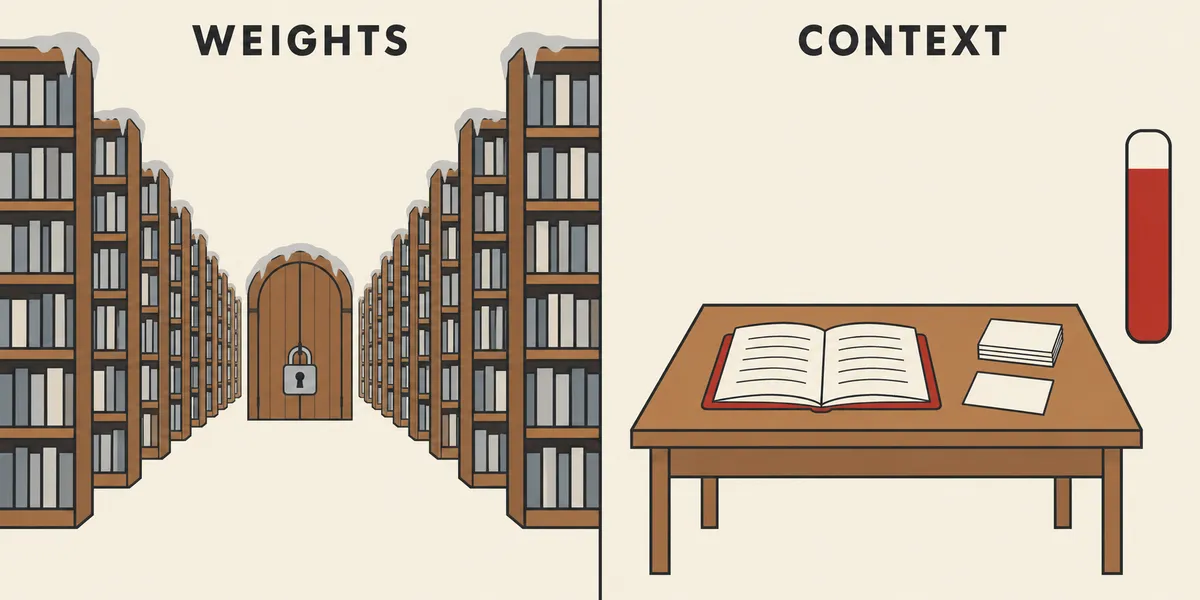
Every AI conversation runs on a working memory called the context window: one shared token budget for the prompt, the whole history, and the answer being written. It fills up as you talk, it costs real money per token, and when it overflows the oldest turns collapse into a summary. The sentence to remember: an AI's memory is a desk, not a hard drive, and whoever controls what stays on the desk controls what the AI knows.
1. The brief
AI looks like it remembers everything. It does not. A model has two kinds of memory. The first is baked into its weights during training: facts, patterns, vibes, frozen at the cutoff date. The second is the context window: the live working memory of this conversation, and the only place new information can go. That window is limited, it is shared by everything including the answer being written, and the infrastructure underneath charges rent by the token.
The last two years turned this from trivia into the central engineering problem of agents. Windows grew to a million tokens. Summarization got automated into an API primitive called compaction. And everyone building long-running agents learned the hard rule: anything that matters goes in a file, because everything else is one summary away from being gone.
2. How it works
Six mechanisms, from the token budget to the summary swap. Tap each card for the plain-language version, one concrete example, and what changed recently. Then fill the bucket yourself.
Fill the bucket
A 200,000-token window, one long session. Every tap adds one chunk. When a chunk would overflow the bucket, the oldest turns collapse into a summary and the session continues. One tap, one chunk.
The session opens with the system prompt and tool definitions already on the desk: 8,000 tokens.
Illustrative, not a real session. Real token counts vary by model and tokenizer, but the shape is right: tool outputs and pasted documents are what fill the bucket fastest, and thinking counts against it too.
What survives the summary, what gets fuzzy
Compaction does not treat all context equally. What survives depends on how it was loaded, not how important it was. Flip the switch.
- System prompt and output style. Never part of the message history, untouched by every compaction.
- Files on disk. The project-root CLAUDE.md and auto-memory files are re-injected from disk at session start, summary-proof.
- Saved memories. ChatGPT stores them separately from chat history and considers them in every future response, even after the chat is deleted.
- Recent turns. On-demand compaction keeps the last few turns word for word and only summarizes the older ones.
- Invoked skills. Their bodies are re-injected, capped at 5,000 tokens each and 25,000 total, oldest dropped first.
- Your summary prompt. You can write your own summarization prompt for when the default drops something a later turn needs.
Survival rules for Claude Code sessions, documented from Anthropic's own docs. The pattern generalizes: disk beats conversation, explicit beats implied, recent beats old.
3. The landmarks
Six moments that built AI memory as we know it, 2017 to 2026. One tap per step, or use the arrow keys.
4. Key voices
Five people and teams who built the machinery or documented it honestly. The real action is at the bottom, where two camps collide.
The real disagreement
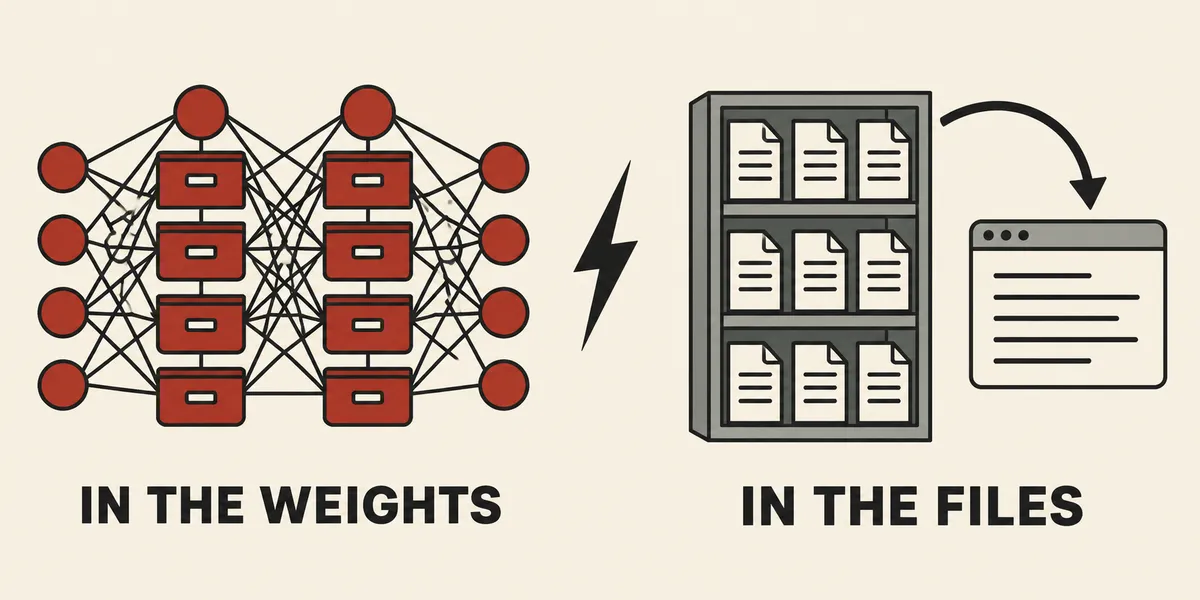
Where should knowledge live: in the weights, or in files the model re-reads? Both camps ship products. Neither has won.
Knowledge belongs in trainable memory layers: dedicated, cheap key-value storage inside the model itself. Files and prompts are a workaround. The architecture should remember, and their paper closes by advocating memory layers in all next-generation architectures.
Knowledge belongs in things the model re-reads: saved memories, memory files, CLAUDE.md on disk. Explicit, editable, inspectable, and it survives every compaction because it is re-injected, never summarized. Weights are where knowledge goes to become unverifiable.
The honest 2026 answer is that the best systems use both: memory layers for facts the model always needs, files and saved memories for everything personal, load-bearing, or likely to change.
5. Where leaders think this goes
Where the people building AI memory think this goes: their visions for the next 5-10 years, shown as named camps so you can see who is on which side. These are their views, not conclusions, and predictions go stale; this section is frozen as of October 2026.
Where they agree
Where they split
Takeaways
The window is working memory: limited, shared by everything including the answer, and rented by the token. When it fills, compaction swaps old turns for a summary, and what survives depends on how it was loaded, not how important it was. Files beat conversation, explicit beats implied, recent beats old. That is the whole game.
- Two memories, one desk. Weights hold what the model learned in training; the context window holds everything new, and the answer is drawn from the same budget as the prompt.
- Long context has a tax. The KV cache stores keys and values for every past token at every layer, growing linearly with context length, and the serving stack fights that tax constantly.
- Compaction is lossy on purpose. Old turns collapse into one summary; exact wording, full tool outputs, and intermediate reasoning go fuzzy or vanish.
- Placement decides survival. Anything re-injected from disk survives, along with the system prompt, saved memories, recent turns, and invoked skills. A rule stated twenty messages ago does not, unless it lives in a file.
- Windows grew, curation still wins. A 1M window is now the default, yet response quality degrades as a conversation grows, so the open fight is whether bigger windows kill compaction or make it more important.
Keep exploring
Sources
Every factual claim in sections 2 through 5 traces to one of these.
- DocsContext windows
- DocsCompaction overview
- arXiv paperAttention Is All You Need
- arXiv paperEfficient Memory Management for Large Language Model Serving with PagedAttention
- arXiv paperMemory Layers at Scale
- ExplainerPagedAttention deep dive: what the KV cache actually stores
- ExplainerThe KV Cache
- Help centerMemory FAQ
- Help centerMemory in ChatGPT
- NewsChatGPT Expands Memory Capabilities, Remembers Past Chats
- ExplainerWhat Survives /compact in Claude Code
The window is the desk. Compaction is the filing. Put what matters in files, and the summary can't eat it.