The only moats left
On October 11, 2026, Nikita Bier, the founder who built tbh and Gas and sold both, posted that technical moats are mostly over, and that anyone building something durable has exactly three moats left: proprietary data, network effects, and a physical component. The post was read 1.7 million times in a day. This primer checks the claim against forty years of moat frameworks and the best 2026 evidence, and finds the direction right and the word "only" wrong: his strongest item is the weakest under scrutiny, the top performer in the only large 2026 dataset is not on his list at all, and the advantage his own career runs on is missing from it.
"Technical moats are mostly over at this point. If you're building something that is meant to be durable, the only moats now are: proprietary data, network effects, a physical component."
Nikita Bier, X, October 11, 2026; read in full for this primer
How it works
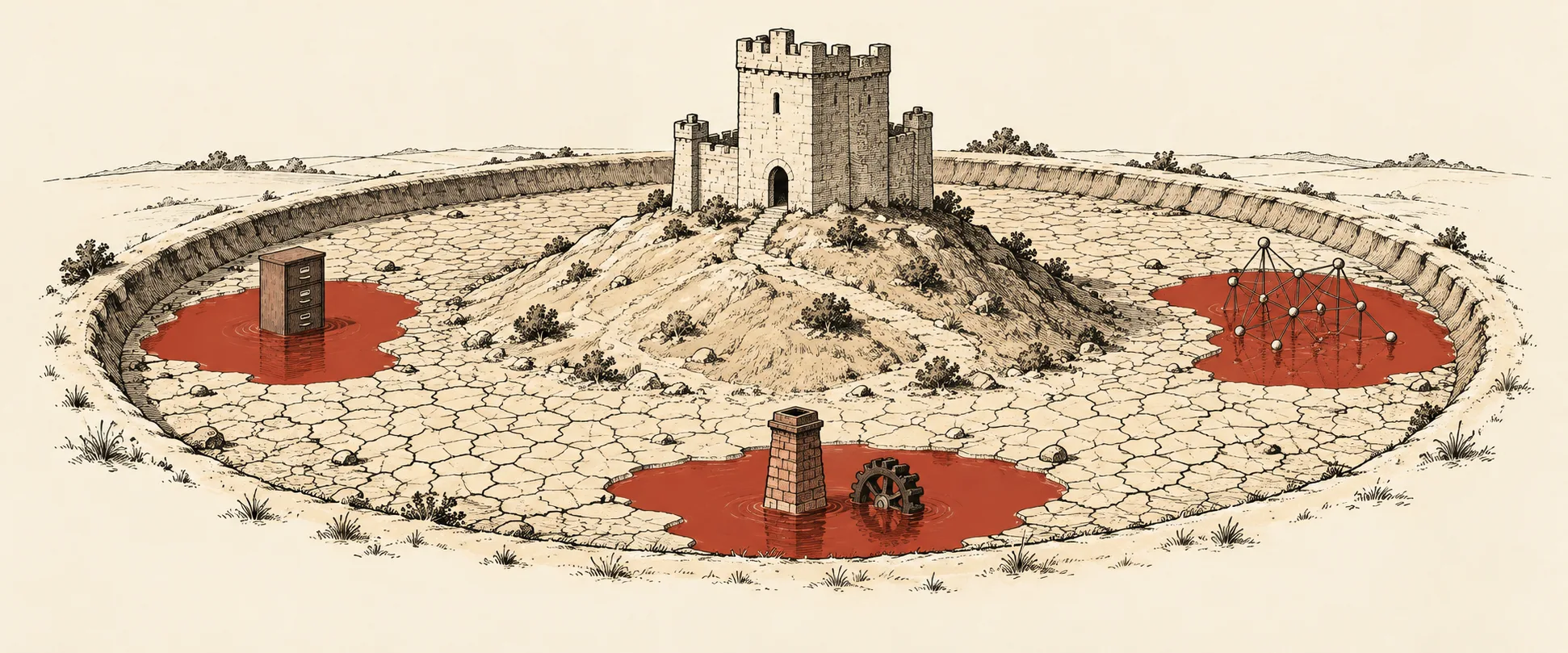
Six mechanisms decide what still defends
Bier's claim bundles several different forces. Unbundled, each one has its own evidence, and they do not all point his way. Tap a card to open it.
In early October 2026, Products That Count and Crunchbase mapped 576 venture-backed AI B2B companies onto Hamilton Helmer's seven powers and compared the valuation multiples of the companies leaning on each. It is a vendor study, not peer-reviewed, and its multiples are valuations, not realized returns. It is also the only large test of Bier's question run this year, so it earns a careful read. Step through it one power at a time.
A business model incumbents cannot copy without damaging their own. Present in 5 percent of companies. Not on Bier's list.
Each new user makes the product worth more to the others. Present in 5 percent of companies. Bier's number two.
Leaving costs the customer real money or pain. Dropped by Bier, and the most expensive power to build, at roughly ten times the capital of network economies in this dataset.
Bier's number one, and the most claimed power of all: 44 percent of the companies leaned on it. It produced the worst multiple of the four published.
Read the chart the way its authors present it: a ranking of what the market currently pays for, not proof of what causes returns. The full study is linked in Sources.
Run the canonical "data business" through Bier's three and then through the powers he dropped. Bloomberg Terminal seats rent for roughly 24,000 to 30,000 dollars a year, pricing power that has survived every technology cycle since the 1980s.
Yes. Decades of long-tail financial data, aggregated in one place, much of it tedious to re-collect.
Yes. Instant Bloomberg, its chat, is a closed network of finance professionals. The terminal is the room where the industry talks.
Barely. There is a famous keyboard and leased hardware, but nobody renews a thirty-thousand-dollar seat for the plastic.
Enormous. Workflows, models, keyboard habits, and compliance records are built on it. Retraining a trading desk is a project, not an afternoon.
"The Terminal" is a status object and a hiring signal on every trading floor, built over forty years of consistent presence.
The lesson: scored on Bier's three alone, Bloomberg looks defended twice and exposed once. Its actual durability is the stack, data plus network plus the two powers Bier deleted. A list that underrates the most durable data business in the world is missing something.
Timeline
Forty years of moat thinking, compressed by one post
The vocabulary Bier uses was built between 1979 and 2016. The fight over whether it still applies started the month ChatGPT shipped. Step through it.
Key voices
Who says what, and what their record says
The people below built the frameworks, ran the experiments, or hold the position Bier is arguing with. At least two of them disagree with each other in print, which is the point.
Nikita Bier
Founder of tbh and Gas; X head of product until August 2026, then advisor
His post is a consumer founder's verdict, and it refines rather than reverses his known playbook. On Lenny's Podcast in 2024 he described that playbook in detail: seed a product school by school until it saturates a closed network, accept that big companies respond in 12 to 24 months, and know that durable consumer social is a black swan that appears about once a decade. tbh sold to Meta for over 30 million dollars and Gas was acquired by Discord; both were technically copyable apps that won on distribution into closed school networks, then exited rather than defending for a decade.
The post's most interesting feature is what it leaves out. Distribution, his signature advantage, appears nowhere in the three, and neither does the word moat appearing in his own 2024 account of why his apps spread. Read the list as a warning about what will not save you, from a man whose wins came from the thing he did not list.
Sam Altman, OpenAI
Remarks reported April 2024; anecdote from YC Startup School 2026
Altman is the strongest named witness for Bier's premise. He has warned founders building thin wrappers that when the next model ships, "we will steamroll you," and that hope is not a strategy. His mechanism is the one inside Google's leaked 2023 memo: a platform with the users can clone a feature cheaply and distribute it for free.
His favorite illustration is an anecdote and should be weighed as one: he has retold how work at his first startup, Loopt, took three months in the mid-2000s and would take seven minutes with today's models. Direction, plausible. Ratio, unverifiable.
Martin Casado and Peter Lauten, a16z
"The Empty Promise of Data Moats," May 2019
The canonical rebuttal to Bier's first item, published seven years before his post. Most companies, they argue, have a data scale effect, where more data helps a little and then stops, and mistake it for a data network effect, where one customer's data makes the product better for the next. Marginal value falls, acquisition cost rises, and historical data goes stale as the world changes underneath it.
Their field evidence includes a search study in which giving Bing a rival's click data would have lifted its click-through rate only from 23.5 percent to 24.8 percent. Their conclusion is not that data is worthless but that it is rarely, by itself, a durable barrier, which is exactly the burden Bier's list puts on it.
Jerry Chen, Greylock
"The New Moats," 2017; "The New New Moats," June 2023
Chen wrote the canonical pro-data statement Bier's first item descends from: in a cloud and AI world, defensibility comes from systems of intelligence built on proprietary data, network effects, and embedded workflows. His 2023 update concedes the other side's best point without surrendering: models and features are easy to copy, and defensible value accrues to whoever owns the proprietary data, the workflow, and the user relationship.
Note what his formulation includes that Bier's drops: the workflow a customer lives inside, which is where switching costs actually come from.
James Currier, NFX
NFX network-effects research and the Network Effects Bible
Currier is the loudest institutional voice behind Bier's second item. His widely quoted figure holds that network-effects companies account for about 70 percent of the value created by billion-dollar tech companies since 1994. The provenance deserves care: it is NFX's own study of 336 billion-dollar companies, where such companies were about 70 percent of aggregate market capitalization but only about 20 percent of the companies, conducted by an interested venture firm and not peer-reviewed.
Even taken at face value, the figure describes a small number of very large winners, not a recipe most companies can follow. NFX's own defensibility list, notably, keeps brand on it.
Eric Compton and Dan Romanoff, Morningstar
"Software moats have not evaporated overnight," March 2026
Morningstar is the closest thing to a referee in this debate: it rates moats for a living and has no startup to sell. In March 2026 it downgraded Adobe, Salesforce, ServiceNow, Shopify, Oracle, and others from wide to narrow moat, a real concession to Bier's direction, and its fair-value cuts were steep: Adobe from 560 to 380 dollars, Salesforce from 300 to 280, Oracle from 277 to 215.
But it kept Microsoft and SAP at wide. SAP's grounds are precise: switching costs so extreme, and regulatory workflows so embedded, that AI features alone cannot pry loose. The moat narrowed across software; it did not drain, and the firm that grades moats for investors explicitly rejected the "evaporated overnight" reading.
Benedict Evans
Essays and talks, 2024 to 2026
Evans argues the layer Bier ignores decides the outcome. If models converge toward commodities, as cloud storage and bandwidth did before them, the durable advantages are distribution, brand, and capital: who reaches the customer, who the customer trusts, and who can fund the race. A widely viewed September 2026 panel of practicing investors made the same point from inside the market, concluding that Google's defense of Gemini is its distribution, not its model.
It is an uncomfortable argument for a three-item list, because the career of the man who posted the list is its best example.
Where leaders think this goes
Agreement on the corpse, a split on the survivors
Positions as published through October 2026. Where a position is known only through secondary summaries, the card says so.
Where they agree: nobody serious defends the feature moat
Sam Altman (2024: the next model will "steamroll" wrapper startups), Dave Robertson of Anthropic (October 2026, on Inc.'s podcast: technical differentiation is no longer a moat, and founders need defensibility not based on technology), the Sernau memo (2023: an open-source feature can be replicated in an afternoon), and the Products That Count dataset (October 2026) all land in the same place Bier does. Feature and engineering advantages now decay in weeks to months. On this, the argument is over.
Where they also agree: AI re-sorts moats instead of abolishing them
Morningstar (March 2026) narrowed most software moats and kept two wide; Constantia's "Moats Matter" (April 2026) made the identical argument from inside equity research: AI raised the bar for what counts as a moat without eliminating moats. Both keep the same survivors: verifiable-quality brand, regulated embedding, cornered data, and multi-sided networks.
Split one: is proprietary data a top moat or the weakest one?
Side A: Bier and Jerry Chen
Data is the asset AI cannot synthesize on demand. Chen's systems of intelligence and Bier's first item both treat exclusive data as the durable residue after models commoditize, and Bloomberg shows a data business can hold pricing power for decades.
Side B: Casado and Lauten, and the 2026 data
Most "proprietary" data is a scale effect with rising costs and falling marginal value, and data goes stale. In the Products That Count dataset it was the most claimed power (44 percent) and the worst performer (2.6x). Liat Benzur pushes it further: synthetic data can outperform real data, so the dataset itself is no moat at all; what survives is a closed loop that keeps feeding real-world data back and shipping what it learns.
Split two: is distribution a moat, or just a head start?
Side A: Evans, and the investor panel
When the product layer commoditizes, distribution, brand, and capital are what is left, and they are not consolation prizes: Google's distribution is the reason Gemini matters, whatever the model rankings say.
Side B: Bier's omission, and the older test
Bier's list excludes distribution entirely, and the classic frameworks back the exclusion in part: Greenwald and Kahn's test asks for a barrier, and reach without a barrier reads as excellent operations that a better-funded rival can outspend. The counterweight is Bier's own record: tbh and Gas won on distribution into closed networks, which suggests reach into a network starts to behave like a barrier.
Split three: do switching costs die when AI agents do the switching?
Side A: They survive where it matters
Morningstar kept SAP wide on extreme switching costs plus regulatory embedding (March 2026), and Constantia expects complex, deeply embedded deployments to retain pricing power. Retraining staff, revalidating regulated workflows, and absorbing audit risk are not tasks an agent makes free.
Side B: Friction is already dying
The Products That Count study notes AI tooling is already easing migration, and a widely circulated summary of Gokul Rajaram's moat framework (secondary reporting, not a verbatim text) has him assigning zero weight to switching costs as AI agents make migration trivial. The honest split is by sector: consumer and light business tools lose this power first; regulated enterprise keeps it longest.
Split four: does a physical component defend, or just cost?
Side A: Capital is voting yes
a16z's American Dynamism fund (1.18 billion dollars, January 2026) and Machine Age fund (1.1 billion, August 2026) are revealed preference, and SpaceX shows the mechanism: unmatched flight rate converted into learning no rival can buy, with roughly 85 percent of components made in-house.
Side B: Atoms clone too, near Shenzhen
DJI's defense is inseparable from sitting inside the Shenzhen supply belt, where components arrive in one to two days against weeks for US rival Skydio, and board revisions take hours against three to six weeks (engineering teardown figures, secondary). Naval makes the same warning in reverse: do not build hardware where the clones are made. Physical defends the firm inside the fastest supply chain, not physical products in general. Tesla's fleet data has the same shape: roughly 8.4 billion supervised miles against Waymo's roughly 200 million rider-only miles is an apples-to-oranges comparison, and fleet size alone settled nothing.
One reply worth noting: the list should be longer
Pieter Levels (@levelsio) replied to Bier within hours that he would expand the list, beginning with proprietary data or content, then network effects. Only the start of his reply could be verified before this primer shipped; the full list could not, so it is credited here as a direction, not a quotation. The expansion instinct is the mainstream one in the replies and in the frameworks alike: three is a good tweet and a short list for a decade.
Takeaways
What to actually remember
Bier is right that software stopped defending itself: a feature lead is now measured in weeks, and the model providers have both the incentive and the distribution to absorb whatever an app layer proves out. He is wrong that exactly three things survive. The frameworks he compresses keep seven powers, the institutions that grade moats for a living narrowed software rather than writing it off, and the one large 2026 dataset ranks his first item last and his omissions first. A moat is still what it was in 2001: a customer benefit behind a barrier a rival cannot cross. The barrier is what got scarce.
- Direction right, "only" wrong. Features and ordinary engineering decay in weeks to months (Altman, the Sernau memo, Chegg's collapse). But Morningstar kept SAP and Microsoft at wide moat in March 2026, and Constantia's durable list has four entries, not three.
- Ask the data question precisely. Does one customer's data make the product better for the next customer? If not, you have a data scale effect, with rising costs and falling returns (Casado and Lauten, 2019), not a network effect. In the 2026 dataset, proprietary data was claimed by 44 percent of companies and returned the worst multiple, 2.6x.
- The omitted power scored highest. Counter-positioning, a model incumbents cannot copy without hurting themselves, returned 5.3x in the same study, ahead of network economies at 4.2x. It appears in no three-item list because it cannot be bought or built directly, only chosen.
- Switching costs split in two. Friction-based lock-in is dying as AI agents learn to migrate data and retrain users. Regulated, workflow-embedded lock-in (SAP's regulated enterprise base) is the version Morningstar still pays for.
- Physical is a location and a learning curve, not a product category. SpaceX defends through flight-rate learning and vertical integration; DJI through sitting inside the Shenzhen belt where parts arrive in days. A factory a rival can also build is capital expenditure, not a moat.
- Distribution is the list's loudest silence. Evans names it as the residual advantage when models commoditize, and Bier's own exits, tbh and Gas, were distribution wins on copyable products. If your plan's defense is not on his list, that may say more about the list than about your plan.
Keep exploring
Related primers
The Harness Is the Product
Why the tooling around a model, not the model, decides what it can do.
How Frontier Labs Change Agents Without Breaking Them
The regression-testing discipline that keeps a moving product defensible.
How AI Keeps Getting Smarter
The improvement engine that keeps eroding feature leads, and where leaders expect it to go.
Countdown to Competence
What 100 deliberate bad attempts do to a skill, and what the research says actually compounds.
Sources
Primary sources
Read October 2026. Vendor studies and secondary reporting are flagged where they appear; nothing on this page rests on a single flagged source without the flag travelling with it.
Nikita Bier, X post, October 11, 2026
Products That Count and Crunchbase: 576 AI companies mapped to the 7 Powers
Casado and Lauten: The Empty Promise of Data Moats
Jerry Chen: The New New Moats
Katz and Shapiro: Network Externalities, Competition, and Compatibility
Peng et al.: The Impact of AI on Developer Productivity
METR: Measuring the Impact of Early-2025 AI on Experienced Open-Source Developer Productivity
Morningstar: Downgrading six wide-moat software companies on AI concerns
Constantia: Moats Matter (PDF)
Altman's "steamroll" warning to wrapper startups
The leaked "We Have No Moat" memo
Lenny's Podcast: How to consistently go viral, Nikita Bier's playbook
NFX: The Network Effects Bible and the NFX archive
Andrew Chen: The Cold Start Problem, summary
Chegg: Q2 2026 results (StockTitan)
O'Brien: Network Economies Are the Real Startup Moat
DJI versus Skydio: the Shenzhen supply-chain teardown figures
a16z: American Dynamism and the Machine Age fund
MySpace sold for 35 million dollars
Benzur: Data Moats Are Dead
Bier steps down as X head of product