Two Hundred Direct Reports
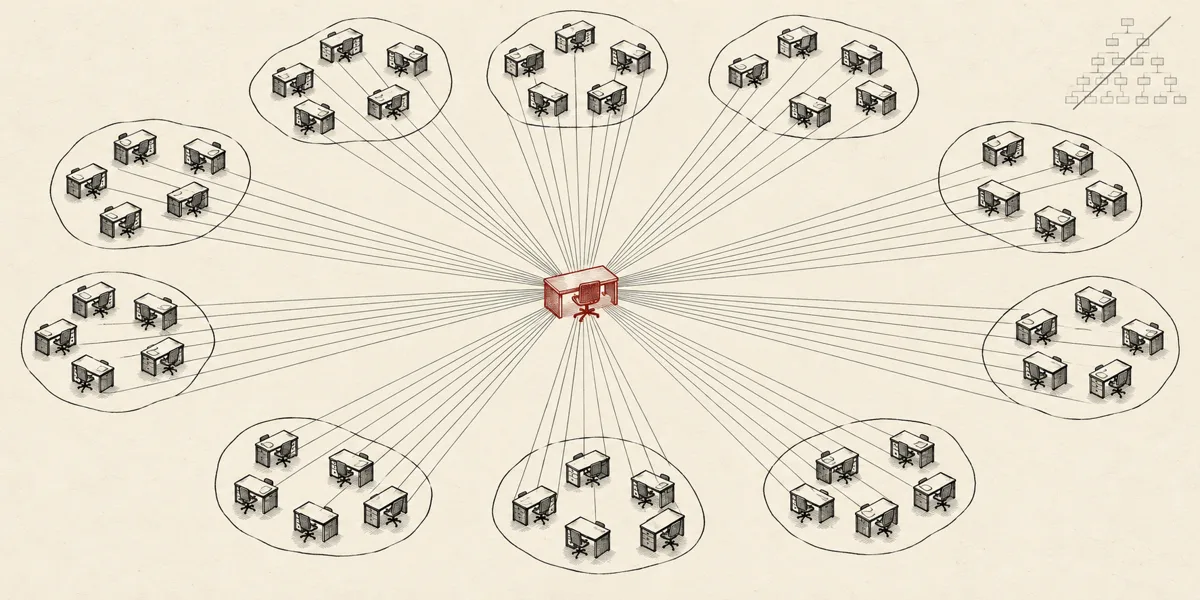
In an interview with David Senra published October 11, 2026, Alexandr Wang, Meta’s chief AI officer, said the frontier research group he rebuilt at Meta Superintelligence Labs runs almost completely flat: more than 200 researchers report directly to him, organized into pods whose technical leads break ties, with no layer of people managers in between. He calls the group, named TBD Lab, “literally anti-bureaucracy,” and admits in the same breath that he would be lying if he claimed to be the best manager for 200 people. This primer takes the claim seriously enough to do its arithmetic: what the relationship math says, what the calendar says, what the layers he deleted were costing, and what ninety years of flat-organization experiments say back.
The brief
Every organization picks a span of control: how many people report to one manager. Textbooks spent a century recommending five to ten. Wang picked more than 200, and he is not being careless about it; the number is a design statement. A manager’s job, in his design, is not supervision but environment: hire people who have already proven they do brilliant work, give them compute, direction, and room, and let technical leads settle technical disputes. The people-management layer is not understaffed at TBD Lab. It is deliberately absent. The sentence to remember: a span of 200 is not management stretched thin; it is a bet that the management layer was the bottleneck, priced in calendar hours and relationship math.
“They don’t need managers. They need a great environment. They just need the room to cook.”
Alexandr Wang, on the David Senra podcast, October 11, 2026 (quoted in Karl Mehta’s post)
The math that says it cannot work
In 1933, the Lithuanian-French management consultant V. A. Graicunas published the first formula for what a manager actually carries. His insight: a boss does not manage people, a boss manages relationships, and relationships multiply far faster than headcount. He counted three kinds. Direct single relationships: you with each report, one to one. Cross relationships: every pair of reports with each other, in both directions, because how Ana treats Ben differs from how Ben treats Ana. Direct group relationships: you with each report in the presence of every possible combination of the others, because a conversation changes with everyone who is in the room. Add them up and the total is:
The formula decomposes into the three counts, which is where the damage hides:
Run it by hand for six reports, a span the textbooks love. Direct: 6. Cross: 6 × 5 = 30. Group: 6 × (25 − 1) = 6 × 31 = 186. Total: 6 + 30 + 186 = 222 relationships. Graicunas’s own table agrees, and his warning was precise: going from five reports to six raises headcount 20 percent but raises complexity from 100 to 222, up 127 percent. Now point the same formula at Wang’s span. At n = 200 the group term alone is about 1.6 × 1062, a number with no physical meaning as a workload. That is not a refutation of TBD Lab. It is a measurement of how much of the classical manager’s job the design has to make unnecessary, because none of it can be carried.
Figure 1: the relationship counter
Drag the span and watch the three relationship counts separate. Up to about eight reports the total is merely large. Past that, the group term takes over and the curve leaves the chart’s ability to describe it.
The counts are Graicunas’s 1933 maximum case, where reports do interdependent work. His minimum case, for fully independent work, grows more slowly, but it still grows geometrically. The formula counts potential relationships, not hours; the next figure prices them in hours.
How it works
Six mechanisms carry the design. Three delete work the classical manager does; three pay for the deletion.
Figure 2: one week, two hundred reports
The worked example, priced in the only currency a manager actually has. Suppose Wang ran TBD Lab the conventional way, with a standing 30-minute one-on-one (1:1) meeting with each report every week. Tap through what the arithmetic does to his week, and what the design does instead.
Tap the card, swipe, or use the arrows.
Figure 3: what a layer costs
Flatness has a second ledger. Take a company with 10,000 people doing the work and ask how many managers it needs at different spans, assuming every manager supervises the same number and the tree is full. Wide spans do not just flatten the chart; they nearly delete the management payroll and shorten every message’s path to the top.
A full-tree count: each layer divides the layer below by the span, rounding up, until one person sits on top. Real companies are messier, but the shape of the trade is the shape here: narrow spans buy supervision with headcount and hops.
Timeline
Tap the card, swipe, or use the arrows.
Key voices
Where leaders think this goes
Positions as of October 2026, each attributed to its source.
Where they agree
Where they split
Takeaways
Wang’s 200 reports are not a bigger version of a normal span; they are a different job wearing the same title. The arithmetic is unforgiving on both sides: Graicunas makes classical supervision impossible at that width, and the layer count makes classical supervision expensive at any width. What survives is environment design, hired-for judgment, and technical tie-breakers, and whether that survives scale is the experiment now running.
- Relationships, not people, are the load. Graicunas’s 1933 formula turns 6 reports into 222 potential relationships and 200 into about 1062; at wide spans the group term, not the headcount, is what breaks.
- The calendar votes first. Weekly half-hour 1:1s with 200 reports cost 100 hours, more than half of every hour that exists in a week, so a flat lab must replace private supervision with broadcast information or not run at all.
- Layers are a payroll and a filter. At span 5, a 10,000-person company needs about 2,501 managers and six hops to the top; at span 200 it needs 51 managers and two hops.
- Seniority is the enabling condition. Every durable flat system, Gore, Valve, NVIDIA, TBD Lab, buys its span with unusually experienced people; the evidence for wide spans among junior staff does not exist.
- The data cuts both ways. Google’s Project Oxygen found manager quality moves performance, and Gallup’s 312-study meta-analysis finds spans past 20 inconsistent, which is why the honest reading of TBD Lab is “untested at the frontier,” not “proven.”
Keep exploring
Sources
Honesty notes. Wang’s 200-plus figure is his own statement on the Senra podcast; Meta has published no org chart for TBD Lab, and no independent count exists, so the number is reported as claimed, not verified. The exact headcount of the lab is not public. Zuckerberg’s 2023 span guidance is quoted from his published Year of Efficiency note as reported at the time. Gallup’s meta-analysis is an executive summary of 312 studies; its span bands are 4 to 9, 10 to 19, and 20 plus, and this primer reports its findings at that resolution rather than inventing finer ones. The 10,000-worker tree is an exact count under stated assumptions (full tree, uniform span), not a model of any real company. Graicunas’s formula is his 1933 maximum case; his paper is the field’s conventional citation for the geometric growth of managerial relationships.