When agents outgrew git
On October 13, 2026, Anthropic's engineering blog described a quiet emergency: Claude writes so much of Anthropic's code that merges grew from about 2,500 a day in May to over 30,000 a day in September, and git, the version control system (VCS) nearly everyone uses, became the bottleneck. The fix is Scion, a version control system built in-house on the opposite assumptions from git: clients are always online, the server does the thinking, and nobody ever downloads the whole repository. This primer covers what broke, how Scion works, who else has hit this wall, and the live argument over what happens to git next.
"New on our Engineering blog: Creating in-house source control."
Anthropic (@AnthropicAI), X, October 13, 2026. 2.4M views as displayed when read. The post links to the engineering article this primer is built on, "Redesigning source control at Anthropic," published the same day.
How it works
What broke, what replaced it, and who got there first
First, the pressure, in the order it builds: merges, repository size, checkout volume, and the workaround stack that eventually became the problem. Then one checkout walked through Scion's tiers, the three earlier systems that hit the same wall, and the mechanisms underneath, as cards.
Six gauges from Anthropic's own post, in the order the pressure builds. Every number is the company's, from "Redesigning source control at Anthropic," October 13, 2026.
A healthy, busy engineering organization. Git was designed for exactly this world, and at this rate nothing about it strains: clones are quick, mirrors are few, and a merge queue keeps up.
The workload changed kind, not just size. Thirty thousand merges a day averages one merge every 2.9 seconds, around the clock (86,400 seconds in a day, divided by 30,000). Anthropic says the latent demand for merging is practically infinite: every bottleneck removed immediately produces more code to merge.
Git's founding bargain is that every clone is a complete, self-contained repository that can diff, blame, and check out any revision while fully offline. When the complete repository is a hundred gigabytes of history and a working copy over 25 GB, the bargain itself becomes the cost, paid by every client on every fresh start.
CI checks out the code to build and test it, and Anthropic's CI does that about 25 million times a day, before developer environments, agent sandboxes, and research jobs are counted. Divided by the seconds in a day, roughly 290 checkouts start every second.
Multiply it out: 25 million checkouts times a 25 GB working copy is 625 million gigabytes, or 625 petabytes (PB), which is the article's "over 600 PB." Nobody actually fetches this way. The number measures the size of the hole the workarounds in the last row have to fill.
Anthropic used every standard trick: shallow clones, sparse checkouts, promisor remotes that fetch missing objects on demand, snapshot seeds kept in blob storage, and at peak several hundred internal git mirrors. The tricks decayed as merges accelerated. Seeds fell behind the tip of main between refreshes, history operations like diff and blame degraded on partial clones, and the mirrors strained against disk and memory limits.
The last row is the hinge of the whole story: the workarounds worked, until operating them became the bottleneck. Anthropic's conclusion was not that a git feature was missing. It was that the design assumption underneath, a complete copy for every client, had stopped matching a world where the clients are agents.
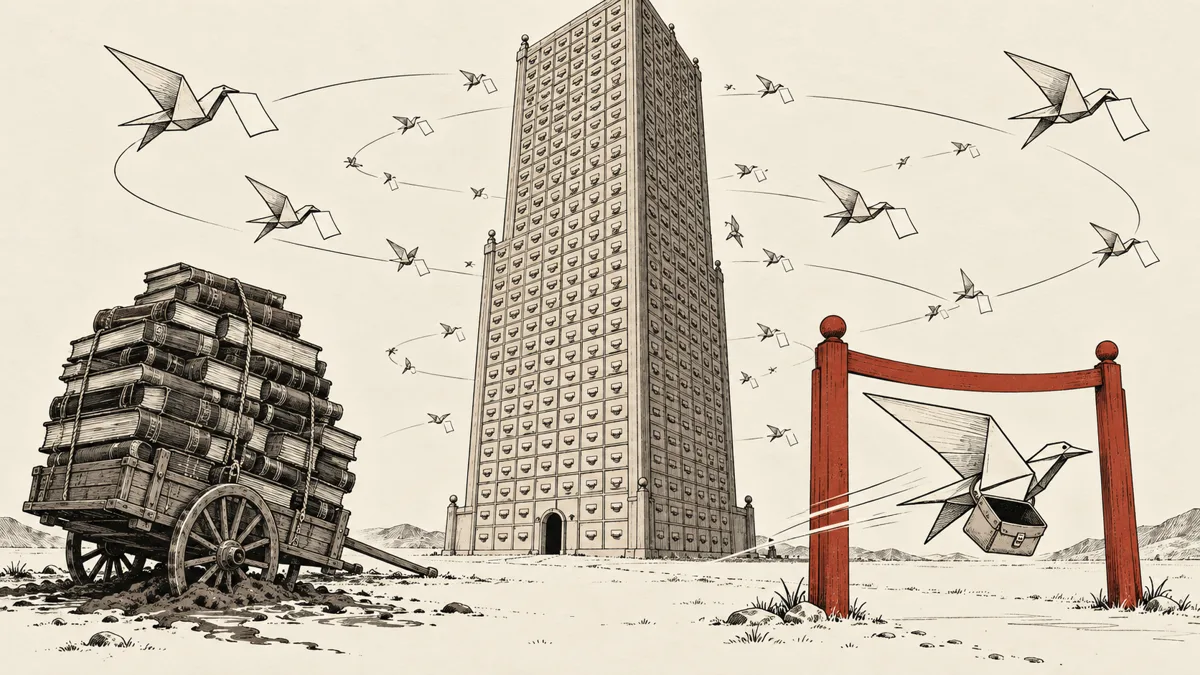
Git's fetch negotiates: the client lists what it already has, and the server packs the difference into one large packfile. Scion's protocol inverts that. The client names the exact immutable objects it wants, tier by tier, and any tier can answer. Tap through one checkout.
A checkout asks for named objects, not a packfile
Starting from the root tree, the client checks its local store, requests the trees it is missing, then the blobs inside them. Every request names one specific object that never changes once stored, so any cache can answer it, the transfer is resumable, and there is never one multi-gigabyte response to restart from zero. The client never tells the server what it already has; that negotiation is simply gone.
Requests answered from cache, at each tier (Anthropic's figures)
All three tiers answer the same requests, so the client never needs to know the topology. The tiers are kept strictly separate anyway, so a failing regional cache cannot stampede the authoritative servers behind it.
What the fleet got back
Scion's infrastructure footprint is 200 times smaller than the git mirroring infrastructure it replaced, in CPU and memory (Anthropic's comparison). Checkouts land in seconds rather than minutes, two orders of magnitude faster, and CI alone realized a 25% CPU capacity win. And because there are no packfiles, there is no repacking and no repository maintenance for clients or caches to run, a whole category of operational work deleted rather than optimized.
Notice what is missing from this picture: a repository. No tier holds a complete copy of the monorepo, not even the servers. The repo exists as content-addressed objects in Spanner and blob storage, assembled on request, which is precisely the property git's design gives up on purpose and Scion's gives up on purpose in the other direction.
Anthropic is the fourth company to hit this wall in public. The first three answers frame the argument in the predictions section: leave the model, or repair it.
Scion is not a git replacement and will not be offered publicly: Anthropic, in its own post. The concepts, it says, make sense only for truly enormous monorepos, with tens of thousands of engineers or swarms of agents writing code, and adopting Scion wholesale would mean replacing code review, code search, and continuous integration (CI) along with it. The stated plan is the opposite of a product launch: share the thinking so the most successful parts can be applied inside git, in partnership with GitHub, GitLab, and the open source community. Hold the company to its own framing when the takes get hotter than that.
Timeline
Twenty years from git to Scion
Landmarks only: the systems that proved a monorepo wants a server, the decade git spent absorbing their lessons, and the six weeks in 2026 when agent traffic forced the question in public. Step through it.
Key voices
Who says what, and where they part ways
The builders of the four systems in Fig 3, the two loudest repair-camp voices of 2026, the client-side alternative, and one independent read. They agree on the disease. They split on the surgery.
Nick G. and the Anthropic source control team
Anthropic engineering blog, "Redesigning source control at Anthropic," October 13, 2026 (byline as printed; most of the team is listed by initials)
Design server-first, because the clients are agents and jobs that are online by definition. Git's offline, full-clone properties were not neutral at Anthropic's scale; they actively undermined it. Two limits the team states plainly: Scion is not a general git replacement, and the transferable contribution is the ideas, which git itself can adopt. Their forward bet is about the builders, not just the tool: rapid infrastructure rewrites by small teams will become more common, because the same agent capacity that created the problem now removes the excuse for living with it.
Brian Celenza, GitHub
Principal Software Engineer, GitHub; engineering blog, October 6, 2026
GitHub is rebuilding git's infrastructure for agent scale under the hood, one week before Scion was announced: storage decoupled into Azure Blob Storage, lightweight cache workers in front, coordination narrowed to ref updates, and compaction moved off the serving path, with up to 35 times the write throughput in internal benchmarks. The numbers behind it are platform-wide: 7.38 billion commits in September 2026 alone, more than five times the year before. And the promise is explicit: nobody is asked to change how they build software, and branch protection, review, and audit controls are preserved, not traded away.
Vicent Marti, Cursor
Principal Systems Engineer, Cursor; "Git at any scale," August 18, 2026 (byline as reported by The Register)
Twenty years on, git's distributed nature is more hindrance than advantage for the average company, which in practice relies on one central host anyway. But the fix he is building keeps the git client, the git protocol, and ordinary repositories on disk, and replaces only what sits behind the server: pushes land as immutable entries in a write-ahead log on object storage, and local copies become warm caches. Agents worsen hosting in a second way his post names early: not just more code, but vast numbers of small, throwaway repositories that replication floors were never priced for.
Meta's source control team
Engineering at Meta; Sapling announcement, November 15, 2022, building on the 2014 Mercurial decision
The earliest clear statement of the leave camp: public source control systems were not, and still are not, capable of repositories of Meta's size, and splitting the monorepo was out of the question, so building their own was the only option left. The nuance that keeps Meta out of the proprietary corner: the Sapling client is open source and git-compatible, deliberately. Meta left git's internals and kept a door open behind it, which is more than Scion or Piper attempt.
Brian Harry, Microsoft
Technical Fellow, Microsoft; "The largest Git repo on the planet," May 2017
The repair camp's founding document, a decade before the current argument. Facing a 300 GB repository and thousands of engineers, Microsoft concluded git, with a virtual filesystem underneath it and performance work upstream, is completely usable at very large scale, and rolled it out to the whole Windows team rather than leaving. Performance stayed his stated top issue, which is the honest core of the repair position: the pain is real, it is just engineering, all the way down.
Martin von Zweigbergk, Jujutsu (jj)
Google source control engineer; creator of Jujutsu, started late 2019; Git Merge talks, 2022 and 2024
The third path: leave the servers and the data model alone, and fix the client. Jujutsu stores commits others cannot distinguish from ordinary git commits, swaps storage backends behind one interface, treats the working copy itself as a commit, and makes conflicts and undo first-class. No statement from von Zweigbergk about Scion was found in this research, and none is implied here; jj stands in this primer as the standing alternative his talks argue for, that much of what feels like a hosting problem is actually a workflow problem wearing a hosting costume.
Simon Willison
Independent developer and writer; link blog, October 13, 2026
The clearest independent framing of the day, offered as commentary rather than reportage: in his reading, Scion is a reinvention of centralized source control along Subversion lines, driven by extreme requirements most organizations do not have. He also labels a guess as a guess, that the arrival of Mythos-class models inside Anthropic was a key factor in the coding velocity that made Scion necessary. Both observations are his interpretation, flagged as such, and they are the coldest water available on the launch-day enthusiasm.
Where leaders think this goes
The bottleneck is agreed; the exit is not
Positions as published through October 2026, each named and dated. Nothing in this section adds facts beyond the research above; these are the leaders' own stated directions.
Where they agree: agent traffic is the new baseline
Anthropic's source control team, GitHub's Celenza, Cursor's Marti, and Cloudflare all published versions of the same claim within six weeks of each other in August to October 2026: agents have changed the workload's shape, source control built for human hands is now a bottleneck, and the growth does not slow on its own. Anthropic adds the sharpest version: it expects this class of problem to become commonplace for other heavy AI-coding organizations within six to twelve months.
Where they agree: separate the storage from the caches
The same four organizations' designs rhyme at the layer underneath. Authoritative data lives in distributed or object storage (Spanner for Scion, Azure Blob Storage for GitHub, S3 for Cursor's Continuity), disposable cache compute sits in front of it, and coordination narrows to a single operation: updating refs. Nobody in the current argument defends the old shape, full repository copies doing durability and read scaling at the same time.
Split one: leave the git model, or evolve it?
Side A: Anthropic and Meta, leave it
At extreme scale, the client, the protocol, and the server all had to change. Anthropic replaced all three for its monorepo in 2026; Meta spent a decade replacing its system after concluding in 2014 that git's internals would not carry an ambitious scaling project. In this camp, git's remaining role at the top end is as the format everyone else's history gets imported from.
Side B: GitHub, Cursor, Microsoft, and jj, evolve it
Keep git's clients, its repositories on disk, and its workflows, and replace only the storage and replication underneath (Celenza at GitHub, Marti at Cursor), or upstream the scaling features into git itself, which was Microsoft's stated intent for Scalar under Derrick Stolee in 2020, or build a better client on git's data model, which is von Zweigbergk's jj. In this camp, the installed base is the feature, and any answer that requires the world to migrate is a non-answer.
Split two: proprietary servers, or open clients?
Side A: the planet-scale parts stay closed
Scion is internal-only, with no public offering planned, and Anthropic's reasons are practical: it diverges too far from git to adopt piecemeal. Piper has always been internal to Google. GitHub's new architecture and Cursor's Continuity are proprietary hosted infrastructure. In this camp, a planet-scale server is an operational advantage, and advantages are not given away.
Side B: the client layer goes open
Sapling's client was open-sourced in 2022, with its server stated as a future aim. Jujutsu is open source under the Apache license. Microsoft open-sourced GVFS and Scalar and upstreamed Scalar's features into core git. Cloudflare's October 2026 competition for the next git platform requires entrants to use a permissive license. The observed pattern across both sides: clients and ideas open, planet-scale servers closed.
Takeaways
What to actually remember
The bottleneck moved. When agents write the code, the constraint is no longer typing speed; it is the infrastructure built for human hands, and source control is simply the first piece to snap in public. Scion's answer is to invert git: the server thinks, clients fetch single objects, and the working copy is optional. Whether the industry follows Anthropic out of git or follows GitHub in rebuilding git's engine, the clone-everything era is ending at the top end.
- The numbers are the argument. 2,500 to over 30,000 merges a day in four months, 25 million checkouts a day, over 600 PB of naive traffic. All Anthropic's own figures, and even discounted, the shape is unmistakable.
- Every giant reaches the same design. Piper, Sapling, and Scion independently converged on central servers, lazy files, and thin clients. When three companies' answers rhyme, the constraint is real.
- Git is not dying; its defaults are. The repair camp (GitHub, Cursor, Microsoft) keeps git's client and workflows and replaces only the storage and replication underneath them.
- Refs are the hard part. Objects cache beautifully because they never change. Agreeing on what main points to, 30,000 times a day, is the actual distributed-systems problem.
- The engineer's job moved up a level. Seven people rebuilt source control in five months by reviewing intent and telling the agent "no." The skill that scaled was judgment, not typing.
- Expect your tools to strain in the same order. Anthropic expects this class of problem to reach other heavy AI-coding shops within 6 to 12 months. Source control first; builds and CI are named next.
Keep exploring
Related primers
The Harness Is the Product
The loop, tools, and context management around the model, in Cursor, Codex, and other harnesses: the layer wrapped around the same agents whose output broke source control.
Pausing and Resuming a Training Run
Another human-scale assumption under strain: what a checkpoint really holds, and why resuming a run is not just loading weights.
How Kimi Is Built
A frontier model taken apart: attention variants, expert routing, and the cache arithmetic that dominates what it costs to run.
Skill Packs vs. Muse Wonder, Checked
The companion question from the same week: when the model is already strong, what does installed procedure actually add?
Sources
Primary sources
Read October 2026. Every scale figure is the publishing company's own claim, as its post or paper states it; none is independently audited. The two flagged secondary items (a byline attribution and one commentary read) are marked where they appear.
Anthropic (@AnthropicAI), X post, October 13, 2026
Anthropic, "Redesigning source control at Anthropic," October 13, 2026
Potvin and Levenberg, "Why Google Stores Billions of Lines of Code in a Single Repository," Communications of the ACM, July 2016
Meta, "Scaling Mercurial at Facebook," January 7, 2014
Meta, "Sapling: Source control that's user-friendly and scalable," November 15, 2022
Microsoft, "Announcing GVFS (Git Virtual File System)," February 3, 2017
Brian Harry, "The largest Git repo on the planet," Microsoft, May 2017
Git project, Scalar documentation
Brian Celenza, "Building Git infrastructure for agent-scale development," GitHub, October 6, 2026
Cursor, "Git at any scale," August 18, 2026
Cloudflare, "We want you to build the next Git platform on Cloudflare," October 1, 2026
Jujutsu (jj) project repository
Simon Willison, link blog on the Scion post, October 13, 2026