The Paper Lab, Recreated
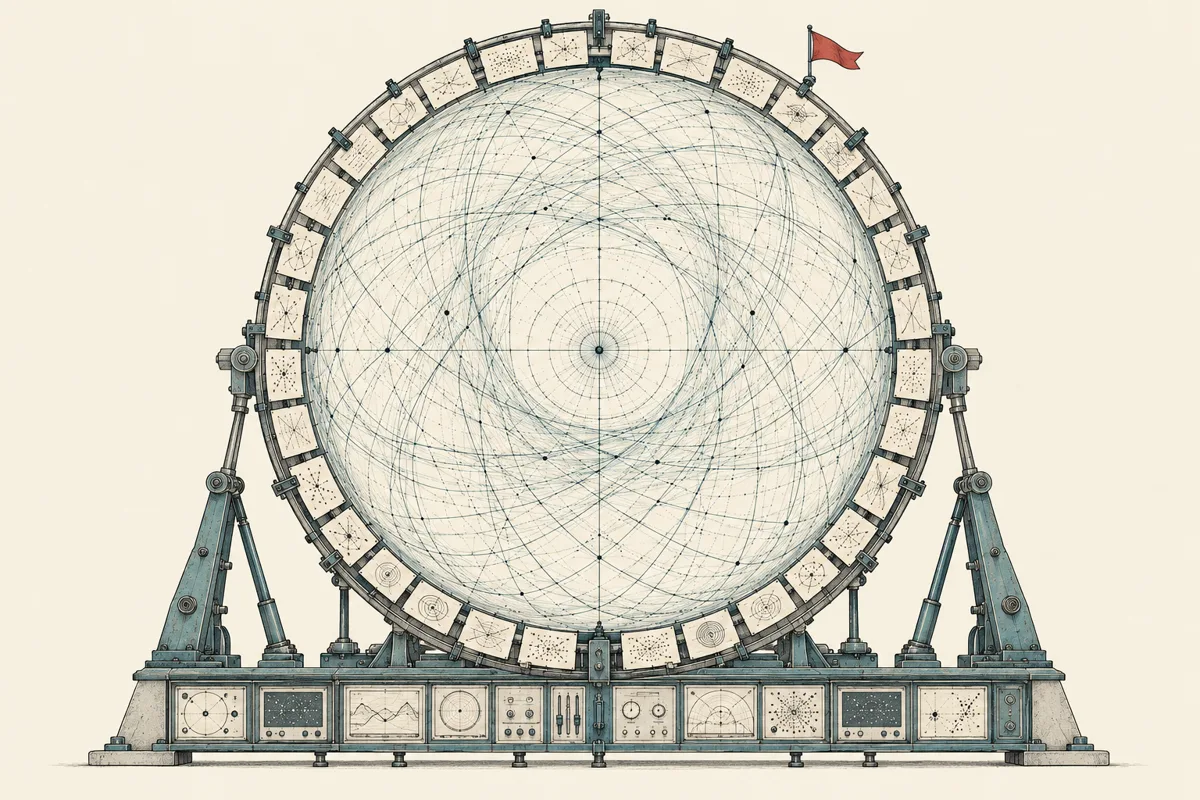
On October 13, 2026, an X post by @Bober_smart described something striking: Boris Cherny, the creator of Claude Code, had allegedly handed a dozen agents (artificial intelligence (AI) workers) a stack of 64 research papers and one assignment, build a browser lab where anyone can rerun the papers’ physics experiments. The post’s video shows the lab as a monochrome mission-control wall: a vast ring woven from thousands of trajectory lines, and under it live panels for a particle solver, validation traces, and twelve agents at work. No public demo, repo, or statement from Cherny has surfaced to confirm any of it, and this primer flags that plainly below. But the animation is real, it is the artifact of record, and the lab it depicts can be rebuilt. So this page recreates it: the ring, the panels, and a working fluid solver inside, with the same checks the post describes, run for real.
The brief
Two claims are tangled together in the post, and they deserve different treatment. The first is a story about agents: twelve of them, split into analysts who extract the math from papers, coders who turn formulas into algorithms, auditors who check the results against the papers (mass conservation, stability, matching the source metrics), and interface specialists who build the controls. The second is a piece of software: a fluid lab where you pick a model, change the conditions, switch algorithms mid-scene, and read the formulas and the error metrics beside the picture. The story is, as of this writing, one post deep (see the honesty note in the sources). The software, though, is buildable from published methods, chiefly Jos Stam’s 1999 stable fluids paper. The sentence to remember: a simulation that looks right can still be wrong, so the lab’s real product is not the picture, it is the checks beside the picture.
Figure 1: the Paper Lab, recreated
A working miniature of the wall in the video. The ring weaves itself from trajectory arcs. Under it, the advection solver is a real semi-Lagrangian fluid simulation running on a grid: stir it with a finger or mouse, switch the method, change the conditions, and watch the validation traces answer. The agents panel and the feed dramatize the post’s pipeline; everything numeric in the validation panel is measured from the solver on this page, live.
The solver is Stam’s method: advect the velocity field along itself by tracing each cell backwards, then project out the divergence so mass is conserved. Switch to explicit Euler, the naive differential scheme, and it grows energy out of nothing until the stability audit trips and zeroes the field; that is why the field switched. Semi-Lagrangian advection cannot blow up, but it quietly dissolves the dye: sharp blobs smear, because every sample blends four cells into one. That gap between stable and accurate is the whole auditing problem, in one panel.
The math the auditors check
Three formulas carry the lab. First, the one the video itself flashes on screen, mass conservation (the continuity equation): what flows into a cell must flow out, or be stored there.
Second, semi-Lagrangian advection, the move that makes the solver stable. To fill a cell’s new value, do not push its old value forward; trace backwards along the velocity to where the fluid now in this cell came from, and sample there:
Because the new value is always a blend of old values, it can never exceed the old maximum: the method is unconditionally stable, at any time step. The price is accuracy: every blend shaves the peaks, so dye dissolves and sharp features smear. Stable is not the same as right, which is exactly what the auditors exist to catch.
How it works
Figure 2: one cell, traced backwards
The worked example. A single advection step for one cell, with the actual arithmetic. Tap through it.
Figure 3: two methods, one dye blob
The comparison the lab exists to make. Both panels start with the same dye blob in the same gentle swirl. The left uses semi-Lagrangian advection; the right pushes values forward explicitly. Run them side by side at a large time step and read the verdicts from the measured numbers, not the pictures: the pictures can both look plausible while one field is quietly dissolving and the other is tearing itself apart.
Sixty steps at a time step of 0.2 seconds, far past the explicit method’s comfort zone. Semi-Lagrangian keeps the blob coherent and loses a little mass to blending; explicit Euler grows energy out of nothing until the values run away. The auditors’ three numbers (mass, stability, residual) are how you tell which failure you are looking at.
Timeline
Tap the card, swipe, or use the arrows.
Key voices
Where leaders think this goes
Positions as of October 2026, each attributed to its source. The Paper Lab itself remains a single-source claim; the camps below are about the method it dramatizes.
Where they agree
Where they split
Takeaways
The Paper Lab story is unverified, and this primer treats it that way. But the pattern it dramatizes is real and already published: papers become runnable artifacts, agent teams split the reading, building, and checking, and the checking is the hard part, because generated simulations fail quietly, by dissolving mass and smearing physics while looking beautiful. The labs that matter will be the ones whose audits you can rerun yourself.
- The claim, flagged. Twelve agents, 64 papers, 11 methods, 28 reference scenes, 7 matched and 4 pending: every one of those numbers comes from a single X post, with no statement from Cherny and no public artifact found as of October 2026.
- Stability is not accuracy. Semi-Lagrangian advection (Stam, 1999) can never blow up, because each new value is a blend of old ones, and that same blending dissolves dye and smears detail. A calm picture proves almost nothing.
- The audit is three numbers. Mass conserved, field stable, divergence residual small: measured against the paper’s own metrics, they catch the failures the eye cannot, as the two-method comparison above shows with live numbers.
- Roles beat headcount. The credible multi-agent results (Anthropic’s research system, Paper2Agent’s tolerance-gated tools) share a shape: isolated scopes, a shared record, and an independent checker whose job is to say no.
- Recreate, then trust. The solver on this page is small enough to check by hand, one cell at a time. That is the standard to hold any lab to, agent-built or not: if you cannot rerun its checks, you are admiring a picture.
Keep exploring
Sources
Honesty notes. The Paper Lab narrative (twelve agents, 64 papers, 11 methods, 28 reference scenes, 7 matched within tolerance, 4 pending revision) comes from a single source: @Bober_smart’s post of October 13, 2026, and its video, which this primer verified firsthand frame by frame. Research for this primer checked Boris Cherny’s public feed and Anthropic’s channels and found no statement from him about a paper lab, and no public demo or repository; a LinkedIn post repeats the same numbers with the same structure and is an echo, not corroboration. The matched/pending tally (7 + 4 = 11) counts methods, not scenes. Everything else here is independently sourced below: the physics from Stam’s 1999 paper and standard references, the multi-agent claims from Anthropic, Cognition, and the Paper2Agent paper, whose numbers are their authors’ own reports. The lab on this page is an original recreation of the described interface using those published methods, not the alleged original, and its validation numbers are measured from its own simulation.