How CRISPR works
Bacteria keep mugshots of the viruses that attack them, stored as DNA spacers, and patrol their genome with proteins that cut anything matching a mugshot. In 2012 that defense system was rebuilt as a programmable editor: swap the mugshot (a guide RNA, made to order in days) and the same protein cuts a chosen address in any genome, yours included. The cutting was never the hard part. What the cell does with the cut, where else the editor touches, and how you deliver it to the right tissue: that is the whole field.
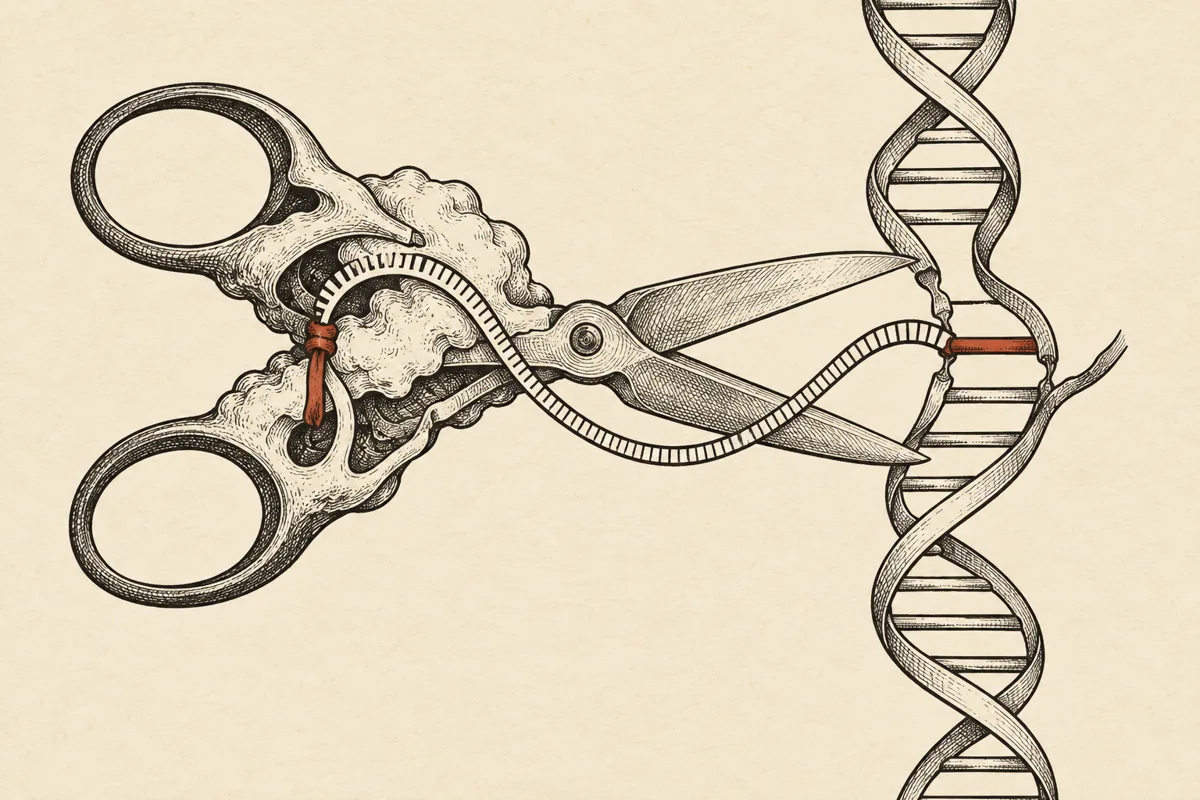
CRISPR is an addressable cut (or, in the newer editors, an addressable chemical tweak) plus the cell's own repair response; the science that matters now is delivery and specificity, not the cutting.
Researched October 2026. Mechanism and numbers are from the primary papers and regulators; lab-reported figures are labeled as such.
How it works
Start with the cut itself, then the family of editors that grew from it, then the arithmetic that explains the field's safety obsession.
Cas9 and its guide, from first contact to the two repair outcomes. The last two steps are the fork every editing strategy is built around: the cell, not the scissors, writes the edit.
Tap the arrows to step through
Fourteen years of variations on one idea: change the effector and you change what kind of edit is possible, and what can go wrong.
Tap the arrows to step through
Why a twenty-letter address sounds unique and still is not. The numbers are worked in full; this is the calculation underneath every off-target assay in the sources.
Tap the arrows to step through
Three ways to get an editor into a patient. Pick a route: what it can reach, its catch, and the landmark that proved it.
The road here
Landmarks only: from a strange repeat in bacterial DNA to a medicine designed for one baby.
Tap the arrows to step through
Key voices
The inventors, the editor builders, the caution camp, and the clinicians who turned it into medicine.
Co-author of the 2012 paper that made Cas9 programmable. In 2015 she helped call for a pause on human germline editing; by 2019 she had notably not signed the blanket moratorium letter, arguing instead for enforceable rules over unenforceable bans. Her through-line: the science will keep moving, so governance has to be real.
The other half of the 2012 discovery and of the 2020 Nobel Prize in Chemistry, and co-founder of CRISPR Therapeutics, the company whose ex vivo therapy became Casgevy. The arc from bacterial immunity paper to approved drug runs through her lab and her company alike.
His lab's January 2013 paper (Cong et al.) showed CRISPR editing working in eukaryotic cells, the result the Berkeley side disputed in a patent fight that is still not final in 2026: the US board again awarded Broad priority for eukaryotic CRISPR in March 2026, with appeal expected. Science by both camps, ownership by lawyers.
Built the editors that do not cut: cytosine base editors (2016, with Alexis Komor), adenine base editors (2017, with Nicole Gaudelli), and prime editing (2019, with Andrew Anzalone). He is also a leading author of the field's own verdict on its bottleneck, the 2022 delivery review: the editors are ahead of the vehicles.
The moratorium skeptic: argued in 2019 that bans push germline work underground and that the incentive structure, not prohibition, is what needs engineering. A consistent voice for treating editing as a technology to be governed by outcomes and transparency rather than paused by category.
Senior author of the 2018 study (Kosicki et al.) that found large deletions and rearrangements at the cut site itself, missed by standard checks. The caution camp's most consequential voice, because his claim was not about hypothetical off-targets but about damage at the intended address, in the intended cells.
Co-led the team that designed, built, and delivered a bespoke adenine base editor for one infant, KJ Muldoon, with severe CPS1 deficiency: designed and manufactured in about six months, dosed from February 2025, reported in the New England Journal of Medicine. His case for the field: the n-of-1 pipeline is the product, not the exception.
Their 2021 NEJM result was the first systemic in vivo CRISPR dosing in humans: one IV infusion of lipid nanoparticles to the liver, serum TTR down 52 percent at the low dose and 87 percent at the higher dose by day 28, in six patients. Small numbers, mild reactions, and the proof that editing inside the body was possible at all.
Where the field agrees
Editing body cells (not embryos) is no longer experimental in principle: an approved therapy since 2023, in vivo human data since 2021, and a bespoke treatment delivered in 2025. The argument has moved from whether it works to where it can reach.
Liu's delivery review, the trial landscape, and the approved products all say the same thing: blood and liver are reachable today, most other tissues are not yet. The next decade of CRISPR is mostly a vehicles problem wearing a biology costume.
Where it splits
Doudna's later position and the 2019 moratorium critics. A voluntary pause failed its only test in 2018, when He Jiankui edited embryos anyway. What works is licensing, registries, and consequences: govern germline editing like a clinical act, with rules that bind, rather than declarations that do not.
Church and the anti-moratorium camp. Bans export the work to the least regulated lab and the least transparent actor; He Jiankui is their evidence too. Their prescription is transparency requirements and aligned incentives, with moratoria reserved for specific, demonstrable harms.
The Casgevy model (Vertex and CRISPR Therapeutics). Take cells out, edit them where you can inspect the result, check for damage, then return them. Control is the argument: every edited cell can be quality-checked before it is a treatment. The cost is a months-long, chemotherapy-conditioned, $2.2 million process.
The LNP camp (Intellia; the KJ team). Most diseases are not in blood cells you can extract. A one-time infusion that edits in place is the only model that scales to the liver today and, they argue, to other tissues as targeting improves. The cost is control: you cannot inspect cells you edited inside a body.
Takeaways
So, how CRISPR works, in one paragraph: a guide RNA gives a bacterial protein a twenty-letter address; the protein opens the DNA there and, in the original version, cuts both strands; the cell repairs the break and the repair is the edit, sloppy for knockouts, precise when a template is supplied and the timing is right. Everything after 2012 is refinement of the three things the 2012 paper did not solve: editors that avoid the break, measurements that see the damage, and vehicles that reach the tissue.
- The address is the invention. Earlier editors (zinc fingers, TALENs) needed a new protein per target. CRISPR needs a new twenty-letter RNA, which is why a bespoke editor for one baby could be designed in months.
- The cell writes the edit. NHEJ and HDR are the cell's crews, not the tool's modes; choosing between knockout and precise rewrite means choosing which crew shows up, and HDR's S/G2 schedule is a hard constraint, not a settings page.
- Not cutting is the safety upgrade. Base editors swap one letter chemically (4 of the 12 possible changes), prime editors rewrite short stretches without a double-strand break; both trade the break's risks for narrower scope or lower efficiency.
- Specificity is measured, never assumed. The arithmetic says near-matches are guaranteed to exist; GUIDE-seq and CIRCLE-seq find them, and the 2018 on-target findings say the intended address needs the same scrutiny as the unintended ones.
- Delivery decides the treatable map. Blood (ex vivo) and liver (LNP) are proven; AAV reaches more tissues at a 4.7 kb cargo limit with no redosing. Everything else awaits a vehicle.
- The KJ case is the template, not the exception. A six-month, design-to-dose, single-patient editor run by an academic team is the working prototype of where this goes: platforms that make the bespoke routine.
Keep exploring
Sources
Every load-bearing number traces to one of these.