Every chatbot and every image generator was trained with almost no human labeling. The trick is self-supervision: the data is its own answer key. Text models learn by predicting the next token; image models learn by predicting noise. This primer covers both objectives, the papers that defined them, the voices behind them, where the two paradigms are colliding, whether one token at a time can hold a whole essay, and whether robots and cars learn the same way.
1. The brief
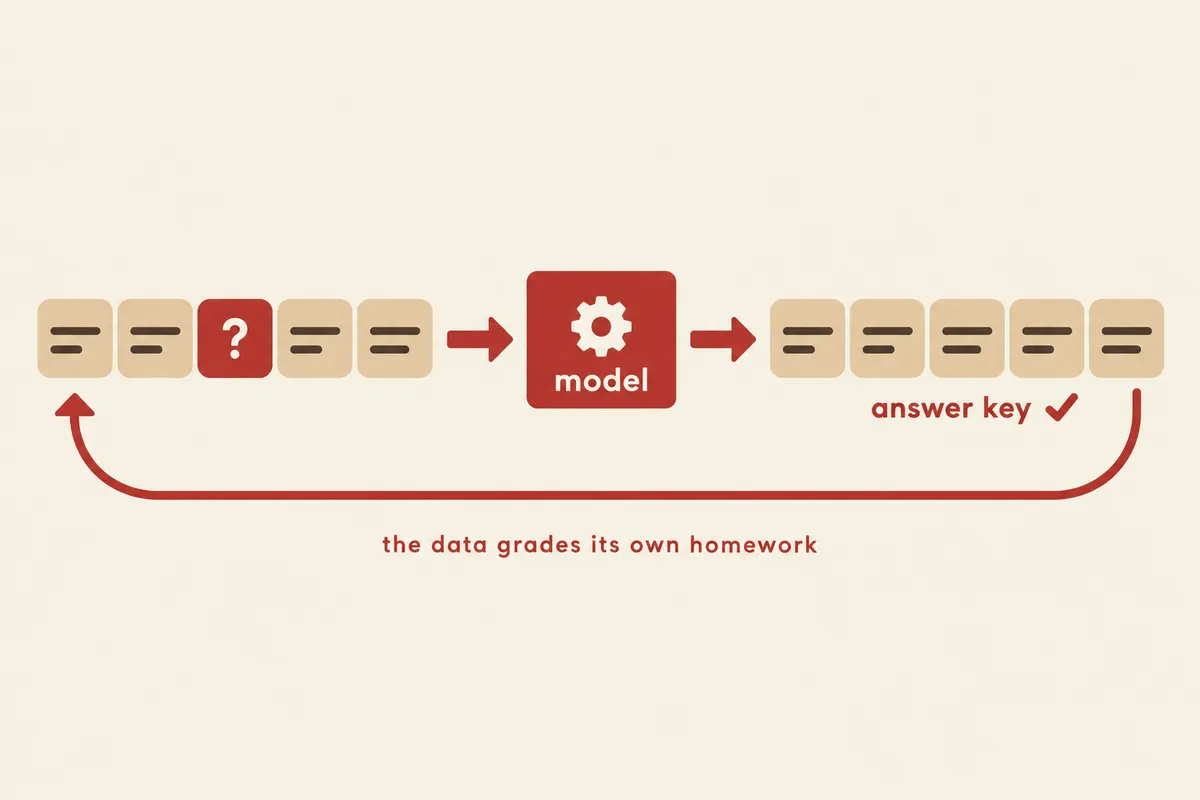
Training a frontier model looks impossible on paper. Nobody labeled trillions of words with correct answers, and nobody drew boxes around billions of images. The field's central insight is that the labels were hiding in the data all along. Take any sentence, cover up a word, and the sentence itself is the answer key. Take any image, add noise, and the original pixels are the target. That is self-supervised learning: objectives where the supervision signal is manufactured from the raw data, for free, at any scale. Two families grew from it. Autoregressive models like GPT predict the next token, one step at a time. Diffusion models like the ones behind text-to-image generators predict the noise that was added to an image, one denoising step at a time. And in 2025, the two met: LLaDA trained a language model with a diffusion objective. The sentence to remember: models learn because the data grades its own homework.
The loop this primer runs on: cover a word, let the model guess, grade against the sentence itself. The labels were never labeled.
2. How it works
Five mechanisms, each a different flavor of self-grading. Tap each card for the plain-language version, one concrete example, and what changed recently.
The model only ever answers one question
Given the tokens so far, what comes next? A language model never writes a sentence in one go; it bets on one token, appends it, and bets again. Five sentences, one blank each: a long-range clue, a genuine ambiguity, a domain fact, a red herring, and one about reading signs. Tap the blank to see what a toy model guesses, then step through with the arrows. Every tap is one step.
The probabilities are illustrative, not measured from a real model. A real model outputs a full probability distribution over its entire vocabulary at every position, tens of thousands of tokens, and the probabilities always sum to one. The sharpness of the guess is the training working: more training makes confident contexts spikier and uncertain contexts flatter.
Watch noise become a picture
Diffusion generation, click by click. Start with pure static, the way every image begins. Each tap removes one slice of noise, the way the trained model does. Nothing is drawn; the picture was always under the noise. Every tap is one step.
100%noise remaining
Toy model, not a trained network: the noise here is a fixed random field blended out in equal slices, and the "picture" is a hard-coded smiley. A real diffusion model predicts a fresh noise field at every step, conditioned on the text prompt, and the denoising schedule is tuned, not even. The shape of the idea is exact; only the numbers are play-pretend.
3. The landmarks
Six moments that defined how models train, June 2018 to February 2025. One tap per step, or use the arrow keys.
4. Key voices
Five people who built the objectives this primer runs on. The real action is at the bottom, where the token predictors collide with the representation predictors.
The big disagreement
Same goal, opposite bets. One switch, every tap flips. No picking sides, just the collision.
The generative camp GPT, BERT, diffusion lineage
predict the raw stuff
The next token is enough. Radford et al. showed in 2018 that predicting what comes next on raw text transfers to a dozen tasks with barely any fine-tuning, and GPT-3 proved at 175B parameters that in-context learning emerges from the same objective with zero architecture change. The diffusion side bets the same way on pixels: predict the noise at every step, and images fall out. Language Models are Few-Shot Learners, May 2020.
Yann LeCun Turing laureate, AMI Labs founder
the dissenter
Predicting raw tokens is predicting the wrong thing. His cake: if intelligence is a cake, the bulk of it is self-supervised learning, with supervised learning as the icing and reinforcement learning as the cherry. But the self-supervision should predict abstract representations of the world, not the next word or the next pixel: generative models waste effort filling in details that are inherently unpredictable. That is the JEPA program, his "path towards autonomous machine intelligence." JEPA and world models, 2026.
The irony the middle ground points out: LeCun called the recipe right (pre-train self-supervised, then fine-tune, then RL) while calling the objective wrong. The industry's frontier models follow his cake and ignore his warning.
5. Where leaders think this goes
Every item below is attributed: who said it, where, when. These are the leaders' visions for where model training goes over the next 5-10 years, not my conclusions. Predictions go stale; this section is frozen as of October 2026.
Where they agree
GPT-1, BERT, GPT-2, GPT-3, and LLaDA's teams agree: self-supervised pre-training stays the foundation
The teams behind GPT-1 (Radford, Narasimhan, Salimans, and Sutskever, OpenAI, Jun 2018), BERT (Devlin, Chang, Lee, and Toutanova, Google, Oct 2018), GPT-2 (Radford, Wu, Child, Luan, Amodei, and Sutskever, OpenAI, Feb 2019), GPT-3 (Brown et al., OpenAI, May 2020), and LLaDA (Nie et al., Feb 2025) all pre-train on raw data with labels manufactured from the data itself. None of the five papers proposes a return to hand-labeled training at scale; the open question they leave is which self-supervised objective.
The through-line across the five arXiv papers in the Sources section, 2018 to 2025.
Where they split
The big split: predict tokens, or predict representations
Side A: predict representations (LeCun). His bet: models that predict abstract representations of how the world changes (JEPA) will win over models that generate raw tokens or pixels, because the latter waste capacity on unpredictable detail. Side B: predict tokens, and scale (the GPT-3 camp). Brown et al. showed in May 2020 that in-context learning emerges from plain next-token prediction at 175B parameters with zero architecture change: scale keeps making the "wrong" objective work.
LeCun's "A Path Towards Autonomous Machine Intelligence" program, described in the JEPA piece linked below, 2026; the generative counter-position is the GPT-3 result, Brown et al., OpenAI, arXiv:2005.14165, May 2020.
One team's bet: diffusion rivals autoregression at frontier scale
The LLaDA authors expect diffusion to rival autoregressive models at frontier scale: diffusion models are "a viable and promising alternative" to autoregressive models, challenging the assumption that in-context learning and instruction following are inherently tied to next-token prediction. LLaDA 8B already matches LLaMA 3 8B on in-context learning. This is one paper team's bet, not a camp.
Nie et al., "Large Language Diffusion Models," arXiv:2502.09992, Feb 2025.
6. Can one token at a time hold a whole essay?
The honest worry about next-token prediction is the scale of thought. One token at a time, no outline, no eraser, and the model never sees the ending before it writes the beginning. So how do long essays come out coherent at all? And where does the trick break? Both sides, with sources.
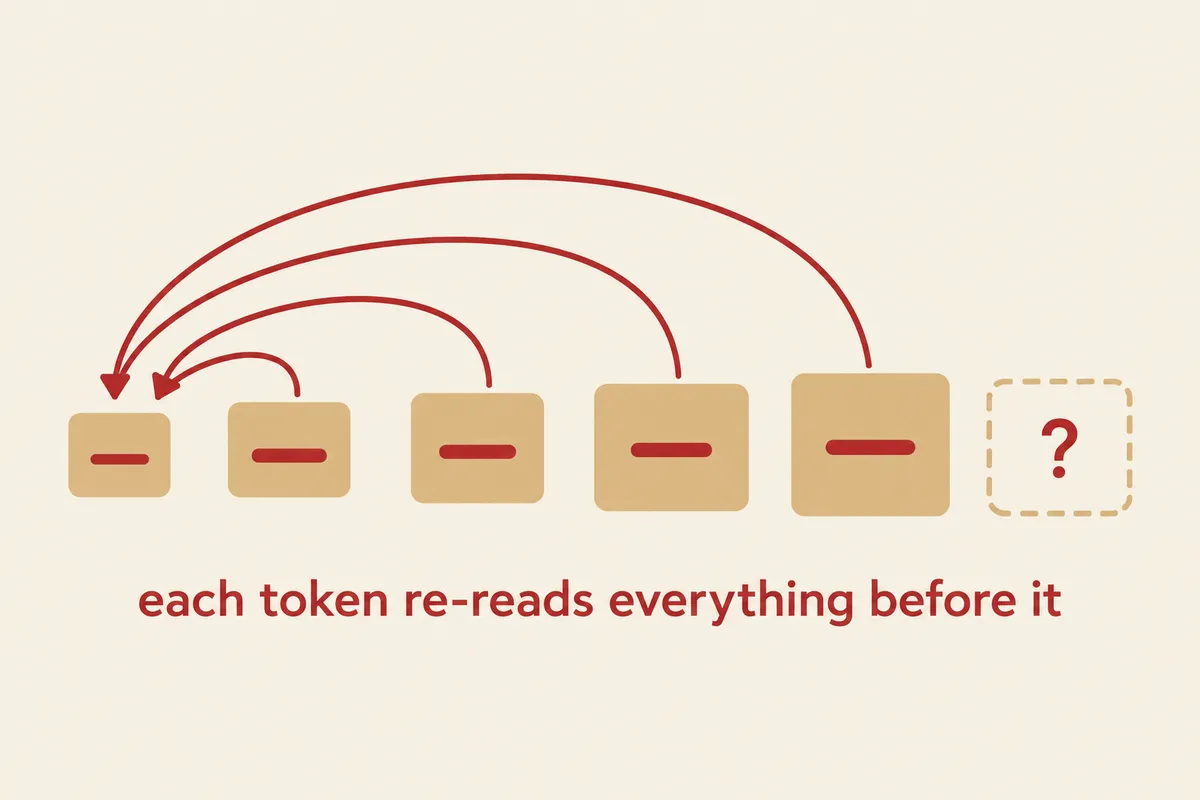
One token at a time, each new token re-reading the whole past before it bets. The entire mechanism, drawn.
7. Do robots and cars learn the same way?
A car predicts where the pedestrian goes. A robot predicts what its arm does next. Is that the same kind of learning as predicting the next word? The honest answer is partly. The objectives crossed over into the physical world, but the data and the stakes did not follow.
Takeaways
Models never needed labeled answers, because the training objectives manufacture supervision from raw data. Text models predict what comes next, image models predict what noise was added, and both learn at a scale no human annotation could ever reach. That one local bet turns out to be enough for long essays and for robot actions too, with one honest caveat: the model predicts, it never plans.
The data is the answer key. Next-token prediction and noise prediction both manufacture labels from raw data, which is why training scales to trillions of words and billions of images with almost no human labeling.
Text models bet one token at a time. Given everything so far, the model outputs a probability distribution over its whole vocabulary, appends its pick, and bets again.
Image models remove noise one step at a time. The forward process adds known Gaussian noise; the model predicts exactly that noise with mean-squared error, and generation runs the process in reverse from pure static.
Local bets learn global shape. The training text already had structure, and every token re-reads the whole past, so long essays come out coherent. But nothing here plans ahead, and early errors feed back as context, which is why long rollouts can drift.
The same playbook runs cars and robots. GAIA-1 predicts the next token over video, text, and action; robot models mix action prediction with action-conditioned observation prediction. Partly similar: the objectives transfer, but robot data is scarce and mistakes are physical.
The two objectives are converging. LLaDA trains language models with a masked-diffusion objective, already competitive with autoregressive models, while LeCun bets the future belongs to predicting abstract representations instead.