Skill packs vs. Muse Wonder, checked
On October 12, 2026, a post by angel (@angeldot_) called five GitHub repositories of AI agent skills a gold mine, and 397.9K people read it. Attached to the post is a long article about twenty Claude features that never names a single skill and never mentions Muse at all. This primer checks both pieces, then asks the question the post implies: are curated skill packs like these better than a strong general model, here Muse Wonder, running with nothing installed? The post's numbers are honest; its one flourish, the authorship of the biggest pack, is wrong. And on the head-to-head, the answer splits cleanly: packs add procedure where a model lacks it, and packaging where it does not, which is why the same benchmark that shows skills adding 16.6 points on average also shows them barely moving software work, the exact thing these repos sell.
"ESTO ES UNA MINA DE ORO"
angel (@angeldot_), X, October 12, 2026; "this is a gold mine," in Spanish in the original. 397.9K views, 3.3K likes, 8.1K bookmarks as displayed when read. The post lists five repos: agency-agents, wshobson/agents, anthropics/knowledge-work-plugins, anthropics/claude-quickstarts, and addyosmani/agent-skills. The article attached to it, "Claude hace todo esto (y casi nadie lo sabe)," is a separate piece about Claude features, checked in rows six and seven of Fig 1.
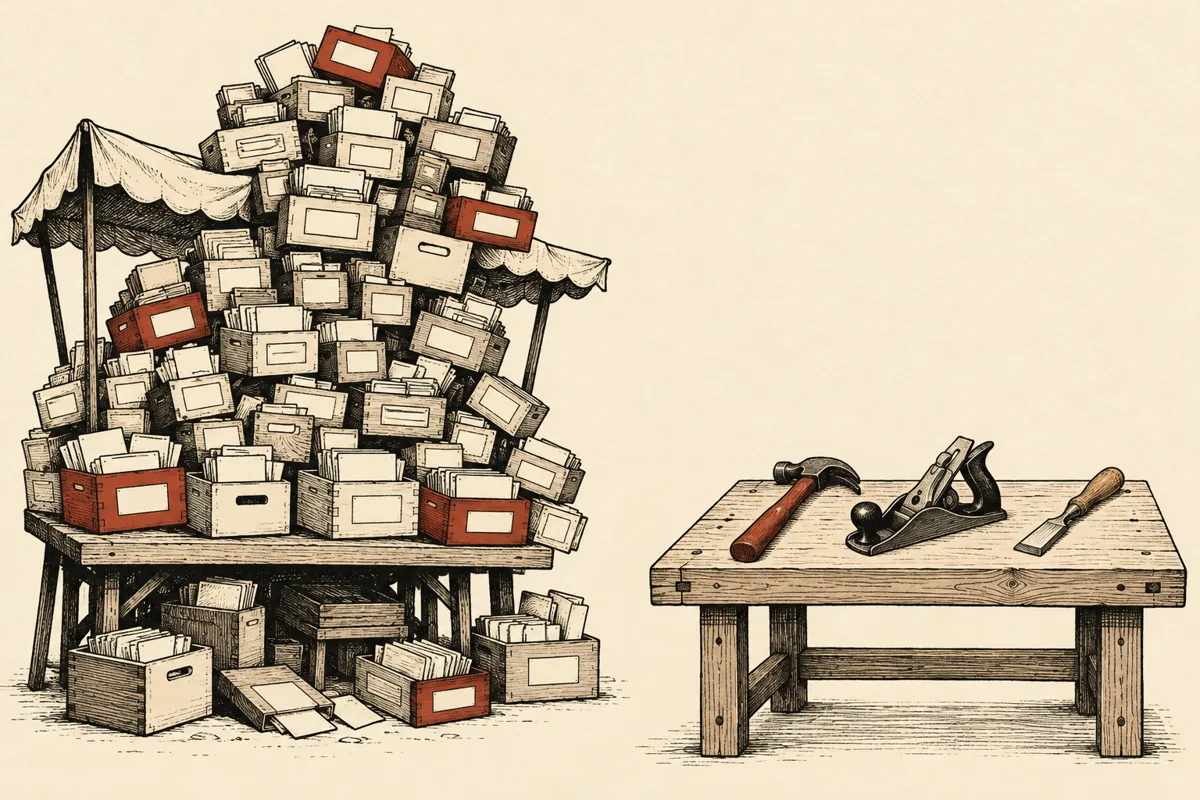
How it works
The repos, the article, and the head-to-head
First, the post itself, checked repo by repo against GitHub, plus the two most checkable claims from its attached article. Then a worked example built for this primer: one buggy code module, reviewed three ways on the same model, with nothing changed except what was loaded alongside it. The mechanisms that explain both results follow as cards.
Five rows for the repos in the post, two for the article attached to it. Star counts were read from the GitHub API on October 13, 2026; contents counts are from each repo's own README.
The stars check out and then some: 159,564 on the API, still growing. The agent count is the stale part. The repo's own README now says 230+ agents across 19 divisions, from engineering and design to healthcare and security, so "about 170" understates the pile by a third. The agents are plain Markdown persona files you copy into your agent folder; loaded whole, their bodies run to roughly a million tokens, which is why other tools load an index instead. Owner: Michael Sitarzewski, a solo founder, no lab affiliation. A reply under the post flagged exactly this category of thing: community repos presented in one breath with Anthropic's own.
The most accurate line in the post. Stars: 40,519. Every count matches the README to the digit: 94 plugins (92 local, 2 external), 202 agents, 184 skills, 105 commands, all generated from one Markdown source per component. One update the post misses: the pack is no longer just for Claude Code; its adapters now render for Codex, Cursor, Copilot and others. Owner: Seth Hobson, an independent developer. His own docs are also unusually candid about the pack's built-in eval scores, saying in effect that they do not prove a task succeeds, a caveat Fig 2 and the mechanism cards come back to.
True, and the post undersells it: 29,367 stars when checked. This one really is Anthropic's, organized by work area exactly as described, 11 plugins listed in the README (productivity, sales, support, product management, marketing, legal, finance, data, and more), each just a manifest, connector config, and Markdown commands and skills. Anthropic's own framing is worth more than the star count: the README presents the plugins as generic starting points whose value comes from customizing them to your company, which is the opposite of the install-and-win framing around them.
Stars: 17,938, and it is genuinely Anthropic's. But the description takes one sample for the whole repo. Quickstarts is about 18 deployable sample applications written in real code, a customer-support agent, a financial data analyst, computer use, browser use, an autonomous coding agent. The daily summary exists: one sample, Managed Agents: Daily Brief, reads Slack channels and GitHub pull requests each weekday and posts one brief. Describing the repo by that single item is like describing a cookbook by its soup. It is also the odd one out mechanically: code you deploy, not prompts you install.
Stars: 105,707, and the 25 skills are exact, 24 lifecycle skills plus one meta-skill, arranged Define, Plan, Build, Verify, Review, Ship, with 9 slash commands and 4 personas. The authorship is where the post goes wrong. Addy Osmani created the repo in February 2026 while he was a director at Google, and the repo says plainly that the skills bake in best practices from Google's engineering culture, citing Software Engineering at Google. The repo's team is three people, Osmani plus two collaborators, and it is a personal project, not an Anthropic product. The twist that makes the post half-defensible: Osmani did join Anthropic, announced September 8, 2026, to work on Claude Code. An Anthropic engineer now; Anthropic engineers, plural, writing it at Anthropic, no. The reply under the post that corrected this was right.
The article's most technical claim is right, and if anything understated. Anthropic's documentation prices a cache read at 0.1 times the base input price on standard models, which is the 90% the article quotes, and at 0.05 times on Opus 5.5 and Sonnet 5.5, which is 95% cheaper. The default cache lifetime is 5 minutes, refreshed at no cost each time the cached content is used. What the article leaves out: writing to the cache costs a premium (1.25 times for the 5-minute cache, 2 times for the optional hour), and the discount applies to cached input tokens only, never to output. The model name in its code example, claude-opus-5-5, also checks out; that model exists in Anthropic's official list.
This section describes real work and attributes it to the wrong thing. No Anthropic product page or doc describes a native Claude video editor, Cowork's published list of supported files contains no video formats at all, and the models take text and images in and return text. Lossless stream-copy cuts, metadata reads, and transcript-based editing are what an agent with shell access does by driving ffmpeg, ffprobe, and Whisper, tools the article's framing never mentions. The genuinely new native feature nearby, Claude Motion (beta, October 8, 2026), generates animated explainers from code; it does not edit your footage. An agent plus free command-line tools is a fine story. It is just not a Claude feature, and a reader who goes looking for the button will not find it.
The scoreboard, in one line: of the post's five repo descriptions, three are accurate, one is accurate but stale (agency-agents), one is accurate except for who wrote it (agent-skills), and none inflates a star count. Viral posts about repos are usually sloppier than this. The failure mode here is subtler: true numbers lending credibility to an implication, that installing the pile is the win, which the next figure tests directly.
No pack in the post has a published with-and-without benchmark, so this primer ran a small one. A 62-line Python shop module was written with 8 planted bugs: a SQL injection, discount math that returns the amount saved instead of the price, a mutable default argument, an off-by-one that drops one order per page, a crash on unknown email, a file that is never closed, a password-reset token drawn from a predictable generator, and a refund function that reports success when the write fails. Three reviewers, same model, same code, same request. One got nothing extra. One got Osmani's code-review skill from the post's own list. One got the agency-agents code-reviewer persona.
Planted bugs found, out of 8
Detection tied. On classic bugs, the kind a strong model has seen ten thousand times, the packs found nothing the bare model missed. If the test stopped here, the gold mine would look like a tie at zero value, and that is not quite the whole result.
Total findings reported, all of them real
Zero false positives in any arm. The skill arms reported two more genuine problems each: refunds that never check the order exists or the amount sane, and a SELECT * habit that drags password hashes toward callers who need a name. The plain review caught the same themes in passing and ranked them as remarks instead of findings.
What the skills actually changed
Structure, mostly. The skill arm opened with a verdict (request changes), sorted findings into critical, required, and optional, and closed with a summary by axis: correctness, security, architecture, performance, readability. It was the only arm to catch that a failed refund also skips its rollback, leaving a poisoned transaction on the shared connection. The persona arm matched the count, added severity tiers and a short "what's good" section, and spotted a second off-by-one in the page numbering convention. The plain review was the shortest of the three and the fastest to read. The skills behaved exactly like what they are: checklists and professional formats that stop a capable reviewer from stopping early.
The honest label on this test
One task, one model, three runs, bugs chosen from the classic canon. That measures the floor: work the model already knows cold. It cannot measure the ceiling, procedures the model does not carry, where the benchmark evidence below shows skills earning real points. Read Fig 2 as a demonstration of the mechanism, not as a benchmark: when knowledge is already in the model, a skill file adds discipline and format. When it is not, the same file is carrying the knowledge itself. The packs blur those two cases on purpose; the prices are the same either way.
Reproduce it: the module, the three reviews, and the grading key are the kind of test anyone can rerun in an afternoon, which is the point. A pack that cannot show you its with-and-without numbers on your own tasks is asking to be believed on star counts. The companion primer in Keep exploring turns this one-off into a standing method for your own skill library.
In October 2025, Anthropic's skills team launched Agent Skills as composable expertise: find where your agent actually fails, write a skill for that gap, evaluate, repeat. In its 2026 prompting guide for its strongest model, Anthropic tells users the opposite move: skills written for earlier models are often too prescriptive for the new one and can degrade output, so consider removing them and re-testing. Both documents are official, both are right about their own model generation, and together they date-stamp every skill pack ever published: a pack is a snapshot of what a past model lacked, and its value decays on the vendor's release schedule, not yours.
Timeline
Two years of skills, from launch to gold rush
Skills went from a launch blog post to an open standard to a star-count gold rush in about a year, and the evidence about when they help arrived in the middle of it, mostly after the biggest packs were already famous. Step through it.
Key voices
Who says what, and where they part ways
The poster, the format's inventor and its most famous blogger, the pack author whose repo started this, the benchmarkers, and the one institution arguing both sides. They agree on the mechanism. They split on the pile.
angel (@angeldot_)
X creator; the post, October 12, 2026, and the attached Claude guide, October 11, 2026
Her post is a list with a verdict on top: these five repos are a gold mine. As reporting, it holds up better than most viral lists: the star counts are real, the internal counts are mostly exact, and the attached guide's hardest technical claims, prompt caching and the model name, check out. Where it misleads is provenance and implication: one pack is credited to the wrong company's engineers, and the gold-mine framing skips the only question that matters, which is whether any of it beats the model you already have. Her guide also hands the video-editing powers of a shell pipeline to Claude as a feature. Enthusiasm, accurate in the small, unexamined in the large.
Simon Willison
Developer and blogger; "Claude Skills are awesome, maybe a bigger deal than MCP," October 16, 2025
Willison's launch-day verdict is the growth camp's founding document: the format's simplicity, a folder of Markdown with a little YAML and optional scripts, is the point, and he predicted a Cambrian explosion of skills dwarfing the MCP rush. Two months later the format became an open standard consumed by rival harnesses, which is his prediction tracking well so far. He also attached the condition everyone else forgets: skills run code and follow instructions, so they belong in environments where prompt injection damage is bounded. Simplicity is the feature; the blast radius is the price.
Addy Osmani
Author of agent-skills (February 2026); formerly Google, now Anthropic's Claude Code team
Osmani's own account of his pack is more careful than the post about it. His argument: agents have read about senior-engineering discipline, Hyrum's Law, verification gates, anti-rationalization, and skip it by default, so skills are scaffolding that bolts the discipline back on, process over prose, with verification as the exit criterion. It is a genuinely good description of what his 25 skills do, and Fig 2 shows the effect: format, completeness, fewer early stops. Note his word, though. Scaffolding is what you remove when the building stands. His framing concedes the mechanism the shrink camp runs on: skills compensate for what the base agent does not yet do unprompted, a gap each model generation narrows.
Barry Zhang, Keith Lazuka, Mahesh Murag (Anthropic)
Anthropic engineering; "Equipping agents for the real world with Agent Skills," October 16, 2025
The team that shipped the format describes skills as composable folders of procedural knowledge that turn a general agent into a specialist, and their method is the opposite of bulk installation: start from evaluations, find the specific tasks where your agent fails, author the smallest skill that closes that gap, then measure again. They also look ahead to agents creating, editing, and evaluating their own skills, a future the benchmark card below complicates, since skills that models generate for themselves currently test at about zero benefit. The inventors' method and the gold rush's method share a format and nothing else.
Anthropic's Fable 5 prompting guide
Anthropic documentation; Prompting Claude Fable 5, 2026
The same institution, one model generation later, instructing users to refactor their prompts and skills when they upgrade: guidance written for earlier models is often too prescriptive for the frontier model and can degrade quality, so remove older instructions wherever the default performs better, and treat every capability jump as the moment to re-audit which guardrails still earn their place. This is the shrink camp with an official letterhead, and it reframes every pack purchase: you are not buying an asset, you are renting a gap, and the landlord ships a new model every few months.
Hamel Husain
ML engineer and evals educator; "Evals Skills for Coding Agents," with Shreya Shankar, March 2, 2026
Husain published his own small set of eval skills and immediately undercut the genre: generic skills are only a starting point, because skills grounded in your stack, your domain, and your data will outperform them. Write your own, and let evals decide which survive. It is the position the evidence best supports end to end: SkillsBench's curated skills were written against the tasks they were tested on, ETH Zurich's gains came only from short human files naming non-obvious constraints, and Fig 2's tie happened precisely where the model's own training already covered the ground. Curation is the product. The pile is not.
Thibaud Gloaguen and colleagues (ETH Zurich)
"Evaluating AGENTS.md," arXiv, February 2026
The closest rigorous study of instruction files in the wild, run over agent benchmarks: repository context files tended to reduce task success while raising inference cost by more than 20 percent. Files generated by models were net negative; only short, human-written files stating constraints the model could not infer helped, by about 4 points at about 19 percent more cost. Their proposed mechanism reads like a description of a 230-persona pack: redundancy with what the model can already infer, plus faithful over-compliance with instructions that did not need giving. Not a study of skills by name, and the cards in this primer flag that; it is the best evidence about the mass-install strategy specifically.
Seth Hobson
Maintainer of wshobson/agents, the post's most accurately described repo
Hobson's pack is the engineering maximalist entry: one Markdown source, 94 plugins, tiered models, structural validation, and an eval layer of LLM judges and Monte Carlo scoring. It is also the only pack whose own documentation concedes the central problem in writing: those eval scores are experimental, unvalidated against human labels, and do not prove that a task succeeds. Between the maintainer who says that and the influencer who says gold mine, believe the maintainer. His pack may well help; neither he nor anyone else has published the with-and-without numbers that would show it, and that absence is itself data about the whole category.
Where leaders think this goes
Agreement on the mechanism, splits on the pile
Positions as published through October 2026. Nothing in this section introduces facts beyond the research above; the forward-looking items are named bets about whether packs grow, shrink, or get absorbed, and by whom.
Where they agree: a skill is a real mechanism, not a prompt trick
Anthropic's skills team (progressive disclosure: a hundred tokens of metadata always loaded, the body only when a task matches, bundled files only on demand), Simon Willison (the format's simplicity is why it spreads), and even ETH Zurich's skeptics (short human files with non-obvious content measurably helped) converge on the mechanism: loading the right procedure at the right moment beats both a bare prompt and a giant static instruction dump. The disagreement in this field is never whether skills can work. It is about how much of the pile works, for how long, and at what cost.
Where they also agree: nobody credible defends installing the whole pile
The independent teardown of agency-agents (2026) concludes it is useful only as source material for a small curated subset, since wholesale import buys context and governance bloat. Anthropic frames its own knowledge-work plugins as generic starting points whose value is customization. Hobson's docs concede his eval scores do not prove task success. SkillsBench's focused-beats-comprehensive result says the same thing with numbers. The gold-mine post is nearly alone in presenting bulk as the win, and it is the only voice in this section that sells anything by doing so.
Split one: cheap leverage, or expensive bloat?
Side A: Willison, Vincent, Osmani, leverage
A folder of Markdown is the cheapest capability multiplier ever shipped. Jesse Vincent's Superpowers, a whole development methodology encoded as auto-activating skills, reached roughly 269K stars and a place in Anthropic's official plugin marketplace; Osmani's pack demonstrably changes reviewer behavior, as Fig 2 shows. In this camp the burden of proof is on the bare model to explain why it skipped the discipline.
Side B: Gloaguen and the teardowns, bloat
Most added instruction mass is redundant with what models infer on their own, agents over-comply with it, and the meter runs about 20 percent higher for zero to negative success gain. SkillsBench itself supplies the friendly fire: skills hurt on about a fifth of tasks, and their smallest gain, 4.5 points, lands in software engineering, the exact shelf these packs stock. Leverage exists; it is just much thinner than the star counts suggest.
Split two: a durable layer, or scaffolding the model outgrows?
Side A: The format compounds
Skills became an open standard in December 2025 and are consumed by Codex, Copilot, Cursor, and Gemini CLI; Anthropic's skills team expects lifecycle tooling, org-wide libraries, and agents authoring skills. In this future, packs are absorbed into every harness as a standard layer, the way editor extensions were: the format wins even if individual packs churn.
Side B: The capability gets absorbed instead
Anthropic's own Fable 5 guide tells users to strip prior-generation skills that now degrade the stronger model, and SkillsBench finds self-generated skills worthless on average, which undercuts the agents-will-write-the-skills future with current data. What survives each model jump, in this camp, is small, private, non-obvious, eval-verified context: Hamel Husain's position, and the opposite of a public mega-pack.
Takeaways
What to actually remember
So, which is better, the packs or general Muse Wonder? On work a strong model already knows, the bare model wins by default: it matched both packs bug for bug in Fig 2, with nothing installed. On procedures the model does not carry, curated skills win big: plus 51.9 points in healthcare on SkillsBench. The packs are inventory. Keep a few focused skills with real jobs, re-test them when the model changes, and treat the rest as decoration with a security surface.
- The post's numbers are honest; its provenance is not. Every star count checked out against GitHub. The one real error credits Osmani's Google-built pack to Anthropic, and the article's video-editing claim hands ffmpeg's work to Claude. Trust the list, verify the framing.
- Stars measure distribution, not improvement. No pack on the list has a published with-and-without benchmark. The measured claims in this space belong to the category (SkillsBench, ETH Zurich), not to any repo.
- Skills pay where the model lacks the procedure. Plus 16.6 points across 87 tasks on average, but plus 51.9 in healthcare against plus 4.5 in software engineering. Fig 2's 8-of-8 tie is the familiar end of that spectrum.
- Focused beats comprehensive; self-written scores zero. Two or three modules beat four or more, and skills a model writes for itself average no benefit. Short, human, non-obvious, and checked is the whole recipe.
- Every model upgrade is a re-test date. Anthropic advises stripping skills tuned for earlier models, because prescriptive scaffolding degrades stronger ones. A pack is a snapshot of a past model's gaps.
- Install like it is software, because it is. Snyk's February 2026 audit of 3,984 skills found flaws in over a third and 76 confirmed malicious payloads. None of the post's repos was named in an audit; the risk is the category's trust model, and the audit step is yours.
Keep exploring
Related primers
New Model, Old Skills
The standing method behind Fig 2: fixed suites per skill, paired with-and-without deltas, and keep, trim, or retire calls when a new model lands.
The Harness Is the Product
Where skills live: the loop, tools, and context management around the model, in Cursor, Codex, and the rest.
How Frontier Labs Change Agents Without Breaking Them
The other direction of change: editing skills and prompts under a fixed model, with regression evals as the guardrail.
The Only Moats Left
Another viral claim checked the same way, where the durable advantages turned out to be data, networks, and atoms, not technique.
Sources
Primary sources
Read October 2026. Repo star counts and contents are from the GitHub API and each repo's README on October 13, 2026. Secondary summaries are flagged where they appear, and no claim on this page rests on a flagged source without the flag travelling with it.
angel (@angeldot_), X post, October 12, 2026
msitarzewski/agency-agents
wshobson/agents
anthropics/knowledge-work-plugins
anthropics/claude-quickstarts
addyosmani/agent-skills
Addy Osmani, biography
Addy Osmani, "Agent Skills," 2026
Anthropic, Agent Skills overview
Zhang, Lazuka, Murag, "Equipping agents for the real world with Agent Skills," Anthropic, October 16, 2025
Anthropic, Prompting Claude Fable 5
Anthropic, Prompt caching
Li et al., SkillsBench, arXiv:2602.12670 (v4, June 14, 2026)
Gloaguen et al., "Evaluating AGENTS.md," arXiv:2602.11988, February 2026
Snyk, "ToxicSkills," February 5, 2026
Simon Willison, "Claude Skills are awesome, maybe a bigger deal than MCP," October 16, 2025
Jesse Vincent, Superpowers, October 9, 2025
Husain and Shankar, "Evals Skills for Coding Agents," March 2, 2026
Anthropic, Claude in Chrome
Meta, "Introducing Muse," September 8, 2026
Meta, "Introducing Muse Wonder and Muse Wonder Full," October 2026