48 Hours in SF: The Model Is 20 Percent of It
On October 14, 2026, Greg Isenberg, who runs the startup studio Late Checkout and hosts The Startup Ideas Podcast, posted his notes from 48 hours in San Francisco: dinners and meetings with artificial intelligence (AI) founders and executives, written up as 21 observations. Read together, they describe an industry repricing itself. The model is becoming a swappable part, and the money is moving to the harness around it, the data underneath it, and the distribution in front of it. This primer checks his biggest claims against the published record.
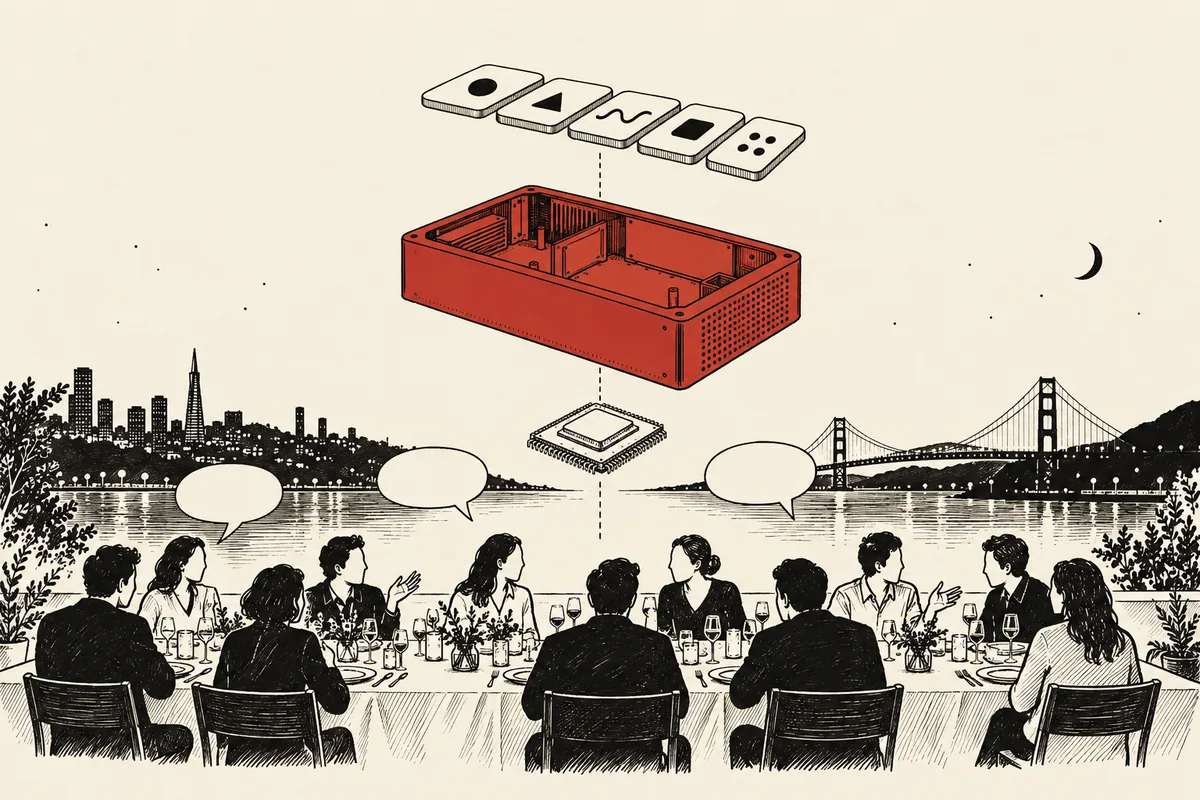
The brief
Isenberg is a company builder, not a lab researcher, and the post is a sentiment instrument rather than a dataset: he reports what the people running very large AI companies say to each other when the microphones are off. That makes the claims worth checking rather than quoting, so this primer pairs each big observation with the hardest public number that bears on it. Some check out completely: agent insurance exists, with prices, and dead startups really are selling their chat archives, with brokers. Some stay anecdotes, and the page says so where they do. The pattern across all 21 observations is consistent enough to state plainly. The sentence to remember: when everyone can rent the same brain, the business is everything around the brain: the harness that aims it, the data only it can see, and the audience only it can reach.
Figure 1: the computer, rebuilt
His fourth observation is the frame for the other twenty. The computer is being reinvented, he writes: the model is the central processing unit (CPU), the harness is the operating system, and skills and plugins are the apps. It sounds like a metaphor until you price it. In the old computer, almost nobody made money selling the processor to end users; the money pooled in the operating system, the applications, and the distribution channels. Tap each layer to see where the post thinks the AI version of that money sits.
What changed recently is that the middle layer acquired standards. A harness used to be a pile of one-off integrations; since late 2024 it is increasingly assembled from a public protocol for connectors, a written set of evaluations, and a review interface, the way an operating system is assembled from drivers, a scheduler, and a screen. Figure 2 builds one, part by part.
How it works
Figure 2: build the harness
The worked example. Take one ordinary job, processing refund requests for a mid-size online retailer, and assemble the vertical harness Isenberg describes, in the order his recipe lists the parts. The company and its numbers are an illustrative construction; the four parts, and the order, are his. Tap through it.
The connector step has real arithmetic under it, and it is the arithmetic that turned plumbing into a standard. Without a shared protocol, every agent needs a custom integration to every system it touches:
Worked: a company running 12 internal agents against 40 tools faces C = 12 × 40 = 480 custom integrations in the no-standard world, and C = 12 + 40 = 52 implementations with the Model Context Protocol (MCP): one client per agent, one server per tool. Add a 41st tool and the first world gains 12 more integrations; the second gains 1. That gap, not elegance, is why Anthropic's protocol, released in November 2024, was adopted by OpenAI and Google within a year and handed to the Linux Foundation's Agentic AI Foundation in December 2025.
Figure 3: the retention leak
Observation 3 is the post's quiet alarm: the rooms celebrate a billion dollars of revenue in 12 months and barely mention retention, yet AI revenue, in his words, can come in fast and leave fast. The leak has a formula. If a revenue base loses the same share of itself every month, what remains compounds downward:
Worked with the published anchor: ChartMogul's December 2025 retention report puts the AI-native median gross revenue retention at 40 percent per year, meaning the median AI company keeps two fifths of its revenue base across a year before expansion. Spread evenly, that is a monthly churn of about 7.3 percent, and the formula gives R(12) = 100 × (1 − 0.073)12 ≈ 40 million dollars left after twelve months of no new sales, plus 7.3 million dollars of fresh revenue needed every single month just to stand still. Drag the leak and watch the shape change:
The anchors around the slider are measured, not vibes. ChartMogul (3,500 software companies, retention through 2025) found median net revenue retention of 48 percent for AI-native companies against 82 percent for business-to-business (B2B) software as a service (SaaS), and the split is price: AI products charging over 250 dollars a month retain like classic B2B software, at 70 percent gross and 85 percent net, while products under 50 dollars a month keep just 23 percent gross. On the consumer side, RevenueCat's subscription data shows AI apps earning 41 percent more per payer in year one than non-AI apps, and churning about 30 percent faster. The model above is deliberately simple (one base, constant churn, no expansion, no new sales) and is labeled illustrative; the report's own caveat applies to its medians too, which ChartMogul calls directional where the samples thin out.
Figure 4: the new speed limit
The bar from observation 3, drawn with the one company that has publicly cleared it. Cursor, the AI code editor built by Anysphere, disclosed its annualized revenue at each funding round; the ladder below is those disclosures, to scale. Ten months separate the first rung from the billion-dollar rung.
Annualized run rates as disclosed by Anysphere and reported by TechCrunch, Crunchbase News, and Forbes; annualized revenue is not audited revenue, and none of these disclosures says what the retention underneath looks like. That silence is exactly Isenberg's point about the rooms.
Timeline
Tap the card, swipe, or use the arrows.
Key voices
Where leaders think this goes
Positions as of October 2026, each attributed to its source.
Where they agree
Where they split
Takeaways
Isenberg spent 48 hours in rooms where the model has already been demoted to a component, and the record mostly backs the rooms up: the standard plug exists, the insurance is priced, the dead companies are selling, and the retention data explains the quiet half of that dinner table. What is being repriced is not intelligence. It is everything that makes intelligence a business: harness, data, memory, distribution, and trust.
- Ask the dinner question. If a better model drops next month, does your company get better or worse? Harnesses, evals, and portable prompts answer better; a product tuned to one model's quirks answers by going quiet.
- The harness is the company. Connectors into the industry's data, evals written by people who know the work, hard rules on what the agent may touch, and a human review screen. The model is the remaining fifth, and it is rented.
- Data became inventory. Work product, including failures and the archives of dead companies, now has brokers, appraisals, and a 10 million dollar bankruptcy auction. Whether it compounds into a moat is the live argument, not a settled one.
- Retention is the leak under the growth story. At the AI-native median, roughly 7 percent of revenue evaporates every month; the companies that fix price and workflow depth retain like classic software.
- Risk is the newest product category. Every agent is a door into the company, and the response is already commercial: named coverage for agent mistakes up to 25 million dollars, underwritten only after a technical audit.
Keep exploring
Sources
Honesty notes. The post's three biggest numbers are unattributed anecdotes, and they are flagged wherever they would otherwise do work: brokers making 2 million dollars a week (about 104 million a year at that rate, against a documented global AI data segment of 826 million dollars in 2025), a cloned suite of ten apps said to be worth 5 billion dollars each, and the claim that only about 50 people on the planet can scale these businesses. None could be verified against a public source, and the post hedges all three itself. The 12-month watch-you-work agent is Isenberg's stated guess. The robotics founder and the consumer chief executive he quotes are anonymous in the post and are described here only as he describes them. Whether dead-company data actually improves models is unproven in public: MIT Technology Review notes no buyer has published a comparison against synthetic data. The refund-agent build in Figure 2 and the churn model in Figure 3 are illustrative constructions anchored to the published figures cited; the arithmetic is exact, the scenarios are simplified on purpose.