Why One Agent Isn’t Enough
Anthropic planted 70 bugs in a codebase of about 116,000 lines and ran the hunt two ways. A single agent found 14, 15, and 27 bugs across three runs. A dynamic workflow, one lead agent running a team in phases, found 66 in every run. This primer is about the machinery behind that gap, and the evidence that should temper it.
The brief
On October 16, 2026, the AI Engineer channel posted a workshop by two Anthropic engineers, CJ Avilla and Harrison Stall. Their subject is Flows, also called dynamic workflows: a feature of Claude Managed Agents where a lead agent writes a program that fans work out to as many as 1,000 agents, in phases, and combines what comes back.
The talk’s argument is organizational, not mystical. One agent fails in three specific, fixable ways, and each failure is a property of having a single context window do everything. The fix is the same fix human engineering found: split the work, isolate the pieces, and put a fresh pair of eyes between making and judging.
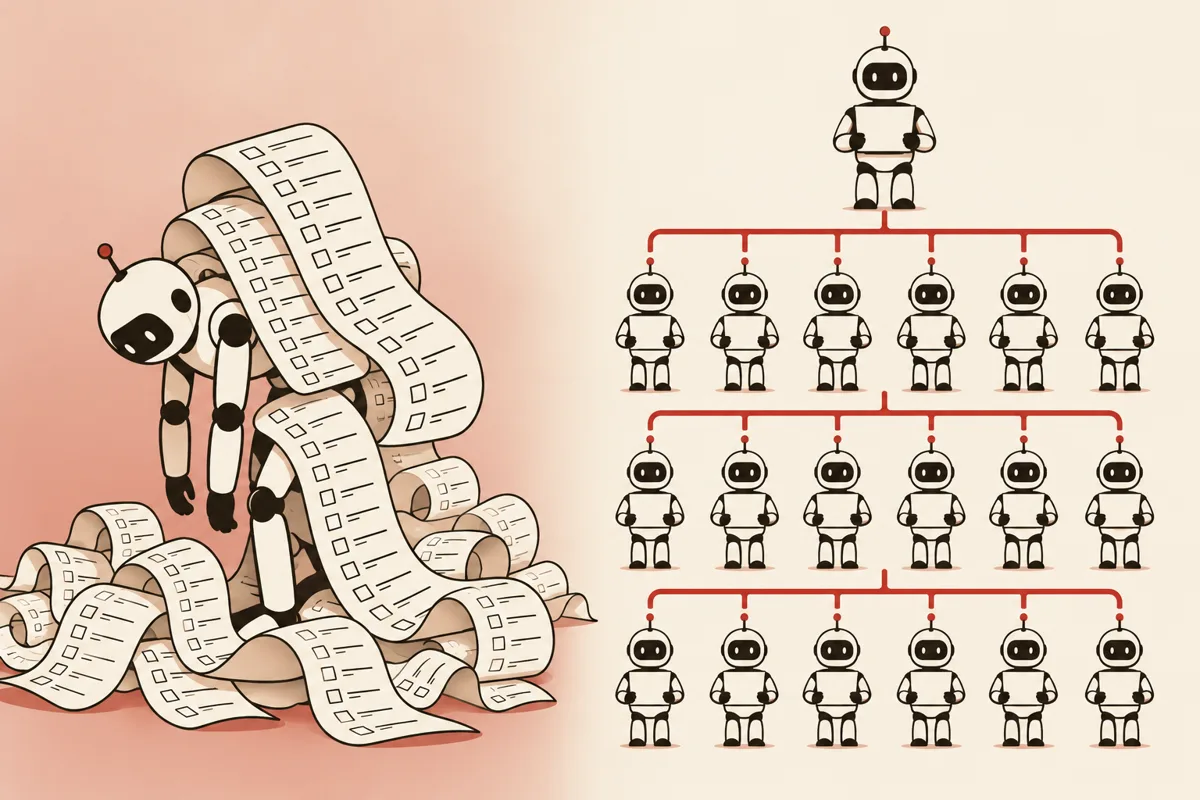
One agent fails by stopping early, grading its own work, and forgetting the goal; a flow fixes all three by giving each piece of work its own context.
How it works
Start with the shape. The talk opens with sixty years of humans hitting the same wall: work outgrows one pair of hands, and the answer is never a bigger pair of hands. It is a better org chart.
Figure 1: the org chart, five times
Each step is a real answer to the same problem: the work got bigger than the person running it. Step through and watch where the lines go.
One person, whole system
Thompson built Unix in about a month, roughly a week per piece, and held the whole design in one head. The talk calls this conceptual integrity: nothing to coordinate, because there is nobody to coordinate with.
Coordination channels: 0. The ceiling is one person’s memory and hours.The surgical team
OS/360 took thousands of person-years and taught Brooks the lesson he published as The Mythical Man-Month. His fix: one chief programmer whose head holds the design, supported by about ten specialists who never redesign anything.
Links: 10, all through the chief. If all 11 people talked pairwise, there would be 55 channels to keep consistent.The star breaks
Every contributor mailed patches to one inbox: Linus Torvalds. In 1998 he announced a vacation, and Larry McVoy posted the diagnosis the next day: “The problem is that Linus doesn’t scale.” One node was the whole network’s bottleneck.
The talk’s slide counts 36 actors feeding one person. A star has few links and one very tired center.The layered trust network
Linux replaced the star with layers: contributors report to subsystem maintainers, maintainers to a small group Torvalds trusts, that group to him. Nobody talks to everybody; each person talks to about four, and trust does the routing.
These 21 nodes need 20 links as a tree. Wired pairwise, they would need 210.The flow
A lead agent writes a plan, splits it into phases, and starts one agent per piece of work. Agents never message each other; results return to the program, which decides what runs next. The org chart is written fresh for every job, then archived.
Documented caps: 64 threads working at once, 1,000 agents over one run’s life, runs of up to 24 hours by default.Tap the card, swipe, or use the arrows.
Shapes after the talk’s telling; the Linux counts are its slides, and the flow caps are Anthropic’s workflow runs documentation. Linux 7.2, shipped in August 2026, credits 2,652 developers in nine weeks by LWN’s count: the layered shape is still the one that works.
Why one agent fails
The talk names three failure modes, and all three are the same shape: one context window is asked to be worker, checker, and memory at once. Run the talk’s own example: an outage somewhere in 50 services, with one standing order, do not touch production.
Figure 2: fifty services, one outage
The 35 is the talk’s number, from Anthropic’s own prompting of a single agent on this task. The flow’s 50 of 50 is the design’s promise, one agent per service; the measured version of that promise is the bug hunt below.
The six mechanisms
Everything a flow does follows from splitting one job into isolated contexts and recombining them on purpose. Six mechanisms carry the design; tap each card.
A flow starts one agent per unit of work: per contract, per file, per ticker. Each agent works in its own session thread, with its own context window and a prompt the program wrote for that piece alone. No agent watches the others work.
The threads share the session’s files, so work composes on disk. They never share conversation history, so one agent’s confusion cannot leak into another’s reasoning.
The talk’s demo: a stock watchlist scanner over six tickers (AAPL, NVDA, AMZN, JPM, XOM, COST). One scan agent per ticker reads only that company; a separate review phase then reads only the summaries.
Older multi-agent setups made you fix the roster in advance. A dynamic workflow is a program the lead agent writes for this job: its phases, its agent count, even which model each phase runs. The server executes it in the background while the lead keeps talking to you.
There is no application programming interface (API) call that starts a run. You turn the capability on in the agent’s definition, and the agent decides from your message whether the job deserves one:
That one field enables subagents and workflows together. Turning workflows back off is where it bites. A practitioner ran five “off” spellings through the real Python software development kit (SDK) and printed what each one sends; tap the three instructive ones:
Pick a spelling to see what the server does with it.
The docs say it flatly: sending null turns workflows on, because the default is enabled. The only spelling that turns them off is the disabled object.
Ask an agent whether its own poem, plan, or patch is good, inside the context that produced it, and it says yes. The talk calls this self-preferential bias: the generator and the judge share one head, so the verdict is rigged before the trial starts.
Flows split the roles by construction. The judge opens the work cold, in a later phase, with none of the maker’s reasoning in its context.
Cognition, which spent a year arguing against multi-agent systems, found the same shape independently: its review agent catches an average of 2 bugs per pull request (PR), about 58 percent of them severe. It works best when coder and reviewer share no context at all.
Verdict: looks good. The judge read the work with the maker’s whole chain of thought still in context, including the reasons each shortcut seemed fine at the time.
In production: Anthropic’s Bug Hunter flow slices a PR, gives each slice to an isolated reviewer, then runs a second phase where fresh agents argue with each flag before anything is posted as a comment.
In the outage task, the standing order came last: do not touch production. As one agent’s context fills with logs and findings, that order slides out of attention, and compaction can drop it entirely. The talk calls this goal drift, and it is the quietest of the three failures.
A flow never asks an agent to remember the goal across hours of work. The program writes the goal and its constraints into every phase’s prompts, so each fresh agent starts with the orders at the top of its context, at full strength.
A thousand agents reading the open internet will eventually read something hostile. The talk lists six concrete risks:
Anthropic’s answer is architectural. The brain, the inference loop and session state, is physically separate from the hands, the sandbox where tools run. And the sandbox never holds a working secret:
Secrets live in credential vaults. Each stored secret carries where it may be injected (a header or the request body) and which hosts it may go to, so the talk’s example, a Twilio key, can only ever be sent to Twilio. There is nothing real inside the sandbox for an injection to steal.
You set a session budget before kickoff, and it cannot be added later. When spend reaches it, every open run pauses and the session reports budget reached. Work already finished stays finished; raise the budget and the run resumes where it stopped.
The run is ready. The model running it has not been told the number.
Two details do the safety work. In-flight requests finish, so a run can overshoot by one request per working thread, and no more. And the model never learns its budget: in the talk’s words, tell it, and “Claude can get a little bit anxious,” which spends tokens on worry instead of work.
Amounts in the meter are illustrative. The pause at the cap, the kept work, and the resume on a raise are the documented behavior; the talk’s own example raises a hit $5 budget mid-session.
Figure 3: the coordination tax
Why not let the agents talk to each other, like a real team? Because conversation is the expensive part. Brooks counted it fifty years ago: if everyone on a team must stay consistent with everyone else, the number of channels grows with the square of the team.
Scores are Anthropic’s own team-scaling tests with Claude Opus 5.5 on a knowledge-base task, from its system card as printed by The Decoder (October 11, 2026): 0.53 with 1 agent, 0.70 with 10, 0.71 with 30, 0.74 with 100.
Flows dodge the coordination tax by design: agents never talk to each other at all, so there are no channels to keep consistent, only results to combine.
The worked example: a planted-bug hunt
Anthropic’s launch test, posted in its developer thread on October 9, 2026: 70 bugs planted in a codebase of about 116,000 lines, three runs each for a single agent and for a dynamic workflow. Pick a run and watch both bars.
Recall is found divided by 70, carried through: the single agent’s best run, 27 of 70, is 38.6 percent. The workflow’s 66 of 70 is 94.3 percent, three runs in a row. The single agent also swung almost twofold between runs; the workflow did not swing at all.
What this test does not show. It is Anthropic’s test, on Anthropic’s codebase, reported by Anthropic. No false-positive count was published, so precision is unknown. No token or dollar cost was published for either side.
And 66 in each run does not say the same 66; four planted bugs survived every run. Treat it as a strong internal result awaiting an independent rerun, not a settled constant.
The workflow found 66 of 70 planted bugs in every run; the single agent never broke 27.
The workflow that produced it is the talk’s Bug Hunter shape: slice the code, give each slice to an isolated reviewer, run a second phase where fresh agents argue with every flag, then send survivors to a prover phase that tries to reproduce each bug before a comment is posted. Coverage, cross-checking, and proof, in that order.
The second production flow the talk names is Explainer Studio, which makes the animated videos on the ClaudeDevs account: research agents plan, scout, and fact-check, then production agents animate scene by scene. A video that took about twenty hours to animate four years ago now starts from one small prompt.
Timeline
Unix in about a month
Ken Thompson writes the kernel, editor, and assembler of Unix at Bell Labs, roughly a week apiece. One person, whole system, no coordination cost.
The Mythical Man-Month
Fred Brooks publishes the lessons of OS/360: adding people to a late project makes it later, because coordination channels grow faster than hands. His surgical team is the proposed shape.
“Don’t Build Multi-Agents”
Walden Yan of Cognition argues that parallel agents make conflicting implicit decisions and produce fragile systems. His prescription: one thread, full context.
Anthropic answers, one day later
Anthropic publishes how its multi-agent research system beat a single agent by 90.2 percent on its internal eval, and warns in the same post that multi-agent systems burn about 15 times the tokens of a chat.
Claude Managed Agents ships
Hosted agents you define once and run in sessions, with a durable event log. The brain and the hands ship separated from day one, per the talk’s history.
Multi-agent, version one
A coordinator agent delegates to a roster you define in advance, one level deep. Useful, but the org chart is yours to design and it cannot change mid-job.
Dynamic workflows launch
Flows reach public beta: the lead agent writes the plan itself and fans out to as many as 1,000 agents. Anthropic posts the planted-bug test the same day.
The workshop
AI Engineer posts Avilla and Stall’s talk. Avilla’s side experiment, an operating system being built by a flow of up to 1,000 agents, is still running at about 85 hours, unfinished.
Tap the card, swipe, or use the arrows.
Every jump in scale, from Unix to Linux to flows, was won by changing the org chart, not by finding a bigger individual.
Key voices
The people shipping this, and the people measuring it, do not agree. The disagreement is the most useful part.
CJ Avilla
Scale works when the work is organized and isolated, not when the same hundred agents are thrown at a problem unorganized. Asked where returns diminish, he declines to name a number: what matters is the shape.
His proof of seriousness is an experiment, not a benchmark: a flow of up to 1,000 agents building a Unix-compatible operating system, still running when he spoke.
Organize first, then scaleHarrison Stall
The safety story is a developer discipline: declare the agent, its permissions, and its tools; contain it with environment policy and physical limits; detect through a durable event stream you can interrupt. Approval prompts are not on his list of real controls, because humans approve about 97 percent of them.
Contain by architectureAnthropic’s research team
The original result and the original warning, in one post. Multi-agent beat single-agent by 90.2 percent on their research eval; token usage alone explained 80 percent of the performance variance; and most coding tasks, with their shared context and dependencies, are a poor fit. Their system also once spawned 50 subagents for a simple query.
Yes, for research-shaped workWalden Yan
The field’s loudest skeptic, and its most credible convert. His 2025 case stands for parallel writers: agents acting on partial context make decisions that conflict at merge time. His 2026 follow-up narrows rather than recants: many agents may contribute intelligence, while writes stay single-threaded, and a reviewer with a clean context outperforms one that watched the work happen.
One writer, many readersDat Tran and Douwe Kiela
The equal-compute challenge. Pin the reasoning-token budget to the same number on both sides, and single agents match or beat multi-agent systems on multi-hop reasoning across three model families. Their conclusion: much of the reported multi-agent advantage is unaccounted computation wearing an architecture costume.
Equalize the budget firstYubin Kim and colleagues
The largest controlled comparison: 260 configurations, five architectures, six benchmarks. Against a single agent, results ran from a gain of 80.8 percent on work that splits into independent pieces to a loss of 70.0 percent on sequential planning.
Architectures with no central verifier propagated errors the furthest. In their measurements, independent agents amplified errors 17.2 times, and a centralized design cut that to about 4.4.
Task shape decidesNoam Brown
Multi-agent systems mainly buy speed, not quality. Four agents finished tasks twice as fast at twice the cost; sixteen agents kept the pattern with slightly worse efficiency. Web research and math parallelize well; a novel does not, and ten thousand agents on a novel would be as pointless as ten thousand people.
Speed, not qualityVals AI
The independent scoreboard. On 50 app builds, teams of GPT-6 Sol and Claude Opus 5.5 cost 1.8 to 5.1 times their single agents, and only one of four comparisons improved scores significantly.
The single best setup, Opus at max effort with a team, scored 93.2 percent at thirty times the cost of its medium single agent. The lead was not statistically significant.
Show the significanceEveryone agrees the shape of the task decides; they disagree about how much of the win is the shape and how much is just the spend.
Where leaders think this goes
Positions as of October 2026, each attributed to its source.
Where they agree
Work that splits into independent, checkable pieces gains from a team; work whose steps depend on each other loses. Anthropic’s own post exempts most coding, Yan’s follow-up keeps writes single-threaded, Kim and colleagues measured the swing from plus 80.8 percent to minus 70.0 percent on exactly this axis, and Brown’s novel example makes the same point from OpenAI’s side.
Anthropic’s system card tests show scores flattening after ten agents while costs keep climbing, and its Fable model slightly worsened from 30 to 100 agents on one task. Brown reports the same shape from OpenAI’s runs: more agents, proportionally more speed and cost, quality roughly flat.
The live argument is narrower than the headlines: not whether teams work, but who pays the token bill and who is allowed to write.
Where they split
Anthropic shipped 1,000-agent flows as a platform feature with budgets, vaults, and an event stream, and its engineers present the org chart as the design surface that matters now. Even Cognition, the skeptic, ships manager agents that delegate to child agents. Avilla and Stall’s position: the coordination layer is where the leverage moved.
Tran and Kiela show the reasoning advantage disappearing at equal token budgets. OpenAI developer Eric Provencher calls the overhead a coordination tax and agent swarms most likely wasted money. Vals AI found no significant team gain at maximum reasoning effort for either frontier model, and the Berkeley MAST study found multi-agent gains often minimal across seven frameworks.
Avilla kicked off a flow of up to 1,000 agents to build a Unix-compatible operating system with a Python interpreter, from a deliberately light prompt. At the talk it had run about 85 hours across three or four flows and roughly 1,000 commits, and it was not finished.
If it lands, it is the strongest demo the orchestration camp has. Until it lands, it is a bet, and it is marked as one here.
Takeaways
A flow is an org chart that writes itself per job: one lead, isolated workers, fresh judges, the goal recopied into every phase. The measured wins are real where work splits cleanly and results can be checked, and they shrink toward the token bill where it cannot. Run many agents when coverage is the problem. Keep one agent, and one writer, when coherence is.
- Coverage is the win. Anthropic’s planted-bug hunt: a workflow found 66 of 70 bugs in every run, against a single agent’s 14, 15, and 27. Breadth is what the extra agents actually buy.
- Isolation does the work. Laziness, self-grading, and goal drift are all one-context diseases. Separate contexts per piece, per phase, and per judge are the cure; headcount alone is not.
- The bill is the argument. Independent tests put teams at 1.8 to 5.1 times the cost, and at equal reasoning budgets the reasoning advantage can disappear entirely.
- One writer. Where agents change the same artifact, the convergent design from both camps is many readers and reviewers, one thread allowed to write.
- Contain, do not ask. Budgets set before kickoff, secrets the sandbox cannot read, and an event stream you can interrupt beat a human approving prompts they stopped reading long ago.
Keep exploring
Sources
- Video Why One AI Agent Isn’t Enough (And How to Run 1,000)
- Docs Workflow runs
- Docs Multiagent orchestration
- Engineering post How we built our multi-agent research system
- Essay Multi-Agents: What’s Actually Working
- arXiv paper Single-Agent LLMs Outperform Multi-Agent Systems on Multi-Hop Reasoning Under Equal Thinking Token Budgets
- arXiv paper Towards a Science of Scaling Agent Systems
- arXiv paper Why Do Multi-Agent LLM Systems Fail?
- Study Do Agent Teams Pay Off? A Case Study on Vibe Code Bench
- Report AI agent teams waste massive tokens for barely measurable quality gains, research finds
- How-to How to Turn Off Claude’s 1,000-Agent Flows (None Turns Them On)
- Report Anthropic is turning Claude Code’s auto mode on by default
- Data Linux Kernel Contributor Statistics 2026
Claims that could not be checked against a primary source are attributed to the talk where they appear: the hour-long single-agent limit, the demo’s shape, the experiment’s progress. The planted-bug test is Anthropic’s own, from its launch thread. Figure 3’s scores are Anthropic’s system card numbers, as printed by The Decoder.