Who Reviews Claude’s Code?
Claude writes about 90 percent of Claude Code’s own code, by Anthropic’s count. On October 15, 2026, the Claude Code team published the system that reviews it: seven layers of mostly automated checks, with human time treated as the scarce resource. This primer rebuilds that stack, checks its numbers, and prices the alternative.
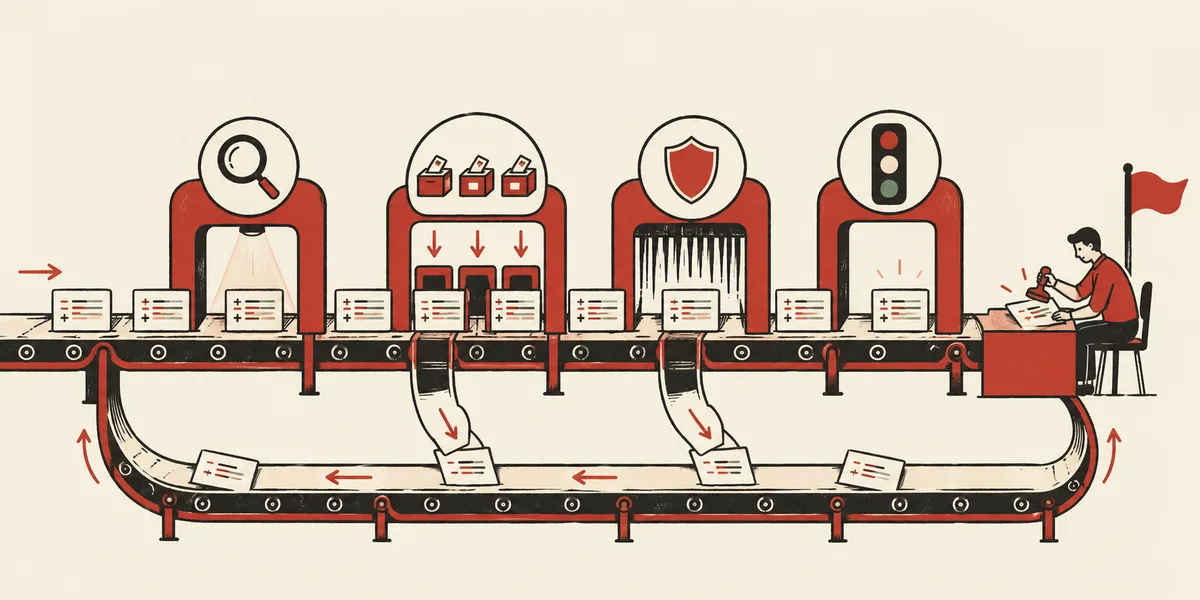
The brief
Code review used to ask one question: did a human read the code? Anthropic’s post swaps it for a better one: what could go wrong with this change, and which check, automated or human, is the right one to catch it? Review stops being a gate at the end of the road and runs continuously, like spellcheck while you write.
The volume forced the question. Anthropic’s monorepo went from about 2,500 merged changes a day in May 2026 to over 30,000 in September. The Claude Code repos feel the same pressure: merged pull requests (PRs) more than doubled from June to September, while the share reverted fell by more than 40 percent.
Review stopped asking whether a person read the code, and started asking which check catches what can go wrong.
The sentence to remember: when the author never tires, review is not a reading job; it is an attention budget, and every layer exists to spend it where the risk is. What follows is the stack Anthropic built to spend it, layer by layer, with their numbers marked as theirs.
Figure 1: the life of a change
One change, from an engineer’s laptop (or a Claude session in Slack) to users, through all seven layers. Most of the path is automated; a person’s attention lands where the risk is.
The work is verified before anyone else looks
The author gives Claude something it can run: tests, a build, a screenshot to compare against the design. Claude has to show the output, not say it is done. Then a subagent reviews the diff with fresh context.
Most changes reach the PR already reviewed once. Boris Cherny, who created Claude Code, calls the verification loop worth 2 to 3 times the quality.AI review on every pull request
Every PR gets a Claude review before a person looks. Several agents hunt bugs in parallel; a separate group votes on each finding, and only findings enough agents agree are real get posted, tagged Important, Nit, or Pre-existing.
After the research preview launched, internal PRs getting substantive review comments rose from 16% to 54%.Security review that can block
Security gets its own automated review. On Anthropic’s repos a PR cannot merge while a finding from the bug review or the security review is still open: fix it, or close the thread with a short reason.
The same setup ships publicly as the /security-review command and an open-source GitHub Action.Automated checks that block
The usual machinery, at unusual volume: lint, type checks, tests on every platform, and a build. The PR template asks how the change was tested and how to undo it. Claude can draft both answers; the person who asked for the change signs off on them.
A typical Claude Code CLI pull request runs dozens of checks before anyone looks at it.Human approval, scaled by risk
A classifier reads the change and sets its tier: low needs no person once automated checks are green, medium needs one, high needs two. An agent’s approval never fills a human slot, and whoever prompted the change counts as one of its reviewers.
The goal: most PRs merge with at most one human in the loop, and that human can be the author.Merge queue, flags, gradual release
The merge queue re-runs every check against main with the change applied, so two PRs that pass separately cannot combine into a broken main. New behavior ships behind a flag to Anthropic employees first, then to the latest channel; the stable channel trails it.
Internal use is a test stage: the team’s own heavy usage surfaces regressions before users do.Fast detection, fast rollback
Some mistakes still get through, so the last layer is speed of recovery: flags turn off without a deploy, a weekly on-call watches, and incident reviews ask which layer should have caught the issue.
Automatic circuit breakers that tighten approval when the dashboards move do not exist yet; the team’s engineers want them.Tap the card, swipe, or use the arrows.
How it works
Each layer catches some problems and misses others; few get through all of them, and rollback handles the rest.
Figure 2: the attention math
Why the old model broke, in arithmetic anyone can check. Anthropic’s monorepo merged about 2,500 changes a day in May 2026 and over 30,000 a day that September. Suppose a human gave every change a real read. Drag the two numbers and watch what the reading alone would cost.
Illustrative arithmetic on Anthropic’s published monorepo volumes; a merged change is not the same thing as a PR, and most changes are small. The point is the shape: volume rose twelvefold in four months, and reading time scales linearly with volume.
Figure 3: which changes still need a person?
The human slot is set by the change, not by habit. A classifier reads each change and picks its risk tier; a second classifier can still pull in another person when the tier says none is needed. Pick a change and see what Anthropic’s rules ask for.
Tiers and examples are the post’s. Two rules hold for every row: an agent’s approval never counts as a person’s, and an approval covers one specific commit; push a commit the system cannot vouch for and the approval has to be given again.
Worked example: one change through the stack
An illustrative trace. The change and the finding counts are invented; every rule it follows is from Anthropic’s post. The change is a tweak to Claude Code’s auto-updater, a sensitive area, so it can never skip the human slot entirely.
Step through, or swipe.
Timeline
Review as a staffed ritual
Michael Fagan at IBM formalizes design and code inspections: scheduled meetings, checklists, roles. Rigorous, expensive, and impossible to run on every change once volume grows.
The ancestor of everything on this page, described in Sadowski et al.’s 2018 history of modern review.Microsoft finds review’s second job
Alberto Bacchelli and Christian Bird study review at Microsoft and find developers value it as much for knowledge transfer, team awareness, and gatekeeping as for catching defects. Reading the diff teaches the codebase.
That second job is what an automated stack has to replace, not just the bug hunt.Google, at 9 million reviews
Caitlin Sadowski and co-authors publish the case study of modern code review at Google: lightweight, tool-based, and still prized by engineers for education and shared ownership, not only defect rates.
The baseline Anthropic’s redesign has to beat: review as a social technology, not a filter.Cherny’s rule: verify your own work
Boris Cherny, Claude Code’s creator, posts his workflow and says giving Claude a way to verify its work is probably the most important thing a user can do. The feedback loop, he says, makes the final result 2 to 3 times better.
Layer 1 of the stack starts as one engineer’s habit, ten months before the team post.curl ends its bug bounty
Daniel Stenberg ends curl’s bug bounty after AI-generated reports flood it: the share of reports that were real vulnerabilities fell from over 15 percent to under 5 percent during 2025. Unverified machine findings, unpaid in attention, become a denial-of-service attack on maintainers.
The counterweight: machines that produce findings owe the humans a filter first.Code Review launches in research preview
Anthropic productizes the internal system: parallel agents find, verify, and rank issues on every PR. Internal substantive comments had already jumped from 16 to 54 percent of PRs. The announcement is explicit: it will not approve PRs; that is still a human call.
Preview pricing: 15 to 25 dollars per review, billed by tokens. Average review: about 20 minutes.Volume breaks the old model
Anthropic’s monorepo goes from about 2,500 merged changes a day to over 30,000, a twelvefold rise in four months, reported in the team’s October post on redesigning source control. Human-everything review stops being a policy choice and becomes an arithmetic impossibility.
Figure 2 above runs this arithmetic: at ten minutes a change, September needs about 625 full-time readers.The team publishes the playbook
The Claude Code team writes up the full stack: verification before the PR, voted AI review, blocking security and CI, risk-tiered human approval, merge queue, flags, and incidents recycled into evals. The same week, Code Review reaches general availability on Team and Enterprise plans.
And the internal line moves past the product’s: some low-risk changes now merge with no human approval at all.Tap the card, swipe, or use the arrows.
Key voices
The disagreement is not whether machines should review; it is who pays attention to machine findings, and what reading code was for.
Where leaders think this goes
Positions as of October 2026. Every camp names its people.
Where they agree
Where they split
Takeaways
Anthropic did not delete review; they disassembled it. Verification moved before the PR, agents took the first read and voted on their own findings, and humans kept the slots where judgment lives: direction, risky code, architecture, and accountability. The result they report is more merges with fewer reverts per change. The transferable lesson is not the tooling. It is the accounting: count human minutes, guard the revert rate, and let evidence set how much review a change earns.
- Attention is the budget. Human minutes are the one input that does not scale; a review system is an allocation policy for them.
- Verify before the PR. A runnable check handed to the author beats any amount of downstream reading; it is worth 2 to 3 times the quality.
- Agents review, then vote. Unfiltered machine findings tax the humans they were meant to help; the filter is what makes the reviewer usable.
- Risk sets the humans. Zero, one, or two approvals, chosen by what the change touches, with a person always on the paths that can hurt people.
- Incidents become evals. Every escape is scored against the layer that missed it, and the reviewer is retrained on the failure set daily.
Keep exploring
Sources
The internal figures on this page (the 90 percent share, the PR doubling, the revert drop, the 59 percent blame result, the 50-round night) are Anthropic’s own reports from the team post; no outside party can audit their repositories, so the page attributes them wherever they appear. Curl’s October 2026 sequel (24 CVE fixes in release 8.23.0, 20 credited to AI-assisted research that humans verified first) comes from release coverage, and is marked as reported, not primary, in the voices above.