Steer by Name
Agents drift. Yours rebuilds what already exists, bolts the new thing onto the side, and forgets the correction you made an hour ago. Lauren Tan, the engineer behind pstack, a plugin of skills for coding agents, fights the drift with 24 short rules. Each principle lives in its own file, most of them 10 to 20 lines, and she steers the agent by naming the rule instead of retyping a paragraph. On October 14, 2026, she posted that this smallest layer of the stack is its most durable part. Here is the list opened up: all 24 with their real sizes, the bug behind the most famous one, and the evidence on whether written rules change agent behavior at all.
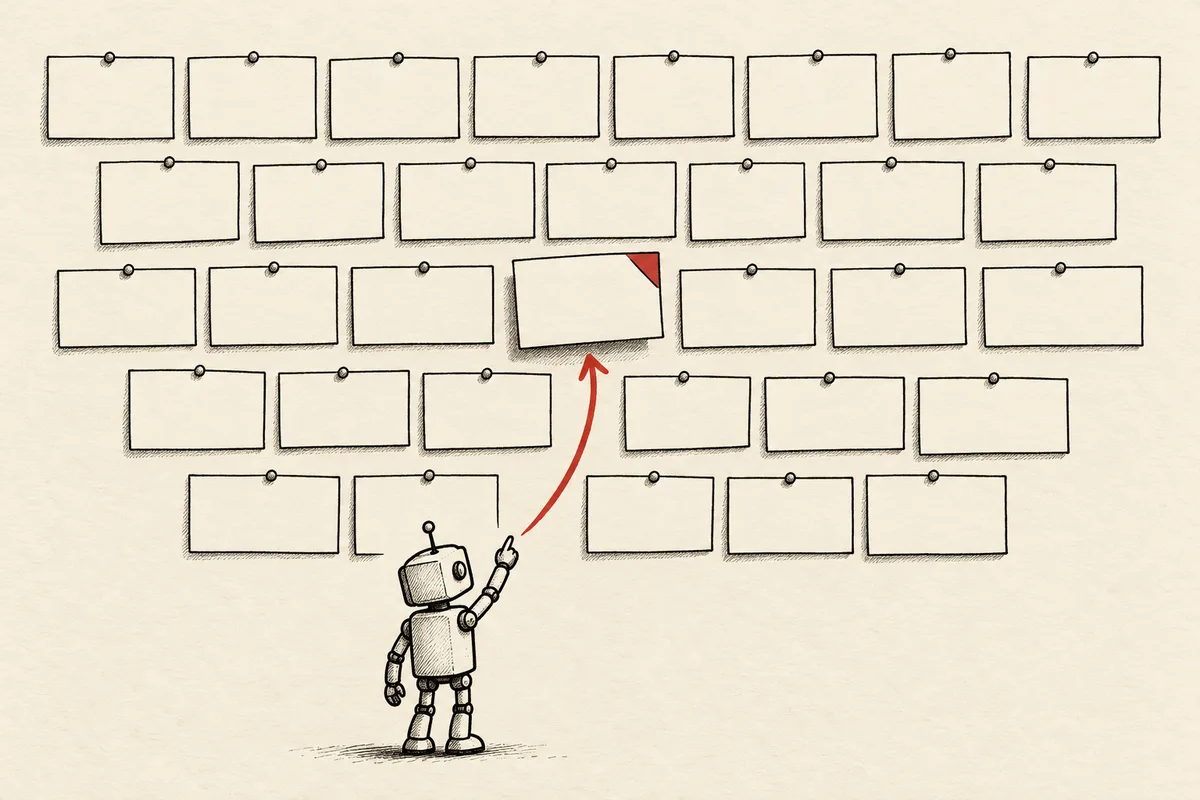
The brief
pstack is Tan’s engineering stack for coding agents, open sourced as a plugin: dozens of skills, playbooks, and one orchestrator, /poteto-mode, that routes each task. Underneath sit the principles, each a single short file holding one complete rule. /poteto-mode keeps a one-line index of all 24, reads the full file when a task triggers one, and then owes a debt: its reply must name each principle that shaped a decision, and the choice it changed. The sentence to remember: write the rule once, in full, in a file small enough to read whole; then steer with its name, and make the agent name the decision the rule changed.
Figure 1: the index, measured
All 24, with each rule file’s real length counted from the repository on October 14, 2026. Tan claimed “about 10 to 20 lines each”; the count mostly agrees, with one honest outlier. Filter by shelf, tap one to read it.
Line counts measured with wc on the repository files, October 14, 2026. Summaries are paraphrases; the full text of each rule lives in its file, linked from Sources. The guide she linked counts 24 principles; an older pstack README listed 20, so the wall grows as new corrections earn names.
How it works
Figure 2: the steering lab
Tan’s guide gives three moments where a human reaches for a principle. Each tab shows the same correction twice: as a paragraph of instructions, and as the name she actually types. The counts come live from the text on screen.
Figure 3: one night on Bend2
The origin of Attack the Premise. In September 2026, Victor Taelin set two frontier models, Fable 5.1 and GPT 6, on an overnight bug in Bend2, his programming language’s runtime, under two rules: do not grow the codebase, do not regress any benchmark. Both failed. The numbers are as he reported them. Tap through it.
Taelin’s diagnosis: the gap was not “can it do the work” but “does it question the frame it is working in”. Once a human pointed at the frame, both models did everything else: the diagnosis, the census, the fix. Attack the Premise bottles that pointing. When fixes keep failing, census which actors hold the imbalance, then question the premise the failed attempts shared.
Timeline
Tap the card, swipe, or use the arrows.
Key voices
Where leaders think this goes
Positions as of October 2026, each attributed to its source.
Where they agree
Where they split
Takeaways
The principles work, when they work, because Tan engineered them like code: small, named, versioned, deleted when they stop paying. The evidence says written rules are neither magic nor placebo: specific, decision-shaped rules measurably help, vague volume measurably hurts. Her contribution is a discipline for staying specific, plus the nerve to keep deleting.
- A name is a compression format. One phrase points at a complete rule the agent has already read, so steering by name beats retyping the paragraph, and the name cannot quietly drift.
- The citation duty is the enforcement. Requiring the agent to name the decision each principle changed makes name-dropping visible in the reply itself.
- Size is a feature, measured. 24 files, 455 lines, median 18.5: the whole index fits in one view, and each rule fits in one read.
- The rules come from corrections. Every principle on the list is a failure somebody already paid for, in Tan’s own sessions or in a public postmortem like the Bend2 night.
- Deletion is the roadmap. Skills compress into principles, principles graduate into checks and scripts, and whatever the model no longer needs gets removed.
Keep exploring
Sources
Built from the pstack repository and guide (cursor/plugins on GitHub) and the posts and studies above, all read firsthand in October 2026. Figure 1’s summaries are paraphrases written for this page; the names are Tan’s, and each rule’s full text lives in its own file. Counts differ across her snapshots: an older README listed 20, a community port says 23, the guide and repository tree say 24; this page follows the guide and the tree. Line counts were measured October 14, 2026. The Bend2 figures are Taelin’s, as reported; the model Fable wrote the underlying account, as his post discloses, and nobody has independently measured the incident. The two studies measure AGENTS.md files in general, not these principles; no controlled study measures the 24 directly, and the camps above are graded with that gap in view.