Move Like a Thing
On October 13, 2026, a developer named diip3sh released feel, a skill for Claude Code that builds user interface (UI) motion out of physics. You describe how a thing should move in plain words, “heavy”, “magnetic”, “thrown”, and the agent builds the component on a simulated body: a mass on a spring, with damping, inside force fields. There are no hand-picked durations and no easing curves anywhere in it, and an audit script fails the build if one sneaks in. This primer rebuilds the physics live, so you can throw the spring around yourself.
The brief
Almost every animation on the web is a recording: someone picked a duration (300 milliseconds is the classic) and an easing curve, and the browser replays that exact path no matter what. If the user interrupts it, taps again mid-flight, or flicks instead of tapping, the recording cannot adapt, because it never knew why it was moving. A spring is the opposite: not a recording but a rule. Give a body a position, a velocity, a target, and three numbers (mass, stiffness, damping) and the motion computes itself, interruptions included. The sentence to remember: a duration is a guess about the future; a spring is a rule that keeps working when the future changes. The feel skill pushes this to its logical end: the words a designer already uses (“heavy”, “snappy”, “bouncy”) become entries in a table of physical parameters, and software agents are forbidden from reaching for the old recording tools at all.
Figure 1: the spring lab
One body, one spring, the same solver design the feel runtime uses (the exact solution, integrated in small steps). Pick a word to load its real parameters from the feel vocabulary, drag the puck, or send it across. While you hold it, the spring pulls it toward your finger, so heavy bodies lag. Let go mid-swing and the release decision comes from where the body would coast, not from where it is.
The plot is the step response for the current numbers: the same body, starting at rest, sent from 0 to 100, with the ±2 percent settle band shaded. The readouts are computed from the parameters, not typed in: stiffness and damping come from the conversion formulas below, overshoot from the underdamped formula, and settle time is measured by simulating the response and finding the last moment it leaves the band, the same definition the feel vocabulary uses.
The one equation
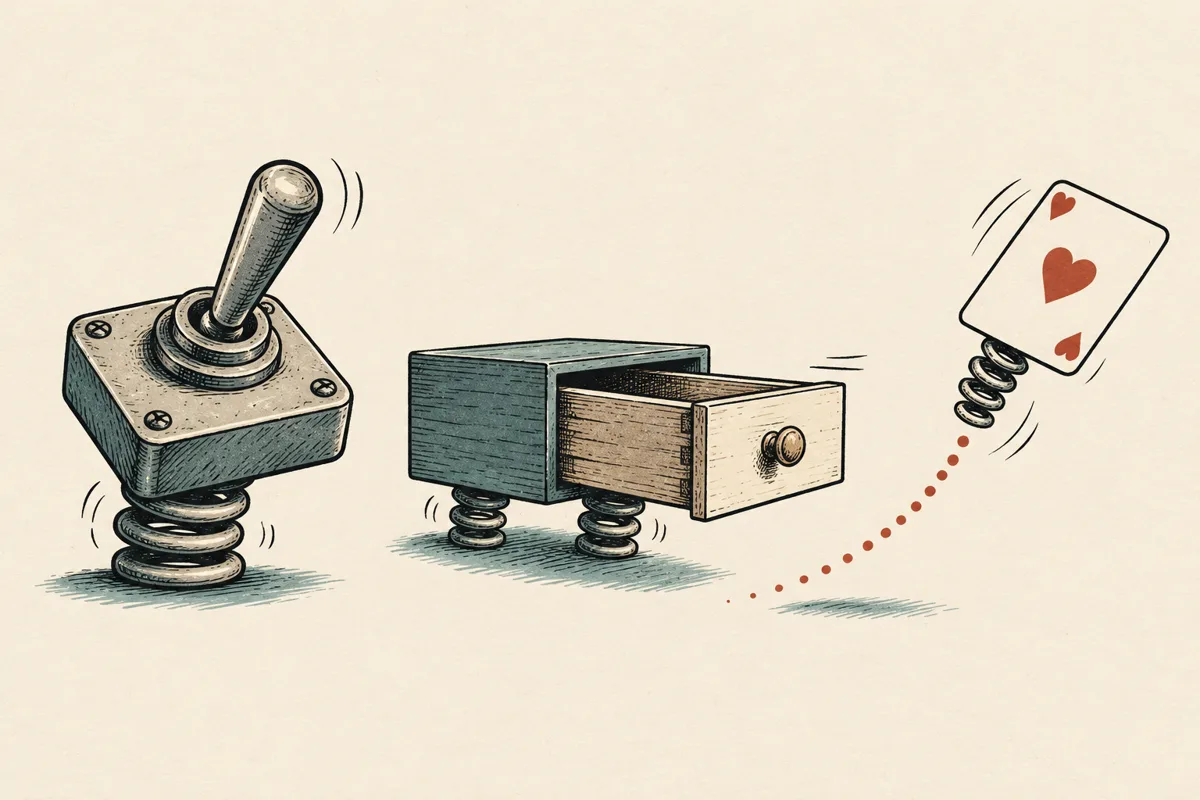
Every model in the feel runtime (the toggle, the magnetic drawer, the thrown card, the detented knob) obeys a single equation. In words first: the spring pulls the body toward its target with a force proportional to the distance, friction-like damping resists the velocity, and any extra forces (magnets, friction, gravity, your finger) add on top. Then the real thing:
Designers rarely set k and c directly. The feel vocabulary stores each word as a mass, a natural frequency f in hertz (cycles per second), and a damping ratio ζ (zeta), because those three map to how a motion reads: frequency is how urgently it gets there, ζ is how it arrives, mass is how it answers a push. The conversion is exact:
And when ζ is below 1, the spring overshoots its target by a fraction set entirely by ζ:
Check the vocabulary against the formulas: “heavy” is mass 3, 1.35 hertz, ζ 0.74. The formulas give stiffness 215.8 and damping 37.66, and an overshoot of 3.2 percent, exactly the numbers in feel’s own table. Nothing in that table is vibes; every word is three numbers and the arithmetic closes.
How it works
Figure 2: words in, numbers out
The worked example, end to end. Ask feel for something “heavy, snappy” and this is the arithmetic it runs. Tap through it.
Figure 3: change your mind halfway
The argument for springs, staged. All three lanes start the same move, from 0 to 100. Halfway through the curve’s run, the target jumps back to the start, the way a user changes their mind mid-animation. The curve lane has to start a brand-new recording from wherever it happens to be, with no memory of its speed, so its path kinks. The springs just get a new target: position and velocity carry over, and the path bends smoothly. Run it both ways.
With retargeting off, all three arrive. The curve is fastest and flattest; the damped spring glides; the bouncy spring overshoots to about 127 before settling, which is the point of it.
Timeline
Tap the card, swipe, or use the arrows.
Key voices
Where leaders think this goes
Positions as of October 2026, each attributed to its source.
Where they agree
Where they split
Takeaways
Motion built from physics survives contact with the user, because it never assumed how the interaction would end. A spring takes three honest numbers, keeps velocity through every interruption, and lets settle time be whatever the physics says. The industry is converging there from both ends: platforms keep re-parameterizing springs to hide the math, and agent tooling like feel now generates the physics directly from the words designers already say.
- Recordings vs rules. A duration plus an easing curve replays one fixed path; a spring recomputes its path every frame from position, velocity, and target, so interruptions bend it instead of breaking it.
- Three numbers carry the feel. Mass, natural frequency, and damping ratio determine stiffness, damping, overshoot, and settle time exactly, which is how a word like “heavy” (mass 3, 1.35 hertz, ζ 0.74) becomes stiffness 215.8 with a 3.2 percent overshoot.
- Releases are decided by coasting. Project where the body would stop (position plus velocity times mass over damping) and snap to the nearest resting place; that one rule is most of what makes gestures feel smart.
- The platforms already moved. Apple teaches springs over timed animations since 2018, and Material Design’s 2025 Expressive update replaced its easing-and-duration system with spring physics while keeping the tokens.
- Restraint is part of the craft. The strongest critics of sloppy animation are not anti-physics; they argue frequent, keyboard-driven actions should barely move at all, and that reduced-motion settings replace travel with fades.
Keep exploring
Sources
Built from the feel repository and documentation (MIT licensed) and the platform sources listed above. The spring lab and race on this page are independent implementations of the same equations, integrated with a Runge-Kutta 4 solver at 240 steps per second; the lab’s settle times are measured from that simulation using feel’s ±2 percent band definition, and can differ a few percent from feel’s published table, which comes from its own solver. Library default parameters (Motion, react-spring, Compose) are quoted from each project’s documentation and source as of October 2026. SwiftUI’s preset spring numerics are not published by Apple and are not quoted here; the 1981 Disney book details rest on secondary sourcing and are presented as the field’s conventional history.