One Line In, a Machine Out
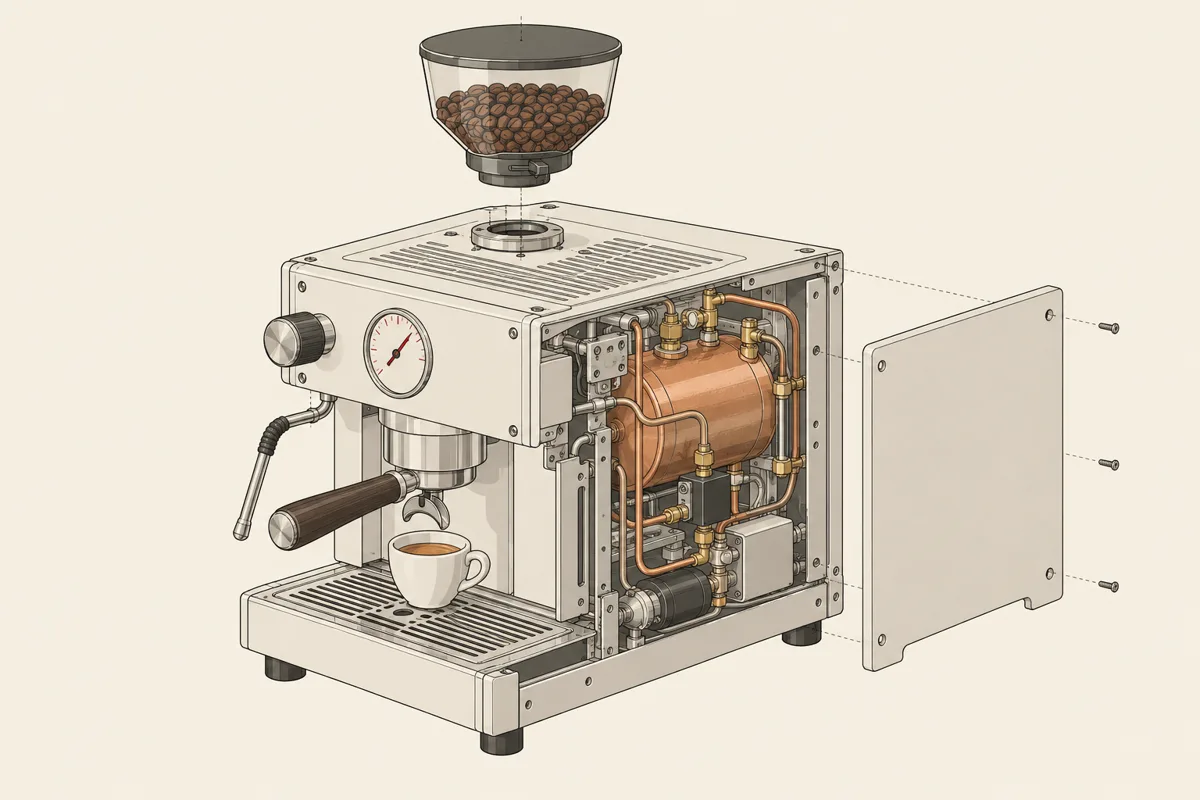
On October 15, 2026, design engineer Ann Nguyen posted a ten second video: an espresso machine drawn as a technical plate, rotated, zoomed part by part, then taken apart into 82 pieces, all of it generated. Her skill turns figures from Anatomy, an open source agent skill by Ryan (@wheresryan22), into reveal style motion videos; the video itself was made by Claude Opus using it. Anatomy does the stranger half: describe a machine in one line, and an agent invents it, builds it as an interactive isometric figure, and prints numbers computed from the same model that draws it.
This primer recreates her video live: the machine in Figure 1 is a real isometric model running in this page. Rotate it, brew with it, take it apart.
The brief
A skill, in Anthropic’s Agent Skills format, launched in October 2025 and opened as a standard that December, is a folder an agent carries: instructions, scripts, and reference material, loaded only when a task matches. Anatomy is one such folder; its instructions impose a discipline most generated graphics never face.
The agent must collect the true numbers first, invent an object that could honestly carry them, write a parts list, build the geometry once from that list, and verify the result like a critic, from screenshots.
The drawing and the numbers come from the same model, so a figure cannot say one thing and show another.
Ann’s reveal skill is not public: no repository can be found, and the tour below is reconstructed from the video’s frames.
The plate’s numbers are the model’s, not a product’s. Some of its readouts are genuine espresso standards and some are figures the generating model authored; the audit below checks each one.
Figure 1: the reveal, recreated
Nothing here is a recording: every face is projected from a 3D model at the angle you leave it in.
The original video tours its machine in seven beats: the whole machine, the grinder, the pressure gauge, the steam knob, the portafilter, an exploded view, and a hero shot with the dimensions. The recreation follows the same seven beats with the same captions.
What differs, stated plainly: this recreation models fewer parts than the video’s claimed 82, its own count printed under the plate, and the shaded materials are rendered in Anatomy’s flat four tone style, and there is no shader layer, because the espresso figure has no fluid or plume effect.
How it works
Collect the specs, design a machine to carry them, build once from a parts list, then audit the screenshot.
Figure 2: one corner, by hand
The tilt is fixed by geometry: sine one over root three, and the three axes land 120 degrees apart.
Anatomy figures are isometric: no perspective shrinkage, all three axes foreshortened equally, and the printed dimensions stay honest along each axis. The camera walks around the machine to a chosen yaw, then tilts down by a fixed angle and flattens the scene:
Then the tilt and the flattening, at the angle whose sine is one over the square root of three, about 35.264 degrees:
The worked substitution, the top front corner at the hero angle: The machine is 380 wide, 415 deep, 470 tall, so the corner is (190, 207.5, 470); the hero yaw is 45 degrees, where sine and cosine are both 0.7071:
Audit the plate
Two of the six are genuine standards, and the rest split between plausible and authored by the model.
Of its six readouts, two are genuine standards (9 bar extraction; the 58 mm portafilter), one names a real category (dual boiler, built-in grinder), one is plausible but unverified (the 250 g hopper; real ones run 250 to 340 g), and two are the model’s own: the 380 × 415 × 470 mm dimensions and the 82 parts in 44 assemblies, computed from its parts list: true of the drawing, of no product. The closest real machine, the Breville Oracle Dual Boiler, measures 374 × 387 × 455 mm.
Key voices
The creator’s case, and the test that complicates it.
Where leaders think this goes
A figure is only as honest as its model.
Positions as of October 2026, each attributed.
Where they agree
Where they split
Takeaways
Every printed number is computed from the same parts list that draws the figure.
Anatomy’s real invention is not the drawing but the discipline: collect true numbers first, build one parts list, compute every figure from the same model, then audit screenshots like a critic. Ann Nguyen’s video shows where that leads: a second skill treating the first skill’s figures as raw material for film. The caveat travels with the craft: the skill amplifies its model.
- True numbers first. The workflow collects real specifications, then invents an object that can honestly carry them; the audit shows the seam: 9 bar and 58 mm are standards, the dimensions are the model’s own.
- The audit is the product. The agent screenshots its own figure, crops close ups, and runs geometric checks for interpenetration and unseated mounts.
- Skills compose. Ann Nguyen’s reveal videos are a second skill consuming the first skill’s output, the pattern the Agent Skills format was designed to spread.
- The model still matters. Ishank’s test: the identical skill on a 1.7 billion parameter local model passes its checks over a 738 byte, essentially empty figure.
Keep exploring
Sources
Built from Ann Nguyen’s post and video (inspected frame by frame), the Anatomy repository and its skill files, and the other coverage, all read firsthand in October 2026. The recreation in Figure 1 is an independent implementation of the same isometric mathematics, written for this page, not Anatomy’s code; Ann’s skill is unpublished. Repository statistics are from the GitHub API on October 15, 2026, and will have moved since. The Breville Oracle Dual Boiler figures in the audit are from the retailer specification table listed in the sources.