Why models go stale
Ask a model about an event from last month and it may answer fluently, confidently, and from before the event happened. That is the knowledge cutoff: the date training data stopped being collected. But the cutoff is not one wall, it is three clocks. A model's weights refresh only when someone pays for a training run; a retrieval index can be rebuilt tonight without touching the model; a search tool fetches the world in seconds, per query, forever billed by the query. Freshness is a system property, not a model property, and almost everything interesting about it, including why new model versions are new training runs rather than patches, follows from which clock a fact lives on.
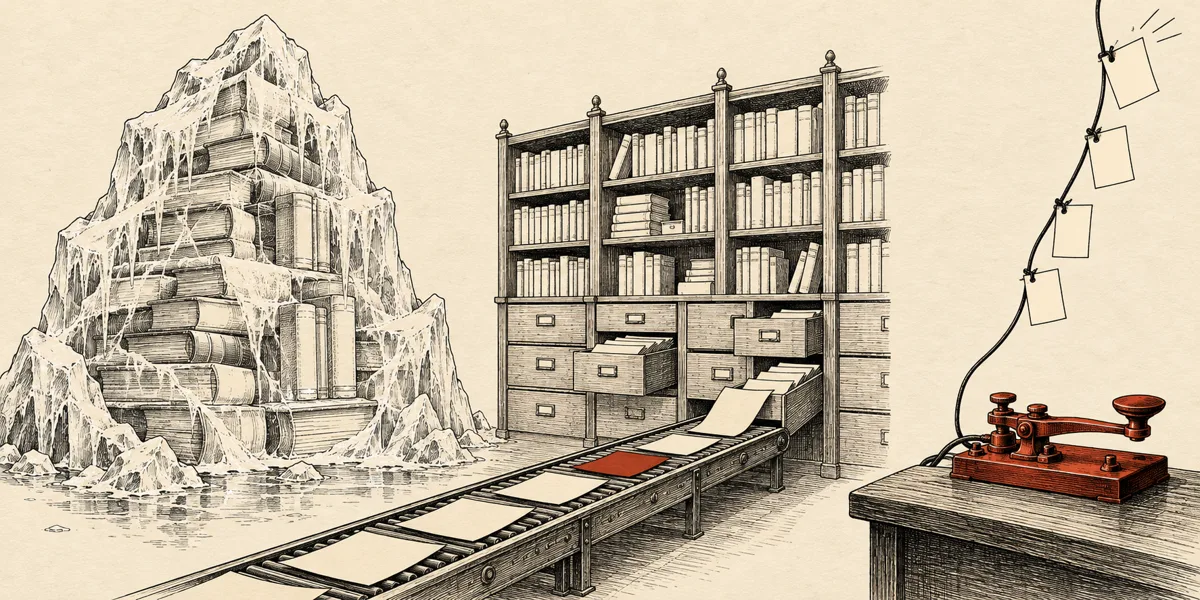
A cutoff is a freeze on data collection, not a wall inside the model, and freshness lives on three clocks: weights update per training run (months), indexes update per rebuild (hours), search updates per query (seconds); a fact is only as current as the clock it rides on.
Researched October 2026. Cutoff dates are as officially published by each lab for the named model versions; where a lab's own documents give two dates, both are shown.
How it works
The three clocks, what an update costs on each, and the cutoff dates the labs actually publish, fine print included.
Four ways newer knowledge reaches an answer, ordered by how fast each can change. Step through them: the trade at every layer is the same, speed bought with either money up front or money per query.
Tap the arrows to step through
One lab published its full bill. DeepSeek-V3's technical report accounts for 2.788 million H800 GPU-hours at $2 per hour, $5.576 million all-in, and the split is the whole economics of freshness in one table. Step through where the money sits.
Tap the arrows to step through
Pick a model. The dates are the labs' own published figures for those versions, and the last entry is the instructive one: a single lab publishing two different dates for the same models.
The road here
Landmarks only: from the RAG paper to search as the default posture.
Tap the arrows to step through
Key voices
The researchers who framed the split, measured it, and published the bills.
The founding framing: a model holds knowledge two ways, in its weights (parametric memory) and in an external index it can look up (non-parametric memory). Their own caveat became the retrieve-it camp's charter: for purely parametric models, provenance is murky and updating world knowledge is an unsolved problem. The index, by contrast, can simply be replaced.
The strongest form of the retrieval bet: with a 2-trillion-token database to consult, their model matched far larger purely parametric models with 25 times fewer parameters. The implication they drew: some of what we expensively train into weights could live outside the model permanently, where it stays editable.
The measurement the field needed: 600 questions sorted by how fast their answers change, over 50,000 human judgments. Every model tested struggled on fast-changing questions and on questions with false premises, and search augmentation (their FreshPrompt method) lifted accuracy substantially where weights alone could not. Their opening premise is worth quoting in spirit: most models are trained once and never updated.
The recipe that made continued training respectable: re-warm and re-decay the learning rate, and replay about 5 percent of the original data distribution alongside the new data; in their reported shifts, that removed most of the catastrophic forgetting. Their work is why "just train it a bit more" is now an engineering option with a known price, not a gamble.
The accountants. By publishing the full ledger (14.8 trillion tokens of pretraining at $5.328M, context extension at $238K, post-training at $10K), they gave the whole field the ratio that organizes Figure 2: everything after the pretrain is rounding error, which is precisely why the pretrain is where the cutoff gets set.
The transparency camp: their reports name mid-training as a formal stage (the Dolmino mixes; OLMo 3's mid-training set is 100 billion tokens of curated late-stage data) and publish the recipes open labs can copy. Where closed labs leave the between-versions question to inference, OLMo documents one honest version of it.
The surgeons: ROME located a single factual association in a single layer's weights and rewrote it; MEMIT scaled the trick to thousands of associations across layers. Their own framing is careful: these are instruments for studying and patching models. The production world has produced no evidence of adopting them as a freshness pipeline, a gap this primer's callout is about.
The most instructive voice is a discrepancy: Anthropic's comparison table lists Claude 4's training-data cutoff as March 2025, while the Claude 4 system prompt describes its reliable knowledge cutoff as the end of January 2025. Both are official. The gap between those two dates is the difference between "data the model saw some of" and "knowledge you can lean on," and every lab has one, whether or not they publish both numbers.
Where the field agrees
The open record is unambiguous: Llama 3 jumped to about 15 trillion tokens with a new 128K tokenizer, Qwen2.5 scaled from 7 to 18 trillion tokens, DeepSeek-V3 ran 14.8 trillion. When the architecture, tokenizer, or data mix changes, and at least one changes nearly every major version, there is nothing sensible to patch onto: the new model is a new run, trained from scratch.
Production systems at every major lab combine all three clocks: periodic new runs, retrieval over maintained indexes, and model-decided search tools in the API. The 2023 framing of weights versus retrieval as competing philosophies has quietly become an architecture diagram with both boxes in it.
Where it splits
The context maximalists. Each long-context launch (million-token windows and beyond) revives the claim, typified by Yao Fu's "the 10M context kills RAG": if the corpus fits in the window, skip the retriever, stuff the context, and let attention do the work. Simpler system, no index to keep fresh.
The retrieval camp's rebuttal (Zilliz's response, vector-database practitioners, Hamel Husain's evals writing): the claim only ever described naive chunk-and-search RAG. Stuffing a million tokens costs on the order of a thousand times a retrieved query, cannot enforce permissions or provenance per source, and still freezes at whatever you stuffed. Agentic search, they argue, is RAG grown up, not RAG replaced.
The continual-learning optimists. With the re-warm, re-decay, and replay recipe published and cheap (about 5 percent replay over the update run), temporal refresh without a full retrain looks like an engineering discipline waiting for its tooling. Expect shipped models to get periodic knowledge refreshes the way software gets point releases.
The retraining pragmatists. So far, continued training in published reports does extensions, variants, and within-version stages, while flagships still start over whenever anything structural moves, which is often. Until a frontier lab documents a flagship refreshed in place, "routine continual updating" remains a prediction, not a practice.
Takeaways
So, why models go stale, in one paragraph: a model is a snapshot of the world as its training data described it, sealed when collection froze, and the published cutoff is the generous reading of that seal (the reliable date is earlier). Nothing inside the model ticks. Everything fresher than the seal arrives from outside it: from the next training run (months, millions), from a retrieval index someone maintains (hours, cheap), or from a search the system runs at question time (seconds, billed per query). New versions are new runs because versions change the things you cannot patch (data, tokenizer, architecture), while continued training handles the seams: longer context, new domains, late-stage annealing.
- Two dates, not one. The training cutoff (data seen, partially) and the reliable cutoff (knowledge you can lean on) differ by months in the one case a lab published both. When a model states its cutoff, it is usually quoting the generous one.
- Freshness has three clocks. Weights: per run. Retrieval index: per rebuild. Search: per query. A system's real freshness is set by which clock serves the question you asked, and products blend all three without telling you which answered.
- The bill explains the architecture. DeepSeek-V3 spent 95 percent of its $5.576M on the pretrain and about $10K on post-training. Capability is bought in the big run; freshness is bought afterwards, cheaply, in the layers around the model, because that is the only place it is cheap.
- Continued training is real but scoped. With learning-rate re-warming and about 5 percent replay, it extends context and refreshes domains without most forgetting. It is how variants and stages ship, not (yet) how flagships stay current.
- Surgical editing is an instrument, not a pipeline. ROME and MEMIT proved facts have addresses in the weights. No evidence shows a production lab keeping a model fresh that way; treat any "we edited the model to know X" claim accordingly.
- Check which layer answered. FreshQA's lesson generalizes: on fast-changing and false-premise questions, unaided models fail in characteristic ways, and retrieval is the measured fix. If the answer matters and the fact is young, ask for the source, not the model's memory.
Keep exploring
Sources
Every load-bearing number traces to one of these.