World Models vs Next-Token Prediction
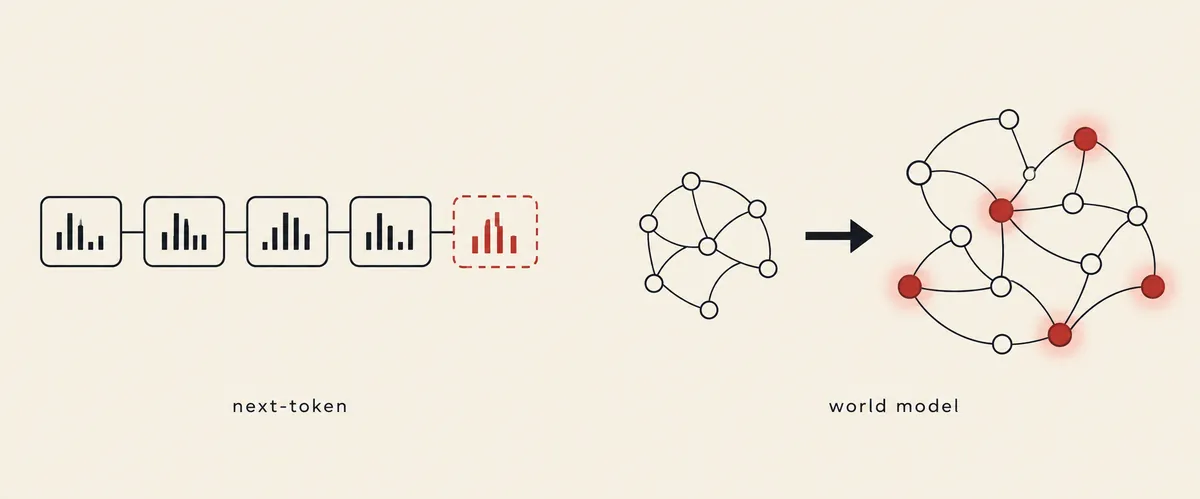
There are two stories about how machines get smart. The first says: teach a model to predict the next word at the scale of the whole internet, and understanding falls out. The second says: that is a detour. Language is a thin slice of the world, and a model trained to guess the next token mimics language about the world without learning how the world works. This is the sharpest architecture argument in AI, with a Turing Award winner's $1.03 billion startup on one side and the entire scaling industry on the other. The sentence to remember: both sides agree prediction is how models learn; they disagree about what the prediction should be of.
1. The brief
Yann LeCun, one of deep learning's three Turing laureates, spent years arguing that large language models are the wrong substrate for intelligence. In June 2022 he wrote the position paper that made the case formally: build world models, systems that learn how the world evolves and predict future states in an abstract internal representation, instead of predicting the next token. Then the industry kept scaling tokens, and kept winning benchmarks. Then LeCun left Meta in late 2025, raised $1.03 billion for AMI Labs in March 2026, and started saying the quiet part out loud: LLMs are "a detour" and will be "largely obsolete" within five years.
The other side has receipts of its own. A tiny model trained only to predict Othello moves quietly built an internal 8x8 board, which nobody taught it. That finding, hardened by a 2025 replication across seven model families, is the best evidence that next-token-style training induces world models on its own. So this primer covers both machines: what next-token prediction actually learns, what a world model is, the one architecture move (JEPA) that separates them, the Othello surprise, and where the disagreement is real and where it is theater.
2. How it works
Five ideas, then the fight itself. Tap each card for the plain-language version, one concrete example, and what changed recently.
The debate, one tap at a time
LeCun's claim, the field's best counter, his reply, the counter to that, then where they genuinely disagree. One tap per step, or use the arrow keys.
Every card in this stepper is sourced: the quote lines link out in the sources section below.
3. The landmarks
Thirteen moments that built the argument, June 2022 to September 2026. No stepper this time, just the record.
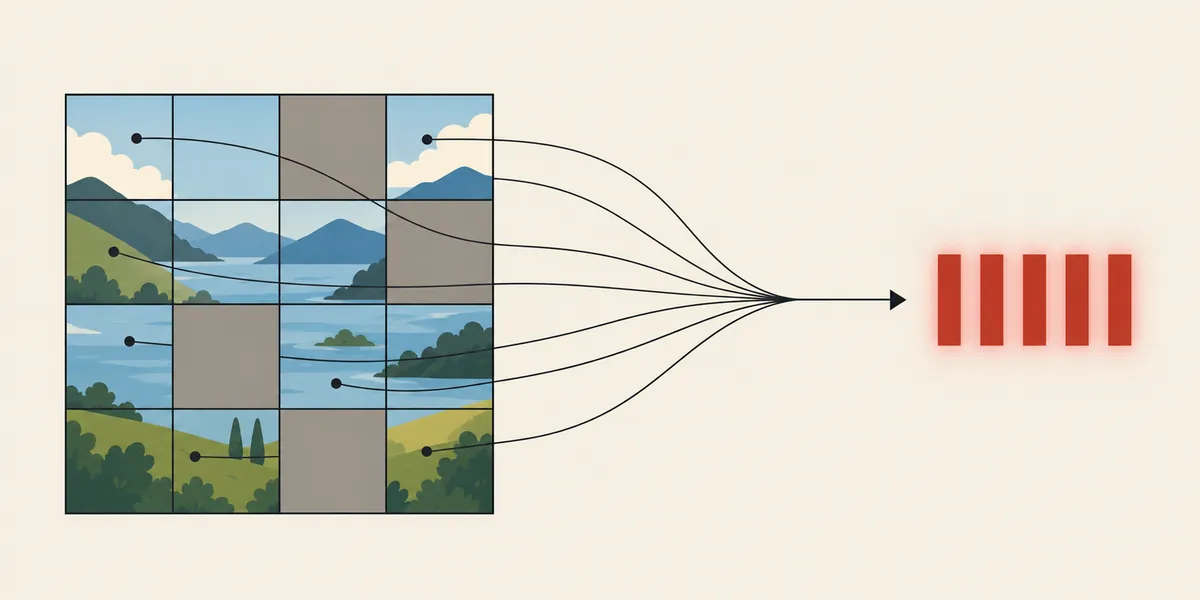
LeCun publishes "A Path Towards Autonomous Machine Intelligence" (OpenReview, v0.9.2): configurable predictive world models, behavior driven by intrinsic motivation, and hierarchical JEPA trained with self-supervised learning, predicting in representation space instead of reconstructing inputs.
Li et al., "Emergent World Representations" (arXiv:2210.13382): a GPT-style model trained only on Othello move transcripts develops a nonlinear internal representation of the board state, and intervention experiments show the representation controls the model's outputs.
"Self-Supervised Learning from Images with a Joint-Embedding Predictive Architecture" (arXiv:2301.08243): predicting the embeddings of masked image regions learns more semantic representations than pixel reconstruction, at matched compute.
V-JEPA (Bardes et al.): the same idea extended across time, masking spatio-temporal regions of video and predicting their embeddings, forcing the model to learn motion and interaction rather than static appearance.
Yuan and Sogaard "Revisiting the Othello World Model Hypothesis" (arXiv:2503.04421): across seven model families, from GPT-2 to Qwen2.5, every model induces the Othello board layout, up to 99% accuracy in unsupervised grounding.
At an NYU Center for Data Science seminar, LeCun declares auto-regressive LLMs "doomed": with per-token error e, the chance of a fully correct answer falls as (1 minus e) to the n, and he argues this exponential compounding is "not fixable (without a major redesign)."
VL-JEPA (arXiv:2512.10942): instead of generating tokens one by one, predict continuous embeddings of target text. In a controlled comparison with identical vision encoders and training data, it beats standard token-space VLM training with 50% fewer trainable parameters.
After about 12 years as chief AI scientist, he departs to co-found AMI Labs (Advanced Machine Intelligence Labs) in Paris, betting the company on world models built with JEPA.
In an MIT Technology Review profile, LeCun says the idea that scaling LLMs reaches human-level intelligence is "simply false." At an MIT symposium he adds that world models will be the dominant AI architecture within three to five years, and "nobody in their right mind" would use today's LLMs.
AMI Labs announces a $1.03B seed at a $3.5B pre-money valuation, co-led by Cathay Innovation, Greycroft, Hiro Capital, HV Capital, and Bezos Expeditions, with Nvidia, Toyota, Samsung, and Temasek backing: Europe's largest seed round, funding fundamental world-model research and open-sourcing the results.
On Bloomberg's "The Close," LeCun says "Large language models are not the path to real intelligence. They're a detour," and predicts LLMs will be "largely obsolete" within five years. He advises doctoral students not to make LLMs their focus.
Meta's JEPA scales to over one million hours of video; V-JEPA 2 hits 77.3 top-1 accuracy on Something-Something v2 and state of the art on human action anticipation. V-JEPA 2-AC, post-trained on less than 62 hours of robot video, plans zero-shot pick-and-place on real Franka arms in two labs, with no data from those environments and no task-specific training or reward.
AMD agrees to acquire Fei-Fei Li's World Labs for $8.2B, betting that spatial intelligence, models that generate, reconstruct, and simulate interactive 3D environments, is the next step after text.
4. Key voices
Six people who are building this, betting on it, or betting against it. The disagreement is real, and it runs in more than one direction.
5. Where leaders think this goes
Each item below is one leader's direction or vision for where AI goes over the next 5 to 10 years, stated as their view, not the author's conclusion. First, where the leaders converge, each view carrying the names that share it. Then, where they argue, as named camps. Every item is attributed: who said it, where, when. These views go stale; this section is frozen as of October 2026.
Where they agree
Where they split
Takeaways
LeCun's case against next-token prediction has sharpened from a 2022 position paper into a $1.03B company and a concrete architecture, while the counter-evidence is that token training already grows world models on its own. The two camps argue about the substrate, but they share the same proving ground: video, robots, and spatial intelligence.
- Predict the future, not the pixels. JEPA's core move is predicting a representation of the future in abstract space, rather than reconstructing pixels or generating tokens, then planning by simulating that future.
- Next-token training already grows world models. A GPT-style model trained only on Othello move transcripts developed an internal 8x8 board, recovered at 98.3% accuracy with causal interventions, and a 2025 replication found the same pattern across seven model families.
- LeCun's charge is the compounding error. With per-token error e, the chance of a fully correct answer falls as (1 minus e) to the n, exponentially with length, which he calls not fixable without a major redesign.
- JEPA is scaling into video and robots. V-JEPA 2 trained on over one million hours of video, and its action-conditioned variant planned zero-shot pick-and-place on real robot arms from under 62 hours of robot video.
- The money is voting for the physical world. AMI Labs raised $1.03B in March 2026, and AMD agreed to acquire World Labs for $8.2B in September 2026, the market's biggest bet so far on spatial intelligence.
- Timelines are the real fight. LeCun expects LLMs largely obsolete by about 2031; Altman expects an internal OpenAI system meeting OpenAI's AGI definition before the end of 2026; Karpathy puts reliable agents about a decade out.
Keep exploring
Sources
Every factual claim in sections 2 through 5 traces to one of these. Quotes are shortened with their meaning preserved.
Next-token prediction taught machines to talk. World models are the bet that talking was never the point. The winner gets to define what intelligence is made of.