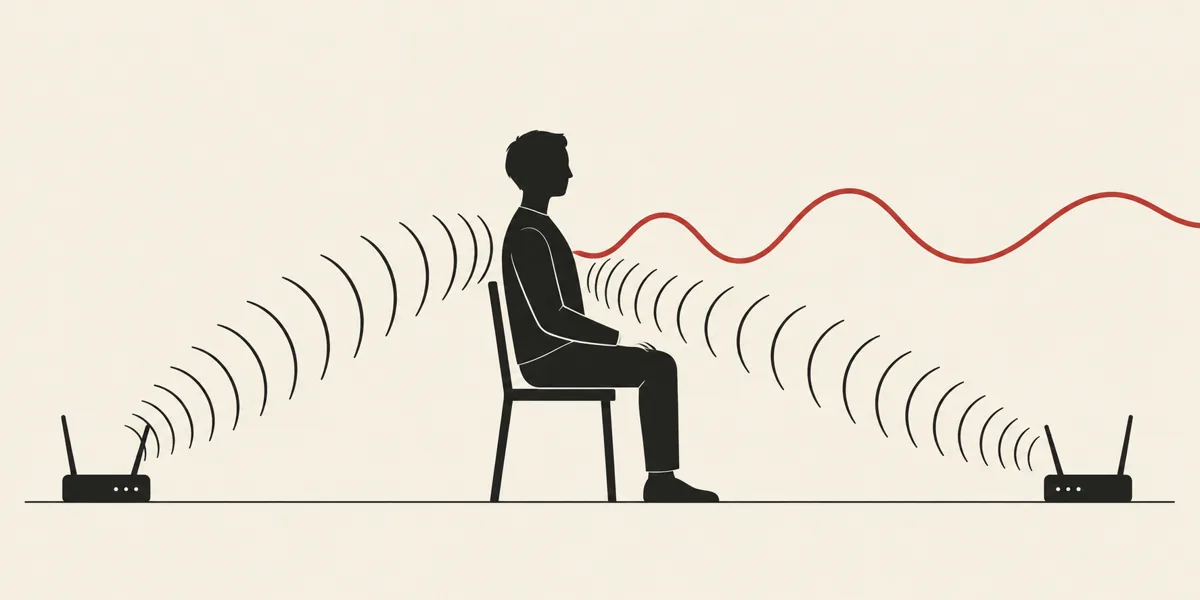
The builders have the accuracy numbers. The pushback is real too: one camp says the models break in new rooms, another says the whole capability is a privacy attack whether it works or not.
ard (@ardchain)
Engineer and researcher; the post and article behind this primer
His argument is that the radio waves already filling the room are a measurement instrument anyone can learn to read. His ESP32 CSI explorer loads a published recording so a reader can explore real CSI in a browser, and his planned two-board ESP32-C3 rig is the hobbyist on-ramp. He is upfront that the two-board setup was not yet bench-tested when he wrote it up.
The post His CSI explorer
Yunpeng Ge, He Wang, Ivan Wang-Hei Ho
Hong Kong Polytechnic University; WiRe-Breath, IEEE Journal of Biomedical and Health Informatics, October 2025
The team behind the recordings in the post's animation. Their claim is restraint as a feature: use only the beacons a router already sends, add no traffic, and respiratory rate still reads at 98.86 percent average accuracy in quiet rooms and 97.72 percent with interference, with apnea detection on top. They released 467 recordings with ground truth so others can check them.
The paper The dataset
Susanna Mosleh and Jason Coder
National Institute of Standards and Technology (NIST); BreatheSmart, IEEE Access, 2022
Their diagnosis of the field was thin data: most earlier work trained on very limited recordings. So they built an evaluation setup instead of a product, a breathing manikin in an anechoic chamber programmed with conditions from normal breathing to chronic obstructive pulmonary disease (COPD), and released the data publicly. BreatheSmart classified the manikin's patterns 99.54 percent of the time, under those controlled conditions, a caveat the primer keeps attached.
The NIST dataset
Dina Katabi
Massachusetts Institute of Technology (MIT); Emerald and Emerald Innovations
The deployment optimist. Her lab's radio box reads breathing, heart rate, sleep, and gait from reflections, and by 2018 Emerald devices had been installed in over 200 homes, including people with Parkinson's, Alzheimer's, depression, and pulmonary disease, with pharmaceutical studies running on the data. Her bet: passive radio monitoring replaces the wearable for long term health tracking.
MIT Technology Review, 2018
Aleksey Tataraidze and colleagues
Smartphone CSI sleep breathing, EMBC 2019
The modest end of the spectrum, and a useful calibration for the headline numbers. A phone's CSI tracked sleep breathing in 5 subjects with a mean correlation of 0.85 against a contact belt and a mean absolute rate difference of 0.39 breaths per epoch. Real people, small numbers, no chamber: the result is believable precisely because it is not 99 percent.
The preprint
Jihe Yan and colleagues
University of New South Wales; foundation models for Wi-Fi sensing, 2025
The generalization skeptics. Their position, stated plainly in their abstract, is that Wi-Fi sensing's practical utility has been fundamentally undermined by domain shift: models trained in one setup fail on new rooms, hardware, and people. Pretraining on 1.3 million samples from 14 datasets improved unseen-domain accuracy by only 2.2 to 15.7 percent. Their conclusion: data scale and diversity, not bigger models, are the bottleneck.
The paper
Julian Todt, Felix Morsbach, Thorsten Strufe
Karlsruhe Institute of Technology (KIT); BFId, ACM Conference on Computer and Communications Security, 2025
The privacy camp, and the sharpest disagreement in this primer. They showed that beamforming feedback information (BFI), the channel reports devices broadcast unencrypted so routers can aim their beams, identifies people by body and gait: 99.5 percent accuracy across 197 participants, no device on the person required. Todt's warning is that the technology "turns every router into a potential surveillance device", and their ask is concrete: build privacy protection into the 802.11bf sensing standard now, while it is still being implemented.
Coverage of the paper