How Voice AI Hears You
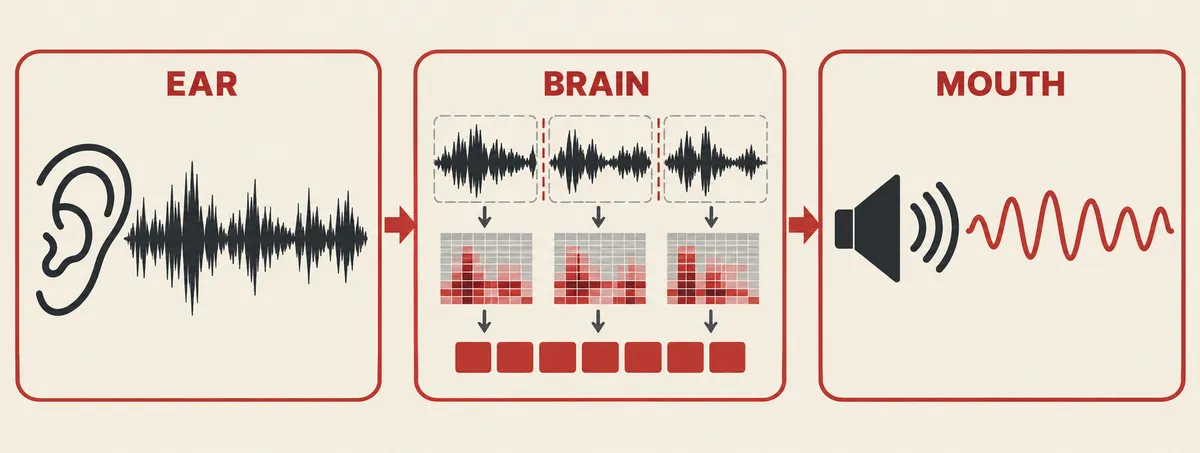
Every voice assistant runs the same relay: an ear turns sound into text, a brain turns text into an answer, and a mouth turns the answer back into sound. The ear is the hard part, because sound arrives as a messy pressure wave and meaning hides inside it. This primer walks the whole loop, from waveform to words and back, with the papers that built it and the researchers arguing about where it breaks.
1. The brief
Talk to any voice assistant and you are running a three-stage relay. First, speech recognition turns your voice into text. Whisper, the open model that reset the field in 2022, does it by chopping audio into 30-second chunks, converting each chunk into a picture of its frequencies, and having a Transformer write out the words one token at a time. Second, a language model reads the transcript and thinks, in pure text. Third, a speech synthesizer turns the reply back into a pressure wave your ears accept as a voice. The relay works surprisingly well now: Whisper makes about half the errors of the previous generation on messy real-world audio, and newer systems like Moshi skip the relay entirely, listening and talking at the same time with about 200 milliseconds of delay. But the ear still invents words when it hears silence, and the whole loop still strains on accents, noise, and interruptions. The sentence to remember: voice AI is translation twice over, sound into words and words back into sound, and every failure is a translation failure.
2. How it works
Six stops on the assembly line, from your mouth to the machine's and back. Step through the pipeline one tap at a time. Each canvas shows what the data actually looks like at that stage.
The stepper above is the half-duplex world. Here is what changed:
Walkie-talkie turn-taking. You talk, then silence: voice activity detection waits for your turn to end, then the cascade runs, speech to text, then the language model, then text to speech, and only then does it listen again. The gaps run one to three seconds.
A phone call. One model listens and talks at the same time, usually a single end-to-end audio model instead of three separate ones, so interruptions and backchannels like mm-hmm work. Gaps shrink to hundreds of milliseconds.
The cascade is the pipeline from section 2. Full duplex figures: Moshi at about 200ms (Kyutai, Sep 2024); the industry target is 200 to 500ms (Brief, May 2026).
Three questions the pipeline raises, answered. Tap each card.
3. The landmarks
Seven moments that built the voice loop, 2016 to 2026. Swipe sideways through them.
Swipe or scroll sideways.
4. Key voices
Four people who built the loop or are stress-testing it. The real action is at the bottom, where the first two collide.
The big disagreement
Same decoder, opposite verdicts. One switch, every tap flips. No picking sides, just the collision.
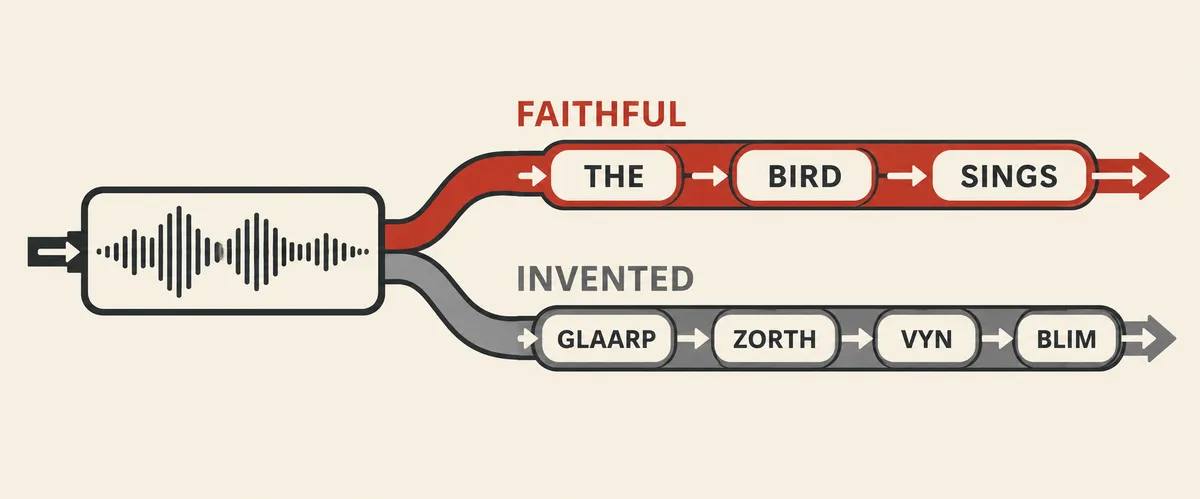
Whisper's decoder is half language model, and that is the point. Trained on 680,000 hours of messy web audio, the model's sense of what words come next cleans up bad acoustics: accents, noise, mumbling. Zero-shot, it makes 50% fewer errors than models fine-tuned on clean benchmarks. Robustness comes from breadth, not from cleaner labels.
Both cite the same architecture. Radford reads the decoder as a denoiser; Koenecke reads it as a confabulator. The field's open question is whether you can keep the cleanup without the invention.
5. Where leaders think this goes
Where the people building voice AI think this goes: their visions for the next 5-10 years, shown as named camps so you can see who is on which side. These are their views, not conclusions, and predictions go stale; this section is frozen as of October 2026.
Where they agree
Where they split
Takeaways
Voice AI is a three-stage relay: an ear turns sound into text, a brain turns text into an answer, and a mouth turns the answer back into sound. The ear is the hard part, because sound arrives as a messy pressure wave and meaning hides inside it. Whisper reset the field in 2022 by chopping audio into 30-second chunks, picturing each chunk's frequencies, and decoding words one token at a time. The decoder's language sense is both the engine of its robustness and the source of its inventions, and that tension is the open question this page argues about.
- The ear is the hard part. The relay is sound into words and words back into sound, and every failure is a translation failure, from accents to noise to interruptions.
- Whisper's recipe: chunk, picture, decode. Thirty-second chunks, each converted to a log-mel spectrogram, fed to a Transformer that writes tokens one at a time, with about half the errors of the previous generation on messy real-world audio.
- The decoder's language sense cuts both ways. Radford reads it as a denoiser: trained on 680,000 hours of messy web audio, it cleans up bad acoustics. Koenecke reads it as a confabulator: about 1% of segments contain hallucinated phrases, 38% of those with explicit harms, falling hardest on people with aphasia.
- The classic pipeline cannot be interrupted. It waits for voice activity detection to declare your turn over, then runs speech-to-text, language model, and text-to-speech in sequence, which is why full-duplex systems like Moshi, listening and talking at once at about 200 milliseconds of delay, feel so different.
- Full-duplex is the consensus direction. Half-duplex turn-taking gives way to always-listening systems that handle overlap and interruption, though architecture, not accuracy, is now the argument.
Keep exploring
Sources
Every factual claim in sections 2 through 5 traces to one of these. Figures are author-reported unless noted.
- arXiv paperRobust Speech Recognition via Large-Scale Weak Supervision
- AnnouncementIntroducing Whisper
- arXiv paperCareless Whisper: Speech-to-Text Hallucination Harms
- arXiv paperMoshi: a speech-text foundation model for real-time dialogue
- arXiv paperWaveNet: A Generative Model for Raw Audio
- arXiv paperNatural TTS Synthesis by Conditioning WaveNet on Mel Spectrogram Predictions
- arXiv paperA Preliminary Exploration with GPT-4o Voice Mode
- Codeopenai/whisper
- EssayMoshi, An Open Alternative to OpenAI's Realtime API for Speech
- AnalysisRevolutionizing Voice AI: Enter the Era of Real-Time, Full-Duplex Conversations
- NewsFull-Duplex Voice AI Hits Developer APIs: GPT-Live-1 Kills Cascaded Pipeline
- NewsAI speech-to-text can hallucinate violent language
- ExplainerPipeline speech recognition: how to process and understand speech and audio data
Sound in, meaning out, sound again. The loop keeps getting tighter, and the pause between you and the machine keeps shrinking.