The specialist model playbook
On October 11, 2026, Coinbase CEO Brian Armstrong posted that his team had fine-tuned a small open model, Qwen3.5-9B, on Coinbase's own data, and that it beat the frontier models at fraud prevention while running cheaper and faster. His prediction: this pattern spreads. Frontier models are brilliant generalists, but inside companies, narrow specialists trained on proprietary data will win the jobs that never change. This primer checks the claim against Coinbase's own engineering receipts, which turn out to be unusually complete, and against the practitioners who argue the opposite: that fine-tunes rot, and prompting plus retrieval should come first.
"We were able to fine tune an open weight model (Qwen3.5-9B) on proprietary internal data at Coinbase, and it out performed frontier models, at much lower cost and speed, for a specialized task (fraud prevention in this case). I think we'll see more of this pattern inside companies."
Brian Armstrong, X, October 11, 2026; read in full for this primer

How it works
From generalist to specialist in six steps
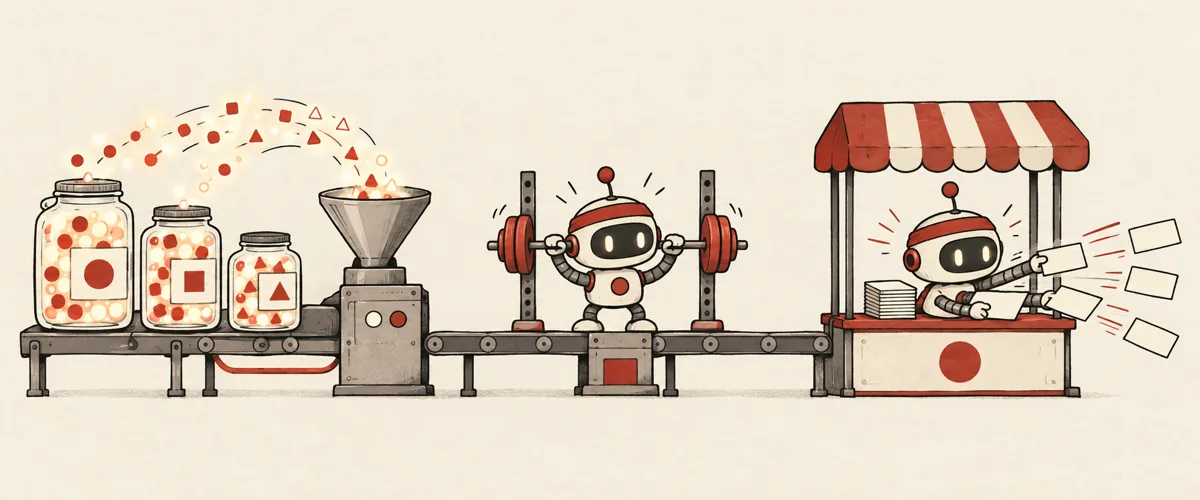
Fine-tuning is not one trick. It is a pipeline: earn a baseline, curate the data only you have, train a small patch on a big model, gate it on your own exam, then run it like a service. Coinbase's fraud agent is the worked example throughout, because they published the numbers.
The setup, from Coinbase's "Owning Intelligence" engineering series (October 6 to 8, 2026). Their Onramp product lets people buy crypto inside partner apps, including guest checkout with no account history, which is exactly where fraud hides. A traditional ML model and rules screen everything first; the language model agent reviews a selected subset, reading sequences of transactions rather than single payments, and outputs one compact thing: a risk level. It can block a transaction the first pass allowed. It cannot un-block one. Coinbase graded every candidate on a fixed replay of 16,140 real transactions from 7,293 users, including 813 confirmed fraud cases, scored on precision, recall, F1, and the one that pays the bills, dollar-weighted recall. Step through what their fine-tuned Qwen3.5-9B did to Opus 4.5 on that exam.
Share of fraud dollars caught. The metric that maps to money saved, and the specialist's biggest win.
Share of all fraud caught. The frontier model's newer versions kept getting worse at exactly this.
The balanced score. Beating a frontier model on F1 with a 9B is the headline Armstrong posted about.
When it says fraud, how often it is right. Precision is what keeps honest customers from being blocked.
Two honesty notes. The unadapted Qwen3.5-9B, before tuning, performed poorly on this exam: the win belongs to the adaptation, not the base model. And the benchmark is Coinbase's own, run on data only they hold, so nobody outside can replicate it. That is not a flaw in their work. It is the pattern itself: the exam is private because the data is the moat.
Start by running the best frontier model you can rent, with your best prompt, on your real task. That run does three jobs: it proves the task is model-shaped at all, it sets the score any specialist must beat, and it generates the raw material for training. Microsoft's Azure guidance is blunt about the order: prompt engineering first, retrieval (RAG) if the gap is knowledge, fine-tuning when the gap is behavior. Google and OpenAI publish the same sequence.
Coinbase did exactly this. Their first fraud agent was Claude Opus behind a roughly 7,000-token prompt of transaction context, history summaries, and review guidance. It worked well enough to cut fraud in a live A/B test. The specialist came second, aimed at a baseline that already existed and could be measured against.
Training data for a specialist is not scraped from the web. It is your own exhaust: production logs, support tickets with resolutions, transactions with confirmed outcomes, documents with the extraction your team already approved. The craft is in the curation: deduplicate, strip personal data, balance the classes so the rare important case is not drowned by the common boring one, and hold out a test set split by time, so nothing from the future leaks into training.
Coinbase's version: 813 confirmed fraud cases inside 16,140 historical transactions, kept frozen as the benchmark. Fraud is rare and expensive, so their training reward was explicitly balanced across fraud and legitimate classes; an unbalanced run learns to call everything legitimate and looks accurate while catching nothing.
LoRA (Hu and colleagues, Microsoft, 2021) freezes the base model's weights and trains pairs of small matrices injected into each layer. On GPT-3 it cut trainable parameters by a factor of about ten thousand and GPU memory by about three, matched full fine-tuning quality, and adds zero latency at serving time once the patch is merged back in. QLoRA (2023) goes further, quantizing the frozen base to 4 bits so a 65B model could be tuned on a single 48GB GPU. Adapters are small files, tens to hundreds of megabytes, so one base model can host a drawer full of specialists, swapped per task. That is literally how Apple Intelligence works: one roughly 3B on-device model, specialized per feature by swappable LoRA adapters.
The other training path is distillation: let a frontier teacher answer ten thousand of your real prompts, then train the small model to imitate the teacher on your distribution. Hinton described the mechanism in 2015; OpenAI productized it in October 2024. Coinbase skipped the teacher because it had something better: ground-truth outcomes.
Supervised fine-tuning trains on prompt and ideal-response pairs, and it is the right first move for format and behavior. Preference tuning goes one step further: DPO (Rafailov and colleagues, 2023) trains directly on chosen-versus-rejected answer pairs, no separate reward model, no reinforcement loop. And where the answer can be checked mechanically, the strongest current recipe is reinforcement learning with verifiable rewards: the model tries, a deterministic scorer grades it against reality, and a method like GRPO pushes probability toward what scored.
That is the Coinbase recipe, and it is why "fine-tuned" undersells it. Their model's reward was not a human's taste. It was history: each training transaction really was fraud or really was not. A 9B model graded against ground truth on one narrow task will beat a genius graded on nothing.
Before anything ships, the specialist must beat the frontier baseline on the private benchmark, under the same decision policy, with the metrics weighted the way the business weights them. Coinbase versions the model, the prompt, and the decision policy together, canaries new checkpoints, and keeps a tested rollback. Practitioner Hamel Husain's version of the same sermon: most teams fail not at modeling but at never building the eval or reading their own error traces, so they cannot tell a regression from an improvement.
Why the gate matters, in Coinbase's own data: every newer frontier version they tested regressed on their exam. The newer Sonnet lost 22.2 points of recall against its predecessor; GPT-5.6 gained 11.5 points of precision and lost 20.7 of recall. An API upgrade is an unrequested model change. Owning the weights is, in part, refusing that surprise.
Coinbase serves the merged model behind an OpenAI-compatible API using Ray Serve and vLLM on L40S GPUs, autoscaling between 2 and 8 replicas, which is how a 9B model answers in production at half the frontier model's latency. Then the real work starts: fraud patterns move, so the team watches quality and latency continuously and retrains on a cadence. Armstrong's internal tooling bet, a skill invoked as "/fine-tune-and-serve-llm" that walks an employee from idea to served model, is an attempt to make this whole pipeline boring enough that any team at Coinbase can run it. The skill's internals are not published; only Armstrong's one-line description exists, and this primer treats it that way.
The honest price tag: training cost under $100 is the number that travels. The standing costs are the data pipeline, the eval discipline, the GPUs idling between spikes, and a human who owns the retraining calendar. Owning intelligence means owning the chores.
Coinbase measured both models live, on the same fraud flow, with a roughly 7,000-token prompt and a one-word-class answer. Ball pace is proportional to speed, so the gap you see is the gap they measured. Latency is not a footnote in risk review: the check runs inside a checkout the customer is waiting on.
P50 is the typical call, P99 is the bad tail one call in a hundred. The specialist's tail (1.04s) beats the generalist's typical (1.52s). Source: Coinbase, "Owning Intelligence" Part 3, October 8, 2026.
Why teams bother: the per-call arithmetic. Frontier prices are the providers' published list rates as summarized by pricing trackers in October 2026; the specialist's is Together's serverless price for the same Qwen3.5-9B, before any self-hosting. Bars are to scale against the largest figure, which is why the specialist's bars barely register. That is the point.
Worked arithmetic, labeled as arithmetic: at Coinbase's roughly 7,000-token prompt shape, input alone costs about 3.5 cents per decision at the legacy Opus rate and about a tenth of a cent at the hosted 9B rate, a gap of roughly 30x before output tokens. Two caveats travel with these numbers: Together's own pages list the 9B at two different prices ($0.17 in and $0.25 out on the model page, $0.10 and $0.15 in a catalog copy), so verify before budgeting; and frontier prices keep falling, which is the skeptics' strongest card, played in the voices below.
When the specialist wins, and when it does not
Fine-tune when
The job is narrow and stable, the output shape must be consistent, and you hold verified labels at volume. Behavior, format, and judgment calls your team makes the same way ten thousand times. A long repeated prompt can be baked into the weights, deleting its cost from every call. Or the data cannot leave your walls, or the latency budget is under a second, or the per-call cost at your volume dwarfs a GPU.
Do not fine-tune when
The gap is knowledge, especially fresh or citable knowledge: that is retrieval's job, because a fact baked into weights has no source and no timestamp. The requirements change weekly. You have forty good examples, not forty thousand. Or you need open-ended general capability, which is the one thing a specialist is designed to give up. Microsoft, Google, and OpenAI all publish versions of this split; it is the closest thing the field has to consensus.
The use cases
Where the pattern earns its keep
The pattern fits wherever four things coincide: the job is narrow, the company owns the labels, and either latency, privacy, or volume makes renting a generalist the expensive option. Tap a card for the evidence.
Every reviewed transaction eventually resolves to fraud or not fraud, which makes risk review the rare AI job with ground truth at scale. Coinbase's tuned 9B beat Opus 4.5 on all four of its fraud metrics and answered in about half the time, inside a checkout flow where the customer is staring at a spinner. The same shape fits chargeback review, account-takeover screening, and merchant risk: sequence context in, one compact risk judgment out.
Intercom's Fin Apex 1.0, a post-trained model on an undisclosed open base, resolved 73.1 percent of support conversations against 71.1 percent for both GPT-5.4 and Opus 4.5 in Intercom's own benchmarks, at roughly a fifth of the cost of calling frontier models directly. Decagon reports about 90 percent of its support workflow now runs on fine-tuned open models, with frontier models kept for new, unproven tasks. Both are vendor-reported on private benchmarks; both point the same direction: decompose support into single jobs, and a tuned small model wins most of them.
Invoices, contracts, filings, and claims all arrive in known shapes and leave as known fields, and every processed document is a labeled example. Databricks' TAO work lifted a Llama 3.1 8B by 24.7 points on FinanceBench document questions, and OpenAI's reinforcement fine-tuning customers include Harvey, whose legal citation extraction gained 20 points of F1. Extraction is classification with extra steps, and classification is the specialist's home turf.
Salesforce's xLAM models show the shape: a 7B tuned on verifiable function-calling data topped the Berkeley Function-Calling Benchmark ahead of GPT-4-class models, and the 1B beat GPT-3.5 Turbo and Claude 3 Haiku, sized for on-device use. OpenAI reports similar reinforcement fine-tuning gains for generating code against a company's private APIs, where the test suite provides the verifiable reward. A generalist has read every public repo. A specialist has read yours.
Policy work is a rubric applied at volume, which is precisely a narrow distribution with labels. SafetyKit, an OpenAI reinforcement fine-tuning customer, lifted its moderation F1 from 86 to 90 percent, and Coinbase's discipline of versioning weights, prompt, and policy together is what regulated teams actually need: when an auditor asks why a decision was made, "the vendor shipped a new model" is not an answer. A pinned specialist is.
Decagon's founders say the move to fine-tuned small models was forced by voice: classify the topic, detect the bad actor, route the call, each a single-task model that answers before the caller notices a pause. A phone conversation cannot wait three seconds for a frontier model to compose an essay. Small models doing small jobs, in a row, is what a voice agent actually is.
The fit is obvious: your click logs are labels, your catalog is the whole world the model needs, and a reranker that answers in tens of milliseconds can sit inside every query. The evidence is thinner here than in the cases above: the strongest write-ups found for this primer are practitioner accounts, including a fine-tuned 400M reranker reported as 10x faster and 100x cheaper per operation than a frontier scorer, rather than named enterprise disclosures. Treat this one as promising and plausible, not proven at Coinbase's standard.
Apple shipped the pattern at planetary scale in 2024: one on-device foundation model of roughly 3B parameters, specialized per feature by LoRA adapters of tens of megabytes, loaded and swapped as features demand, for summarization, proofreading, and the rest of Apple Intelligence. It is the clearest proof that "one base, many specialists" is an architecture, not a hack: the adapter is small enough to be a downloadable feature.
Timeline
How the specialist became possible
The 2026 headline rests on a decade of quiet enablers: a way to teach small (LoRA), a way to teach cheap (QLoRA), open weights worth teaching, and rewards you can verify. Step through it.
Key voices
Who says what, and what their record says
The builders with receipts, and the practitioners pushing back. The disagreement between them is real and specific: not whether specialists can win, but whether the win survives the next frontier release.
Brian Armstrong
CEO, Coinbase; X post, October 11, 2026
Armstrong's post makes three claims of increasing boldness. First, the demonstrated one: a fine-tuned 9B beat frontier models at fraud prevention on Coinbase's data, cheaper and faster. Second, the pattern claim: frontier models are amazing generalists, but specialists will increasingly win narrow tasks, working in teams with other models or alone, and Coinbase is making fine-tuning easy enough internally that any team can do it, with a skill invoked as "/fine-tune-and-serve-llm". Third, the long shot: some backend services may end up replaced entirely by this architecture, a claim no other source in this primer's research makes.
Weigh the post as a CEO's summary of work his engineers documented separately. The receipts exist (Yao Ma and colleagues, next card). The skill's mechanics do not, beyond his description: no Coinbase publication describes what the skill scaffolds or enforces.
Yao Ma and the Coinbase engineering team
"Owning Intelligence" Parts 1 to 3, Coinbase Engineering, October 6 to 8, 2026
The rare vendor series that publishes its benchmark, its method, and its caveats. Their discipline is the transferable part: a frozen replay benchmark of 16,140 transactions; candidates graded under the existing decision policy before any prompt changes are credited; model, prompt, and policy versioned together; retraining treated as a permanent obligation because fraud patterns move.
Their most quoted finding cuts in two directions. Every newer frontier version they tested regressed on recall, F1, or dollar-weighted recall on their exam, which is their argument for owning weights. It is also a warning to specialist owners: decision boundaries drift silently, including your own model's, and only a frozen exam notices.
Databricks and Mosaic Research
TAO: training efficient LLMs without labeled data, Databricks blog, 2025
Databricks argues the bottleneck is not tuning but labels: enterprises do not have thousands of graded examples, and prompting gives limited, error-prone gains. Their TAO method uses reinforcement learning against the data companies already generate, and reports a tuned Llama 3.1 8B gaining 24.7 points on FinanceBench while the 3.3 70B approached GPT-4o and o3-mini quality at a claimed tenth to a twentieth of the running cost. If TAO generalizes, the specialist playbook stops requiring a labeling program, which removes its biggest upfront cost.
Jesse Zhang and Ashwin Sreenivas
Co-founders, Decagon; the a16z Show, July 31, 2026
Decagon runs customer support agents for large companies and reports the split plainly: about 90 percent of its workflow runs on fine-tuned open models, 10 percent on frontier models reserved for new products where no tuned specialist exists yet. Their two claims are worth separating. Small open models out of the box are not good enough; you have to fine-tune them. And decomposing an agent into single tasks is what makes a small tuned model equal or better per task, with voice latency forcing the architecture. In their telling, the 90/10 split is where the whole industry is heading.
Chip Huyen
Author, AI Engineering (O'Reilly, 2025); position via her book and podcast summaries
The clearest named case against reaching for the tuner. Huyen's sequence: maximize prompting first; if the failures are missing information, add retrieval; fine-tune only when the failures are behavioral. And her sharpest claim, reported from her recent appearances: she has largely stopped fine-tuning herself because frontier models leapfrog fine-tuned ones every two to three months, so the specialist's lead is a depreciating asset with a maintenance bill attached. Treat the cadence as her stated view rather than a measured finding; treat the sequencing advice as close to consensus.
Hamel Husain
Practitioner and evals consultant; "Your AI Product Needs Evals" FAQ
Husain's pushback is aimed at both camps: most teams argue about prompts and fine-tunes while never building the evaluation or reading their own failure traces, which means they cannot tell whether any change helped. His order of operations, error analysis on real data first, is unglamorous and is also exactly what Coinbase's series demonstrates at scale. In his frame, the Coinbase win is not a fine-tuning win. It is an evals win that fine-tuning got to cash.
Eugene Yan
"Patterns for Building LLM-based Systems and Products," 2023
Yan's widely used taxonomy puts fine-tuning in its place: one pattern among seven, for getting better at specific tasks, sitting downstream of evals, which he calls the foundation, and of retrieval, which he favors for knowledge because updating an index is cheaper than retraining a model. Written before the current wave, it still describes the winners: Coinbase is his evals pattern and his fine-tuning pattern executed in his order.
Where leaders think this goes
The fleet spreads; the argument is about upkeep
Positions as published through October 2026. Where a position is known only through secondary summaries, the card says so.
Where they agree: the fleet is coming
Armstrong (October 2026), Gartner's Sumit Agarwal (April 2025, predicting small task-specific models will be used at least three times more than general-purpose LLMs by 2027), Decagon's founders (the 90/10 split is where the industry is moving), Databricks (tuning on data firms already have), and OpenAI's product line (hosted fine-tuning, custom models, and reinforcement fine-tuning sold as a business) all land in the same place: companies will run many small models they own, each fitted to one job, next to frontier models they rent for everything else. On the direction, the argument is close to over.
Split one: train early, or prompt and retrieve first?
Side A: earn the right to tune
Microsoft's official guidance sequences prompt engineering and RAG ahead of fine-tuning, with tuning reserved for behavior and task performance on the right data. Anthropic's published position, known here through practitioner summaries and flagged as such, is similar: prompting is faster, cheaper, and reversible, with fine-tuning for extreme consistency, rare jargon, or constrained deployment. Yan and Huyen argue the same order from practice.
Side B: the baseline is the tax, pay it once
Coinbase and Decagon both started on frontier models, so the disagreement is narrower than it looks: not whether to baseline, but how long to stay. Decagon's founders treat the frontier phase as scaffolding for new products, migrating each proven task to a tuned specialist as soon as its data exists. Armstrong's internal tooling pushes the same way: make the migration so cheap that staying on the generalist is the decision that needs justifying.
Split two: do fine-tunes rot?
Side A: yes, on a two to three month clock
Huyen's leapfrog argument: each frontier generation absorbs much of what the last round of fine-tunes bought, so a specialist's edge decays while its maintenance bill does not. Add the per-model lifecycle, data pipeline, retraining cadence, checkpoint registry, serving, rollback, and the fleet's true cost is a standing team, which is why she expects most fine-tunes to be quietly retired.
Side B: the generalist rots too, and you cannot pin it
Coinbase's benchmark is the counter-evidence: on a private task, frontier upgrades regressed, repeatedly, by up to 22 points of recall. A rented model changes underneath your product on the vendor's schedule; a specialist changes only when you retrain it. Rot is real on both sides of the comparison. The question is whose drift you would rather manage: yours, on your calendar, or theirs, on theirs.
The one-person bets
Three claims in this primer belong to exactly one source each. Armstrong alone goes all the way: some backend services will be replaced entirely by specialist-model architecture, not merely assisted by it. Databricks alone bets that label-free reinforcement tuning (TAO) beats the label-first supervised consensus, which would delete the playbook's most expensive step. And Intercom alone is betting a legacy software company can become a model company for one vertical, with its base model still undisclosed. Each is falsifiable within a couple of years, which is what makes them worth naming.
Takeaways
What to actually remember
Armstrong's headline survives its receipts. Coinbase did the unglamorous parts in the right order, baseline, frozen exam, verifiable rewards, gated promotion, and the small model won on quality, latency, and cost at once. The skeptics are also right about the shape of the risk: the win is rented from your data discipline, and it decays the moment the discipline does. The specialist era is not really a modeling story. It is an operations story: the companies that win it are the ones whose labels, evals, and retraining calendars were already in order, which is why a CEO is out posting about it as an internal tooling problem.
- The asset is the labels, not the model. Qwen3.5-9B is a free download and, untuned, it performed poorly on Coinbase's exam. What competitors cannot download is 16,140 graded transactions. Fine-tuning is how proprietary data becomes proprietary behavior.
- Narrowness is the mechanism. A specialist wins because its whole world is one distribution: fraud sequences, your support intents, your document schemas. The same narrowness is its ceiling, so the pattern fits jobs that stay the same, and misfits jobs that sprawl.
- The exam is the gate, and it must be yours. Frontier versions regressed on Coinbase's private benchmark by up to 22 points of recall while improving in public. If you cannot grade a model on your own frozen history, you are not choosing models. You are accepting them.
- Cheap training is the small print. Under $100 of compute is real and also the least of it. The standing costs are curation, eval upkeep, serving, and retraining as the world drifts. Teams that quote the $100 without the chores are selling something.
- Sequence honestly: prompt, retrieve, then tune. Even the pattern's loudest winners started on a rented frontier model. The baseline is not a failure of ambition; it is how you learn what the specialist has to beat, and it generates the traces you will train on.
- Rot cuts both ways, so choose your drift. Huyen is right that frontier generations erode fine-tune leads, and Coinbase is right that rented models regress silently under your product. Owning the weights means owning the calendar: nothing changes until you change it.
Keep exploring
Related primers
How AI Keeps Getting Smarter
The improvement engine behind the frontier models the specialists chase, and where leaders expect it to go.
How Inference Works
What actually happens when a model answers, and why a smaller model answers sooner.
The Harness Is the Product
Why the tooling around a model decides what it can do. Armstrong's fine-tune skill is a harness bet.
Mixture of Experts
The other way to specialize: many expert subnetworks inside one model, routed per token.
Sources
Primary sources
Read October 2026. Vendor benchmarks and secondary reporting are flagged where they appear, and the flags travel with the claims on this page.
Brian Armstrong, X post, October 11, 2026
Coinbase, Owning Intelligence Part 1: building the fraud agent
Coinbase, Owning Intelligence Part 2: the evaluation
Coinbase, Owning Intelligence Part 3: owning the model
Hu and colleagues: LoRA, Low-Rank Adaptation of Large Language Models
Dettmers and colleagues: QLoRA
Rafailov and colleagues: Direct Preference Optimization
Hinton, Vinyals, Dean: Distilling the Knowledge in a Neural Network
Microsoft: fine-tuning guidance for Azure OpenAI
Google Cloud: Vertex AI tuning API
OpenAI: Model Distillation in the API
Databricks: TAO, training efficient LLMs without labeled data
Salesforce AI Research: xLAM large action models
VentureBeat: Intercom's post-trained Fin Apex 1.0
Why Decagon runs 90 percent of its enterprise AI on open models
VentureBeat: OpenAI reinforcement fine-tuning customers
Gartner: small task-specific models, 3x by 2027
Apple: Foundation Models tech report
Hamel Husain: Your AI Product Needs Evals, the FAQ
Eugene Yan: Patterns for Building LLM-based Systems and Products
Luo and colleagues: catastrophic forgetting in continual fine-tuning
Qi and colleagues: fine-tuning aligned language models compromises safety
Extracting training data from fine-tuned language models
Together: Qwen3.5-9B model page
Qwen: Qwen3.5 release notes