Sine and Cosine From First Principles
Every calculator, physics engine, and signal processor on Earth will tell you that the sine of 30 degrees is exactly one half. Almost none of them will tell you why, or what sine even is before the button is pressed.
This primer rebuilds the two most used functions in mathematics from nothing, three separate ways: as coordinates on a circle, as the only possible solution of a two-line differential equation, and as the infinite series a machine actually adds up. The payoff is that the three constructions can be proved to agree, not just observed to agree.
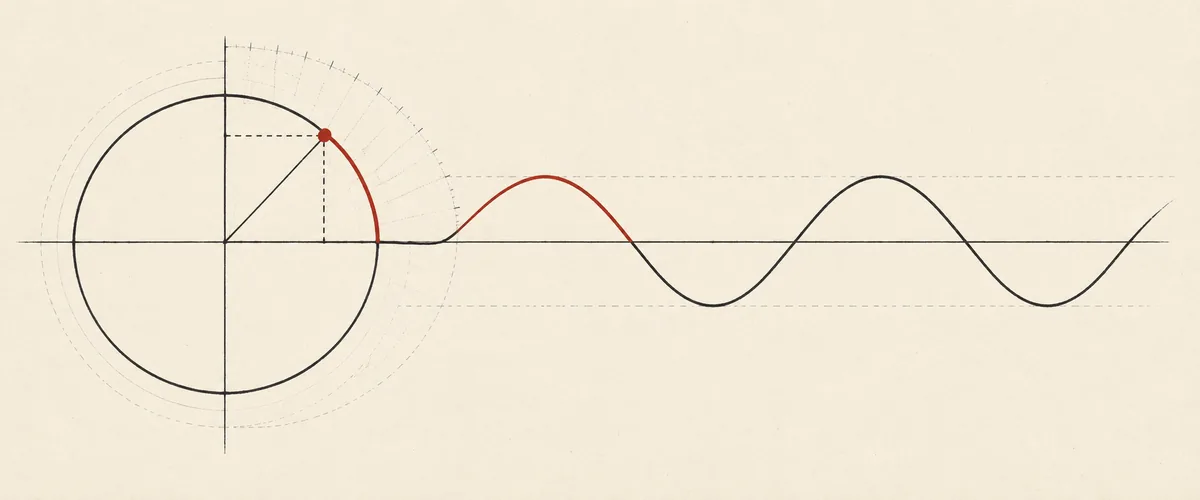
The whole subject in one drawing: a point on a circle, its two projections, and the wave those projections trace as the point walks.
The brief
School presents sine and cosine as buttons and as ratios in a triangle, in that order, and both presentations hide the same gap. The triangle ratios only cover angles inside a right triangle: nothing past 90 degrees, nothing negative. The button simply refuses to explain itself.
Underneath both sits a single definition that covers every real number, and a chain of consequences, each one derived, with the arithmetic shown, from the step before. The chain is this primer:
Underneath both sits a single definition that covers every real number.
- The definition. Two coordinates of a point walking the unit circle.
- The one limit. Everything in the calculus of these functions hangs on it.
- The derivatives. Cosine as sine’s rate of change, proved in five steps.
- The addition formulas. How the functions of a sum split into products.
- A second construction. The same functions rebuilt from a differential equation, no circle allowed.
- The bridge and the machinery. Euler’s formula, then the series evaluation and CORDIC (the COordinate Rotation DIgital Computer algorithm) that real hardware uses.
One honest warning. The circle definition borrows arc length and sector area before analysis has built them, and some of the most careful textbooks refuse the loan: they start from the series, or from axioms.
Who takes which side is the fight in the voices and camps sections below. This primer takes the circle as its front door, because the circle is what the functions mean, and flags every place where the debt comes due.
Draw an equilateral triangle with side 2. Every angle is 60 degrees. Bisect it from the top vertex, along the dashed line in the drawing.
Each half is a right triangle: hypotenuse 2, base 1 (half of the side 2), and height √3, because Pythagoras says height squared = 22 − 12 = 3. The angle at the top of each half is 30 degrees, and its opposite side is the base, length 1.
Shrink the same triangle onto the unit circle (divide every length by the hypotenuse, 2) and the point at 30 degrees lands at (cos 30°, sin 30°) = (√3/2, 1/2). No calculator was consulted; the value is forced by the drawing. Figure 1 step 2 shows this exact landing.
Figure 1: the definition, walked
The definition fits in one line: walk along the unit circle a distance θ (theta) from the point (1, 0), counterclockwise; wherever you stop, your first coordinate is cos θ and your second is sin θ.
Because the radius is 1, the walk distance and the angle are the same number, which is all a radian is. Step through the stops and watch the two coordinates trade places.
Tap the card, swipe, or use the arrows.
Two consequences fall out of the definition immediately, before any calculus. First, Pythagoras on the dashed triangle gives sin2 θ + cos2 θ = 1 for every θ, since the hypotenuse is the radius, 1.
Second, the triangle-ratio definition from school is just this one restricted to the first quadrant: for an acute angle, the point’s height over the radius is the opposite over the hypotenuse. The circle is the general definition; the triangle is its postcard.
The circle is the general definition; the triangle is its postcard.
Where radians come from
Figure 1 measured the angle as arc length and called the count radians, without saying where the unit comes from. Not from a committee: from laying the radius along the circle and counting how many radii of arc you have walked. Step through it.
Tap the card, swipe, or use the arrows.
The word is far younger than the idea. Roger Cotes had the measure in everything but name by 1714, and his cousin Robert Smith published Cotes’s calculation of one radian in degrees, 57.2958, in 1722. Euler was using the measure implicitly by 1765.
The word itself first appeared in print on 5 June 1873, in examination questions set by James Thomson, brother of Lord Kelvin, at Queen’s College, Belfast.
Degrees are the older unit, and the arbitrary one: Babylonian astronomers, counting in base 60, split the full turn into 360 parts, and the split stuck.
Nothing in the circle picks 360. The circle picks 2π, because that is how many radii its circumference measures.
And the punchline, as a limit. The ratio sin h / h tends to 1 only when h is measured this way; Figure 2’s callout has the arithmetic.
The ratio sin h / h tends to 1 only when h is measured in radians.
How it works
Six mechanisms, in the order the derivation needs them. Each one is proved from the ones before it; the two interactive derivations (Figures 2 and 3) then run the two hardest steps live.
So series sine and circle sine are one function.
How the addition formula is earned
Card 4 stated sin(x + h) = sin x cos h + cos x sin h, and Figure 3 spends it. It is not a definition and nobody guessed it: it is one picture read vertically. Take x = 50 degrees and h = 10 degrees more, so the formula has to earn sin 60 degrees.
By definition, sin(x + h) is the height of the point P at angle x + h on the unit circle. With x = 50 degrees and h = 10 degrees, the height to explain is sin 60 degrees, about 0.8660254. The next steps earn it from the two angles separately.
From the point at angle x, turn h further to reach P. Drop a perpendicular from P to the ray at angle x; the foot is Q. Triangle OQP is a right triangle whose hypotenuse is OP = 1, the radius.
In triangle OQP the angle at O is h and the hypotenuse is 1, so the side along the ray is OQ = cos h and the side across it is QP = sin h. At h = 10 degrees: cos h = 0.9848078 and sin h = 0.1736482.
Q sits at distance cos h along the ray at angle x, so Q’s height is cos h copies of sin x, and the dashed lines carry that height across to P’s vertical. The red piece: sin x cos h = 0.7660444 × 0.9848078 = 0.7544065.
QP is perpendicular to the ray, so it leans exactly x away from the vertical, and its rise is its length times cos x: cos x sin h = 0.6427876 × 0.1736482 = 0.1116189. The blue piece, stacked on the red one, tops out exactly at P.
P’s height is the two pieces stacked and nothing else: 0.7544065 + 0.1116189 = 0.8660254, sin 60 degrees to seven places. The formula is the picture read vertically, which is why Figure 3 can spend it without apology.
Tap the card, swipe, or use the arrows.
The formula is the picture read vertically.
Ptolemy had this same projection in chord language around 150 CE; the sine version is his construction with half-chords, which the chords section below unpacks.
Figure 2: the squeeze, live
For a small positive angle h, three regions nest inside each other on the circle: the inscribed triangle (area ½ sin h), the sector (area ½ h), and the tangent triangle (area ½ tan h).
Because they nest, their areas order themselves, and that ordering, divided through, traps sin h / h between cos h and 1. Drag h down and watch both walls close on the ratio. The bar under the picture is the trap itself, drawn on the number line.
The algebra is three lines. The nesting says ½ sin h < ½ h < ½ tan h. Divide everything by ½ sin h, which is positive, and the chain becomes 1 < h / sin h < 1 / cos h. Reciprocals of positive numbers reverse inequalities, so:
The derivative needs one more limit, and it is free from the same identity. Multiply top and bottom of (cos h − 1) / h by (cos h + 1), and use cos2 h − 1 = −sin2 h.
The fraction splits into −(sin h / h) · (sin h / (cos h + 1)), which tends to −1 · (0 / 2) = 0. Two limits, both earned from one picture. Figure 3 spends them.
Two limits, both earned from one picture.
The sector’s area is ½ h only because h is arc length, which is what a radian is. Run the same limit in degrees and it lands somewhere else entirely: sin(0.5°) / 0.5 = 0.0174531, closing on π / 180 = 0.0174533, not on 1.
Every clean formula after this one, the derivative being cosine, the series having coefficient 1, inherits a π/180 smudge if you insist on degrees. Radians are the unit in which the geometry and the algebra agree to keep the books clean.
Where tan comes from
Sine and cosine are coordinates; tangent is a length, and it is named for where it lives. Draw the line that touches the circle at (1, 0), the tangent line, and extend the angle’s ray until it meets that line. The segment the ray cuts off on the tangent line is tan θ.
Thomas Fincke gave the function that name in his Geometria rotundi (1583), from the Latin tangere, to touch. Walk the angle and watch the segment.
Sine and cosine are coordinates; tangent is a length, and it is named for where it lives.
Figure 2 already used this segment without naming it: the outer triangle there stands on this same tangent line, which is why its area is ½ tan h.
And at 90 degrees the ray runs parallel to the tangent line and never meets it, so the segment runs off to infinity. That is the whole content of the warning that tan 90 degrees is undefined.
Figure 3: the derivative, derived
The most memorized line in calculus, d/dx sin x = cos x, is five steps of algebra standing on Figure 2. Step through the whole chain; nothing is skipped, and the last step grades the proof against a number.
The most memorized line in calculus is five steps of algebra standing on Figure 2.
There is no shortcut at this step. Using L’Hôpital’s rule here would differentiate sine in order to prove what sine’s derivative is. The fraction has to be evaluated by hand.
The addition formula is doing the work: it separates the part that depends on the step h from the part that depends on the position x.
Pure rearrangement: gather the two terms containing sin x over the common denominator, and the term containing cos x stands alone. Now the whole question is what the two brackets do as h tends to 0.
Numeric witnesses, from Figure 2’s own arithmetic: at h = 0.01 the brackets already read 0.99998333 and −0.00499996. The first is nearly home; the second is dying like −h/2.
The same chain run on cos(x + h) = cos x cos h − sin x sin h gives d/dx cos x = −sin x. The minus sign is inherited from the cosine addition formula.
Card 3’s picture says why: stepping along the circle, your height changes at the rate of your horizontal position, and your horizontal position changes at minus the rate of your height.
A crude finite check: the symmetric difference quotient (sin 0.501 − sin 0.499) / 0.002, computed with a step of a thousandth, gives 0.87758242. It agrees with cos(0.5) to seven decimal places, and the proof above is the statement that the agreement becomes exact as the step tends to 0.
Tap the card, swipe, or use the arrows.
Card 5’s series, cashed out at x = 0.1 radians. Every line is arithmetic you can redo on paper:
term 2: −x3/3! = −(0.001)/6 = −0.0001666667
term 3: +x5/5! = 0.00001/120 = +0.0000000833
sum: 0.1 − 0.0001666667 + 0.0000000833 = 0.0998334167
The next term, x7/7! = 0.0000001/5040 ≈ 0.0000000000198, bounds the error: in an alternating series whose terms shrink, the true value sits within that distance of the sum.
A calculator says sin(0.1) = 0.09983341664682815. Three terms of hand arithmetic matched it to ten decimal places, and the eleventh place is fenced in by the bound. This is the entire trick behind the sine button, run at human scale.
Figure 4: the series, building itself
Same game at a less tiny angle, x = 0.5, where the terms are big enough to watch. Step through and grade each running total against the true value, sin(0.5) = 0.4794255386.
Five terms reproduced the sine button, and every term was forced by the equation, not fitted.
The bridge: Euler’s formula
The exponential function has a series of its own, ex = 1 + x + x2/2! + x3/3! + …, and nothing stops you from feeding it an imaginary input.
Feed it iθ. The even powers come out real, with i2 = −1 flipping every other sign, and they spell the cosine series.
The odd powers keep one factor of i each, and they spell i times the sine series. One series, split by parity, is the bridge:
Rotation and growth are the same series read two ways.
Euler published the formula in the Introductio in analysin infinitorum (1748, §138); Roger Cotes had the equivalent logarithm form in print in 1722.
Its content, in this primer’s terms, is that rotation and growth are the same series read two ways. That is why the point walking the circle in Figure 1 and the exponential curve are cousins, and why oscillating systems, from springs to alternating current, all speak sine in the end.
The older root: chords
Before sine there was the chord, and the two are one halving apart. Ptolemy’s Almagest (about 150 CE) tabulates chords in a circle of diameter 120, at half-degree steps, in base 60. Step through three of his entries and watch the modern function fall out.
A chord spans an arc, and its length depends only on the central angle. Ptolemy built his table geometrically: seed values from Euclid’s Book XIII, then his theorem on cyclic quadrilaterals for the chords of sums, differences, and half arcs, and interpolation for the gaps.
The punctuation is base 60: 37 + 4/60 + 55/3600 = 37.0820, in a circle of radius 60. Divide by 60 to put the same chord on the unit circle: 0.618034, which is 2 sin 18 degrees. Ptolemy earned this entry from the pentagon geometry of Euclid, Elements Book XIII, Proposition 10.
The chord of 60 degrees is the side of the inscribed hexagon, so it equals the radius exactly: 60 in his parts, 1 on the unit circle. The cleanest entry in the table, and a check on all the others.
The chord of 90 degrees is the side of the inscribed square: 84.8528 of his 60, which is √2 on the unit circle. Now halve it, as the red half shows: the half-chord of twice an angle is that angle’s sine. Sine was never a new function. It is the chord, halved.
Tap the card, swipe, or use the arrows.
Sine was never a new function; it is the chord, halved.
So the oldest table in trigonometry is a sine table read at double angles, and sine is the half-chord: the length Aryabhata chose to tabulate is exactly half of Ptolemy’s chord of twice the angle. The next section follows that half-chord’s name on its way west.
Why sine and cosine are named that
Sine is a mistranslation that stuck, and cosine is a prefix. Step through the chain; every hop crosses a border, and the word changes shape at each one.
Sine is a mistranslation that stuck, and cosine is a prefix.
The chain starts with the function from the chords section: one length per angle, Ptolemy’s chord, built on Hipparchus’s lost table of about 140 BCE. Nothing named like sine exists yet.
Indian astronomers tabulated the half-chord instead, and named it for the picture: a chord slung across its arc is a bowstring, jya in Sanskrit, also written jiva. Aryabhata’s jya table, about 500 CE, is a sine table in everything but name.
Carried west into Arabic astronomy, jiva was transliterated as jiba. Arabic script usually leaves the vowels unwritten, so the bare consonants were later read as an ordinary Arabic word, jayb: a fold, a pocket, the bosom of a garment. The bowstring was gone, and nobody noticed.
Gerard of Cremona, translating Arabic astronomy into Latin at Toledo around 1150, translated the word in front of him: jayb became sinus, the Latin word for the same fold or bay. Europe inherited the slip, and sinus later shortened to sine.
Cosine is the same word with a job description attached: complementi sinus, the sine of the complementary angle, the one that completes x to 90 degrees. Edmund Gunter used the phrase in print in 1620; it later contracted to cosinus and then cosine. The picture is the reason the name had to exist: the height at 90 degrees minus x is exactly the width at x.
Tap the card, swipe, or use the arrows.
Timeline
Every entry is the same function changing clothes: chord, half-chord, series, then the circle definition cashed out in nanoseconds.
Tap the card, swipe, or use the arrows.
Key voices
The voices split on one question: whether the circle may be used before analysis has built it.
Where leaders think this goes
Positions as of October 2026, each attributed to its source. For a foundations topic the live question is not a forecast but a definition: what sine is allowed to be, and what each answer costs.
The fight is over which side gets to be called the definition, not over whether they agree.
Where they agree
Where they split
Takeaways
Sine and cosine are one picture, a point walking a unit circle, that three constructions agree on: the circle itself, the unique solution of y″ = −y starting like sine, and the series those two force. Every famous fact about them, the derivative being cosine, the addition formulas, Euler’s bridge, is a short derivation from that picture plus one squeezed limit.
Memorized values are just the places where the derivation happens to be drawable.
Every famous fact about them is a short derivation from that picture plus one squeezed limit.
- Definition before formulas. (cos θ, sin θ) is a point at arc length θ on the unit circle; sin2 θ + cos2 θ = 1 is Pythagoras restated, and the school triangle ratios are the first-quadrant special case.
- One limit carries the calculus. Three nested areas give cos h < sin h / h < 1, so sin h / h tends to 1; with its partner limit, (cos h − 1) / h tending to 0, the derivative of sine falls out as cosine in five honest steps.
- The equation picks the series. Demanding y″ = −y with y(0) = 0 and y′(0) = 1 forces every coefficient of x − x3/3! + x5/5! − …, and the energy (y′)2 + y2, which never changes, proves nothing else can satisfy the same conditions.
- Three terms can be plenty. sin(0.1) from x − x3/6 + x5/120 matches a calculator to ten decimal places, with the first omitted term as a proved bound on the error.
- Machines rotate or reduce. CORDIC reaches sine and cosine by repeated rotation through the fixed angles atan(2−i), using only shifts and adds; modern libraries reduce the angle to a small window and evaluate a polynomial, which is the series wearing a hard hat.
Keep exploring
Sources
Honesty notes. Madhava’s own writings do not survive; his series are attributed to him by Nilakantha’s Tantrasangraha (about 1500) and proved in Jyeshthadeva’s Yuktibhasa (about 1530), and this primer reports the attribution the way his school recorded it. The Almagest is dated to about 150 by convention.
Every number on this page that is not credited to a source was computed during the build (Python, double precision), including the squeeze table, the central-difference check, the CORDIC run in card 6, and both worked examples; the page’s visualizers recompute their readouts live from the same formulas, and the verification harness checks those readouts against the hand-computed values. The geometric squeeze is presented the way the standard curriculum proves it, with Lee’s objection stated where it belongs: sector area and arc length are used before analysis has built them, and the analytic route in card 5 is the debt-free version.