The Windmill That Visits Every Point
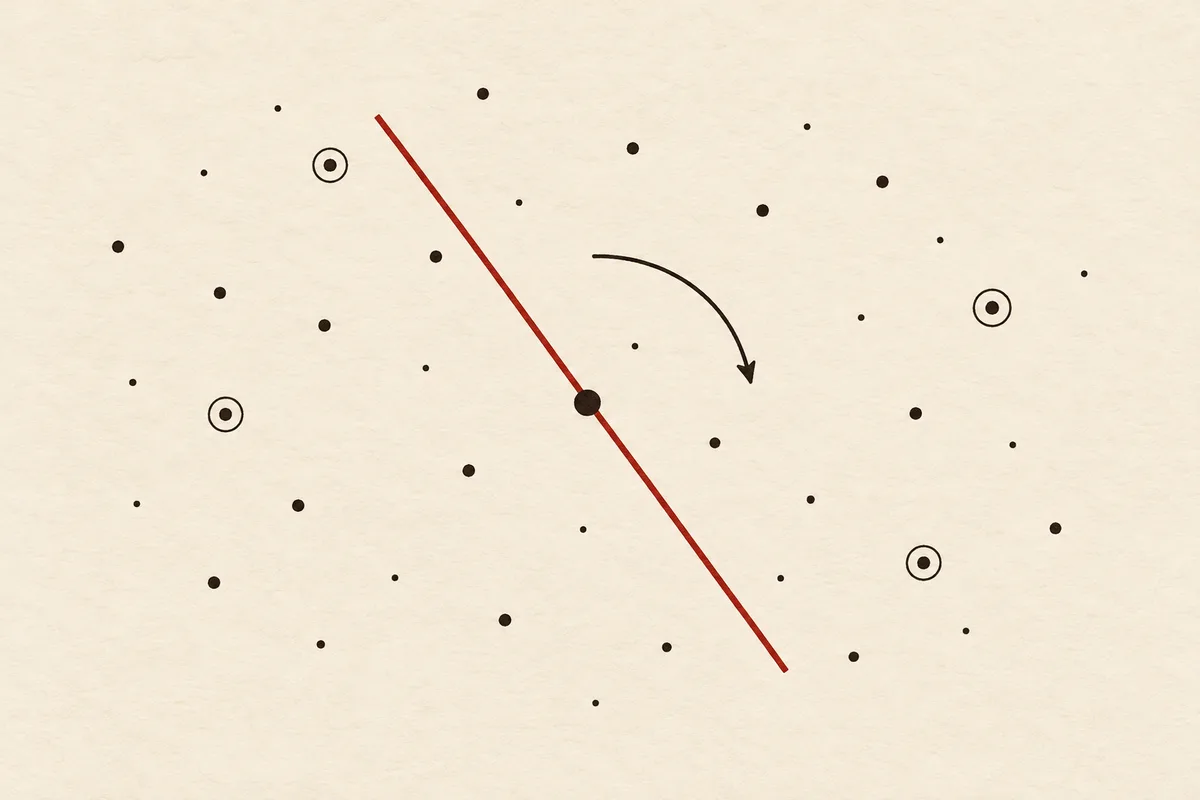
On October 14, 2026, the account Math Files posted a 35 second animation of a line turning through a field of dots, handing its pivot to each dot it reaches, and asked whether it could turn forever without leaving a single dot unvisited. The question is Problem 2 of the 2011 International Mathematical Olympiad (IMO), the windmill problem, and its answer is a proof short enough to fit in a paragraph and slippery enough that complete solutions were scarce even among the best school mathematicians on earth. This primer rebuilds the process live, so you can run the windmill, watch the one quantity that never changes, and step through the proof on real numbers.
The brief
Here is the problem, in plain words. Take a finite set of points in the plane, at least two, with no three on a single line. Put a line through one of the points and start turning it clockwise around that point, which is called the pivot. The moment the line reaches another point of the set, that point takes over as the new pivot, and the line keeps turning clockwise around it, on to the next point, forever. The claim to prove: you can choose the starting point and the starting line so that the windmill uses every point as a pivot infinitely many times. The sentence to remember: start balanced, and a point can change sides only by becoming the pivot, so a half turn of the line is forced to visit everything. Everything below is that sentence, made mechanical.
Figure 1: the windmill lab
The real process, simulated exactly: at each step the line turns clockwise by the smallest angle that brings it to another point, and that point takes over. Two point sets are loaded. The nine point meadow echoes the Math Files video; the five point set is the worked example used throughout this page. Start balanced, then tap Step and watch the two side counts under the canvas. Then try the edge start and watch what the counts do instead.
Two things to notice while you play. First, from the balanced start the side counts never move: the meadow holds at 4 and 4 through every handoff, and the five point set holds at 2 and 2. Second, from the edge start the counts sit at 0 and 8, and the line walks the outside of the set; in this workspace’s simulation the two interior points of the meadow are still unvisited after 1,800 degrees of turning. Same process, same rules: the start decides everything. The proof is the explanation of those two observations.
The arithmetic of balance
Give the line a direction, an arrow along it, and every point that is not the pivot falls on one of two sides. Write L for the count on the left of the arrow and R for the count on the right. The pivot itself is on neither side, so the two counts always add up to the rest of the set:
A start is balanced when the split is as even as the count allows, which pins the right count to a fixed number:
Run the substitution for both sets on this page. The meadow has n = 9, so R = (9 minus 1) / 2 rounded down = 4, and L = 8 minus 4 = 4: the 4 and 4 in the Math Files video’s counter. The five point set has n = 5, so R = (5 minus 1) / 2 = 2 and L = 2. A balanced start always exists: stand at any point, turn a line around it through a half circle, and the right count walks from some value k to (n minus 1) minus k in steps of one, so it passes through the balanced value on the way.
The second identity is what a half turn does. Turn the directed line by 180 degrees and left and right trade places, so whatever was on the right is now counted on the left:
Check it on the lab’s edge start: R starts at 8 with n = 9, and after a half turn the formula gives R = 8 minus 8 = 0. The counts swapped, but a lopsided split stays lopsided, which is why the edge start proves nothing. At a balanced start the swap maps the split to itself (4 to 4, 2 to 2), and that small fact is the hinge of the whole proof, as the stepper below shows.
How it works
Figure 2: the proof, one turn at a time
The standard proof, walked on the five point set: A(1, 5), B(4, 8), C(7, 4), D(5, 1), E(2, 2). Blue marks the left of the arrow, orange the right, red the pivot. Every angle in this walk is measured from the actual process, not drawn to look right.
Tap the card, swipe, or use the arrows.
Figure 3: the worked example, with the real angles
The same five points, run as a windmill from the balanced start at B, with the line vertical. Each tap adds the next handoff exactly as the simulator computed it: the angle swept, the running total, and the side counts, which sit at 2 and 2 the whole way down. All five points have been pivots by 135.00 degrees, inside the first half turn, and then the cycle repeats.
Why the angles land where they do: from B, the next point met is the one whose line through B sits the smallest clockwise turn away, taking directions modulo 180 degrees because a line has no head or tail. The line from B to E points at 71.57 degrees, so from vertical the sweep is 90 minus 71.57 = 18.43 degrees, the first row of the table. Every other row is the same computation at the new pivot.
The proof
The lab shows the process behaving on two sets, and Figure 2 runs the argument on the five points with names on them. Here is the argument itself, for every finite set at once, following the official IMO 2011 solution in the coloring form used by Evan Chen’s solution notes. Nothing in it belongs to five points, or to any one picture: it is bookkeeping about two counts.
Tap the card, swipe, or use the arrows.
Read back against Figure 2, the five point stepper is this same argument wearing numbers: its swap step is step 3 here, and its census at 135.00 degrees is step 5 with the angles filled in.
Timeline
Tap the card, swipe, or use the arrows.
Key voices
Where leaders think this goes
Positions as of October 2026, each attributed to its source.
Where they agree
Where they split
Takeaways
The windmill problem survives because its difficulty and its proof pull in opposite directions: the process looks like chaos, yet one count, the split of points across a directed line, never changes, and that single invariant settles everything. Choose the start so the split is balanced, and a half turn forces every point to have served as pivot; the rest is repetition, forever.
- Invariants do the heavy lifting. When a process looks chaotic, hunt for the quantity it cannot change; here it is the count of points on each side of the directed line, fixed at every handoff.
- The start is a real choice. Balanced starts visit everything: the nine point meadow covers all nine points within 157.2 degrees. Edge starts can fail outright, walking the hull while interior points wait forever.
- A half turn is the whole argument. Every point changes side across 180 degrees of turning, and the only way to change sides is to be a pivot, so one half turn is a complete census.
- Easy to state, hard to see. The problem sat early on the 2011 paper, yet complete solutions were scarce enough that a single charity mark was offered for a trivial observation about it.
- Simulation is a legitimate first move. Running the process, as the lab here and Bert Peters’ 2019 simulator do, exposes the invariant faster than staring at the diagram does.
Keep exploring
Sources
Honesty notes. The problem statement and the proofs are paraphrased here, not quoted. Every number attributed to the windmill process itself (sweep angles, totals, visit counts, the 1,800 degree edge start window) was measured with this workspace’s own simulator of the process, the same algorithm the lab above runs; the edge start claim is a finite window, not a proof that those points can never be reached from that start. Retellings of the 2011 contest sometimes cite an exact count of perfect Problem 2 scores; that count could not be verified against a primary source for this page, so it is not used. The difficulty evidence on this page is the UK student report’s charity mark account and the contest record that only one perfect total score was achieved.