A Pyramid Drawn by Circles
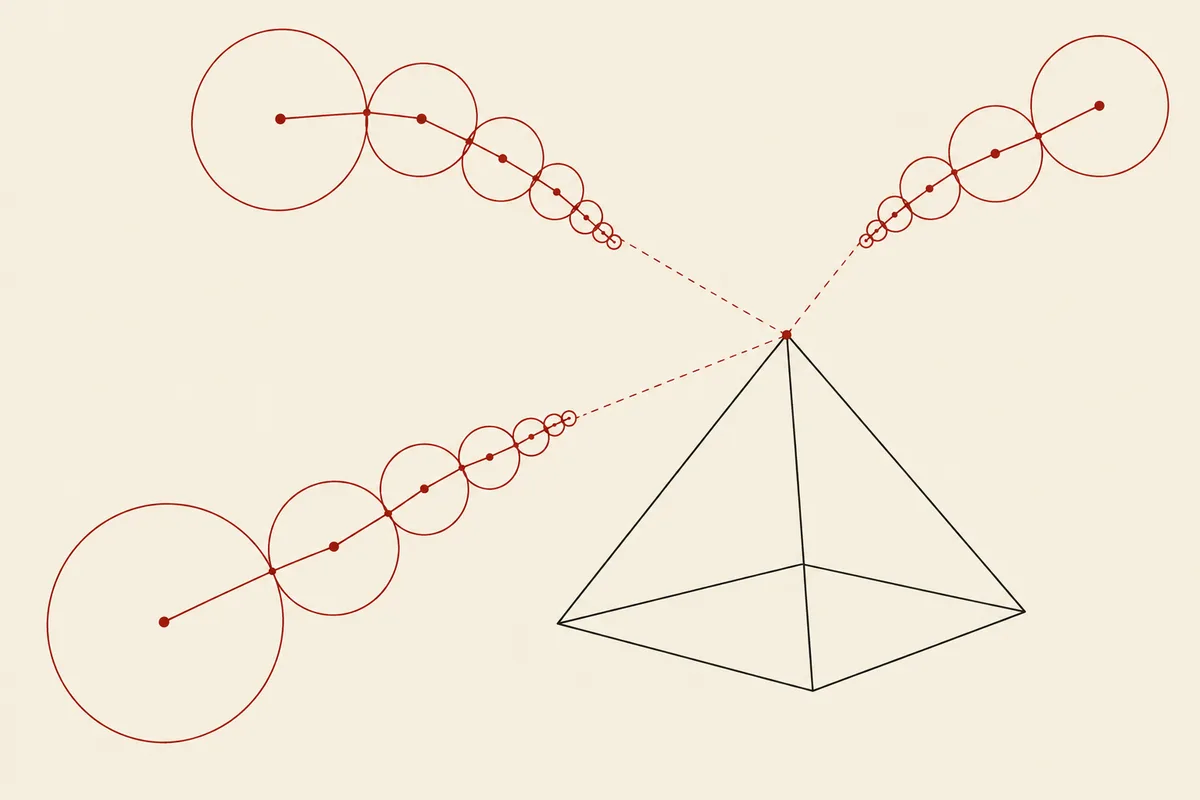
On October 16, 2026, the math animation account Math Pulse posted a 27-second video: a square pyramid draws itself in midair, traced by a glowing pen, while three chains of rotating circles do the drawing, one chain per direction in space. The post measures the trick. With one circle per chain the pen misses by up to 48.3 percent of the pyramid’s width; with 100 circles, by 0.666 percent. This primer rebuilds that machine from its equations, checks its numbers, and hands you the dial the video never gives you.
The brief
A pyramid is one closed line; one closed line is three wiggles; three wiggles are three chains of circles.
The pen walks one closed route around the pyramid’s edges and comes home. At every moment it has three coordinates, and each coordinate, watched over one full trip, is a single repeating wiggle.
A Fourier series rebuilds any such wiggle from rotating circles: big slow circles for the broad shape, small fast ones for the details. One chain of circles per coordinate, and the three chain tips, combined, put the pen back in space. The idea is Joseph Fourier’s, from 1807; the atoms it sums are covered in Sine and Cosine from First Principles.
The video freezes its choices: one pyramid, one route, three circle counts. Here every frozen choice is a control, and the governing formula recomputes in front of you. The route is one of the choices: Figure 1's gallery swaps it, and the last two slots in the gallery are yours.
The rebuild uses the construction the video’s own formulas print. Base corners sit at (±1, 0, ±1) and the apex at height √2, so all eight edges have length 2, and the pyramid’s width, its base diagonal, is 2√2 ≈ 2.83.
Figure 1: the machine, rebuilt
This is the post’s video, rebuilt from its formulas and left running. Three chains turn at three stations; dashed guides carry each chain’s number to the pen; the faint wireframe is the true pyramid the pen is chasing. The pyramid is the first example, not the limit: the gallery under the stage swaps the route for other solids, knots, flat drawings, and lines of your own, and the same three chains draw whatever they are fed, because the machine only ever sees three wiggles.
$x_N(t)$ the pen’s rightward coordinate, built from $N$ circles. $t$ time, running 0 to $2\pi$ over one trip around the route. $a_k, b_k$ the $k$-th circle’s cosine and sine weights. $\bar{x}$ the average of $x$ over the trip, the anchor the chain hangs from. The height $y_N(t)$ and the depth $z_N(t)$ are the same sum with their own weights and anchors.
Draw your own
Sketch one loop on the pad, any shape at all. The machine closes it for you, resamples it to 240 points, centers and scales it, and draws it with the same three chains.
The pad is empty. Draw a loop, then tap Draw this.
Or paste points
One point per line as x, y or x, y, z, or a JSON list like [[0, 0], [2, 0], [2, 2], [0, 2]]. The loop closes in the order given, and two-number rows are drawn flat.
Fidelity: the layout, the green, gold, and violet chains, the dashed guides, and the red trace follow the video, and the pyramid turns as it draws, as the original does. The numbers on this page are recomputed from the construction, not copied from the post. Deliberate differences: primer ink colors on a dark stage instead of neon on black, labels the original omits, and the controls below the stage, which the video freezes. Drag N down to 1 and the pyramid collapses to a wobbling blob turned by three circles total; at 100 per chain the trace is the pyramid to inside a percent. The gallery and the pad swap the route, never the machine: every example, and both of yours, runs through the same three chains and the same sums. Worst and mean miss are percents of the drawing's own diameter, the widest span between two of its points; for the pyramid that span is the base diagonal, the yardstick behind the post's numbers, and smooth shapes pay it off far faster than cornered ones.
How it works
Split the line into three signals, give each signal its own circles, and let the corners set the price.
The machine is three copies of one idea, plus a route and a price. These six cards take the pieces in order.
Worked example: the height chain, checked by hand
The height chain, checked by hand: two tents, one average, one first circle, one missed apex.
Every number in Figure 1 comes out of three sums like the one above. Here is the height sum, $y_N(t)$, done slowly, with arithmetic you can check on paper.
Step 1: the height signal is two tents
Follow the route and watch only the height. The pen sits on the base, height 0, except for two excursions: up a slant edge to the apex and straight back down, twice per trip.
So $y(t)$ is two triangles. Each spans $\tfrac{2}{11}$ of the period and peaks at the apex height, $\sqrt{2}$.
Step 2: circle zero is the average height
Before any circle turns, each chain hangs from an anchor: the average of its signal. The average is the signal’s area over one period, and a triangle’s area is half its base times its height.
$\bar{y}$ the height chain’s anchor, its constant term, $\approx 0.2571$. 2 two tents. $\tfrac{2}{11}$ one tent’s width as a share of the period. $\sqrt{2}$ the apex height. The same bookkeeping puts the other two anchors at $\bar{x}=\bar{z}=\tfrac{1}{11}\approx 0.0909$.
Step 3: the first circle of the height chain
The first circle’s weights come from wrapping the signal once around a cosine and once around a sine. Split at the tent edges, the four straight pieces integrate in closed form.
$u$ the trip as a fraction, 0 to 1 (so $t=2\pi u$). $a_1, b_1$ the first circle’s cosine and sine weights for the height. Integrating the same tents gives its radius directly:
$R_1$ the radius of the height chain’s first circle: $a_1^2=0.0185$ and $b_1^2=0.0247$ sum to the 0.0432 under the root. The biggest single wobble in the height is only about a fifth of a unit, because the tents are narrow.
Step 4: the apex test
Now spend one circle per chain and ask where the pen is at the second apex visit, $u=\tfrac{6}{11}$, where the true point is $(0,\ 1.414,\ 0)$. Each chain adds its anchor and its first circle, with $\cos\tfrac{12\pi}{11}\approx -0.9595$ and $\sin\tfrac{12\pi}{11}\approx -0.2817$.
Each line is anchor plus first circle. The first-circle values, from the weights: $x$: $0.9496(-0.9595)+0.1395(-0.2817)=-0.9504$. $y$: $(-0.1361)(-0.9595)+0.1571(-0.2817)=+0.0863$. $z$: $0.0415(-0.9595)+0.2700(-0.2817)=-0.1159$. The angle is $t=2\pi u=\tfrac{12\pi}{11}$ at $u=\tfrac{6}{11}$.
The one-circle pen sits at $(-0.86,\ 0.34,\ -0.03)$ while the apex is at $(0,\ 1.41,\ 0)$. The miss is $\sqrt{0.86^2+1.07^2+0.03^2}\approx 1.37$, which is 48.5 percent of the 2.83 width.
That is the worst miss at $N=1$ anywhere on the route, and it happens at the apex. With one circle, the pyramid’s point is the first thing the machine cannot afford.
Figure 2: build the machine in five steps
The video shows the finished machine. Here it is assembled piece by piece, in the order the pieces earn their place.
Tap the card, swipe, or use the arrows.
Figure 3: the worst miss, live
The post’s three numbers, recomputed from the pyramid’s own coefficients; this lab stays with the pyramid, the route the post measured, whichever drawing Figure 1 is showing. Move the dial and watch the worst miss anywhere on that route.
Doubling the circles roughly halves the worst miss. That is the signature of corners: a smooth curve would pay off faster, and a jump would never pay off at all.
| Circles per chain | The post reports | Recomputed here |
|---|---|---|
| 1 | 48.3% | 48.5% |
| 10 | 5.86% | 5.94% |
| 100 | 0.666% | 0.68% |
Same construction, same metric: the largest distance between the pen and the true point over the whole route, as a share of the base diagonal, 2√2. The gaps are a few tenths of a percent, the size of the difference between reading a maximum off one sample grid or another.
Timeline
Circles first drew planets, then heat, then portraits, then a pyramid.
Tap the card, swipe, or use the arrows.
Key voices
Fourier said any wiggle qualifies. Lagrange said not so fast. The argument never really ended; it changed subjects.
Where leaders think this goes
Everyone agrees circles are the atoms of periodic motion. They split on which chain tells the truth.
Positions as of October 2026, each attributed to its source.
Where they agree
Where they split
Takeaways
The drawing is exact in the limit and honest at every dial setting before it.
A pyramid drawn by circles is a bookkeeping trick with a price list. Split one closed line into three signals, rebuild each signal from spinning arrows, and the drawing returns. The cost concentrates where the line turns: corners eat circles at a rate of about one halving of the worst miss per doubling of the count. That trade, exact in the limit and measurable at every setting, is the whole machine.
- Three chains, not one. A line in space is three signals, $x(t)$, $y(t)$, $z(t)$; each gets its own Fourier series and its own chain of circles, and the pen is where the three agree.
- Ten legs for eight edges. Four corners of the pyramid have odd degree, so any closed route retraces at least two edges; parity, not taste, sets the route’s length.
- Corners are the price. Coefficients fall like $1/k^2$ and the worst miss like $1/N$: from 48.5 percent at one circle per chain to 0.68 percent at a hundred.
- The post checks out. Math Pulse’s 48.3, 5.86, and 0.666 percent recompute here as 48.5, 5.94, and 0.68, the same numbers to within grid noise.
- The machine is old. Ptolemy’s epicycles drew planets with circles on circles; Fourier made the circles a series; the fast Fourier transform (FFT) made them cheap; the pyramid is the same idea in three dimensions.
Keep exploring
Sources
Built by rebuilding the construction in Math Pulse’s October 16, 2026 video from its printed formulas: a square pyramid with base corners at (±1, 0, ±1) and apex at height √2, one closed 10-leg route around its edges, and one real Fourier chain per coordinate. The original is a video with no published code; its exact route and sampling grid could not be recovered, so this page defines its route explicitly (the knot list in Figure 2) and prints its own recomputed error figures beside the post’s. Error figures are the largest pen-to-path distance over the route, as a share of the base diagonal 2√2, evaluated on an 8,192-point grid. Fourier’s 1807 reception and the Gibbs overshoot are told as the standard histories in the sources tell them.