A Brain for Every Robot: the Pi API
On October 13, 2026, Physical Intelligence opened the beta of the Pi API: upload data from your robot, fine-tune one of their frontier robot models on compute they manage, and run it on your machine through a hosted gateway. The same model family already loads dump trucks, picks strawberries, pushes cattle feed, portions food, packs warehouse orders, and folds laundry for partner companies. This primer explains what is actually being sold, how a vision-language-action model steers a robot one second at a time, why the cloud round trip does not break the machine, and the three way fight over how robot intelligence will be sold.
The brief
For two years, Physical Intelligence (PI) has published the strongest generalist robot models in the open: pi0 in October 2024, which folded laundry and assembled boxes; pi0.5 in April 2025, which cleaned homes it had never seen; pi0.7 in April 2026, which operated an air fryer it was never taught, to cook a sweet potato nobody demonstrated. Each release argued the same thesis: a robot model trained on enough different robots doing enough different jobs stops being a program for one machine and becomes something closer to a physical common sense, transferable to bodies it has never moved.
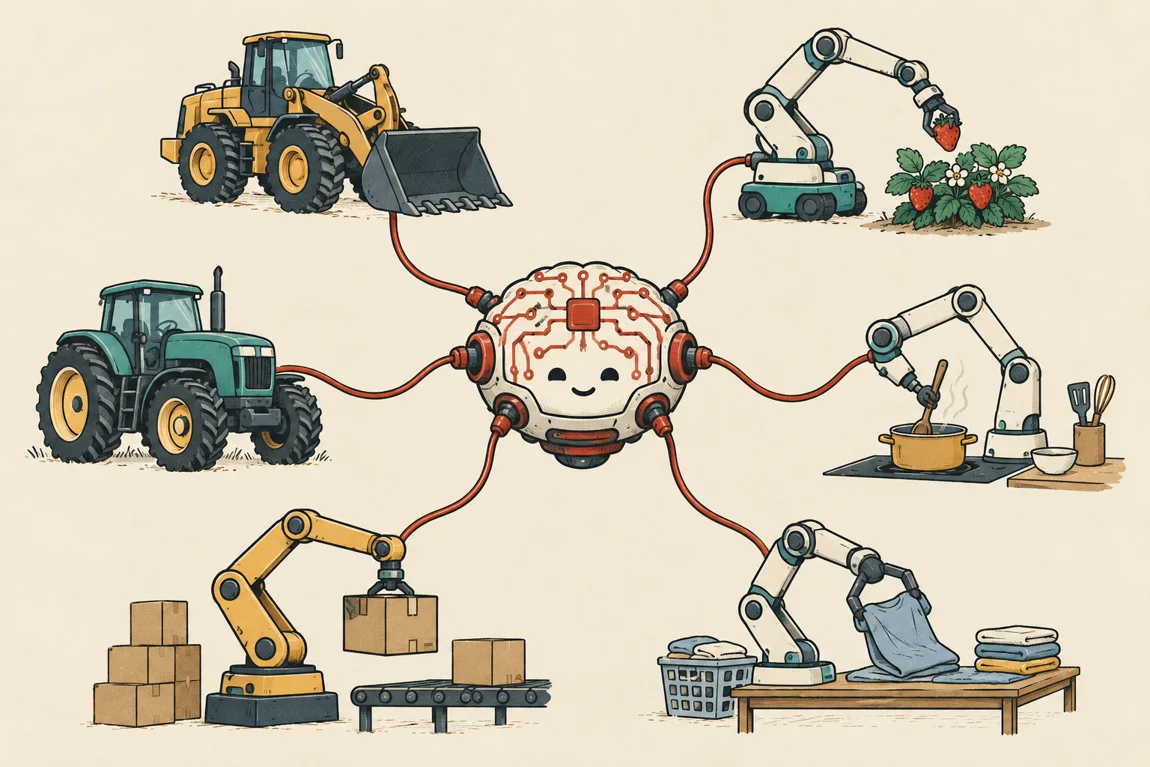
The Pi API is that thesis turned into a product. PI's own announcement post, "Frontier Models for Every Robot", describes a four step loop: you upload data, launch fine-tuning on compute and infrastructure PI manages, run the model on your robot through their hosted gateway, and feed evaluation results back into the next round. Access is a waitlist ("tell us what you want to build"), and PI publishes no pricing, no endpoint documentation, and no latency guarantee. What it does publish is the partner list, and the partner list is the argument: six companies in six industries are already running their machines on this layer, from a Utah wheel loader working a real commercial site with nobody in the cab to a Brooklyn warehouse packing orders through a full shift. PI's February 2026 essay said the quiet part plainly: this is meant to work in the same way developers use API based language models, a physical intelligence layer the whole field builds on.
The featured partners from PI's announcement. Six bodies, six industries, one loop: cameras and a task description go up to the model, one second chunks of motion come down.
Tap the card, swipe, or use the arrows.
How it works
Six mechanisms: what a VLA (vision-language-action) model is, how it writes motion, why it thinks in one second chunks, where its physical common sense comes from, what adapting it to your robot actually involves, and what it costs to run a robot brain from the cloud.
The obvious objection to a cloud robot brain is the round trip. The chunk is the answer: the robot is never waiting for the next command, because it is always executing a second of motion it already has. Drag the round trip and watch the buffer.
buffer is the number of actions still in hand when the next chunk lands. L is the full round trip in milliseconds: send the camera frames, run the model, send the chunk back. 20 is the milliseconds per action at 50 hertz (50 actions per second), and 50 is the actions per chunk. At PI's measured 139 ms round trip for a mobile robot: 50 minus 139 over 20 is 50 minus 6.95, about 43 actions of buffer, nearly nine tenths of a second of motion still queued. The robot only starves if a round trip ever exceeds a full second.
The grey ticks are the actions burned while the cloud thinks. In the next chunk, the amber ticks are the overlap that PI's real time chunking (RTC, June 2025) freezes to agree with what the robot will already have done, so the fresh chunk continues the motion instead of contradicting it. PI measured 108 ms end to end for a static robot and 139 ms for a mobile one, and reports RTC staying smooth past 300 ms of added delay.
The Pi API is one answer to a question every robotics company now faces. The market has produced exactly three, and serious players are running all of them at once.
The road here
Landmarks only: two and a half years from a research lab's first generalist policy to a waitlist for the layer.
Tap the card, swipe, or use the arrows.
Key voices
The people making the generalist case, the platform case, the simulation case, the skeptic's case, and the cases for keeping the brain in house or giving it away.
General purpose robots are close, and the engine is a self improvement flywheel: deployed robots generate the data that makes the next model better, which deploys more robots. His median estimate for fully autonomous household robots is 2030, and he argues robotics will scale faster than self driving did because data can come from many robots and many tasks at once, not one fleet driving one kind of road. On pi0.7 in April 2026, he added the scaling claim that matters for the API: once a model can remix skills compositionally, capability grows more than linearly with data, the way it did in language.
The product was never a brain for one robot; it is a single generalist brain for any robot, delivered the way developers already consume intelligence in software: as an API layer. PI's Layer essay argues developers should not have to rebuild the intelligence stack (data pipelines, training infrastructure, evaluation) any more than an app developer trains a language model, and the partner results in Figure 1 are presented as the first evidence: applications proliferate once the layer exists. The Pi API beta is this essay with a waitlist attached.
Fan agrees the foundation model is the destination and disagrees about the fuel. NVIDIA's bet is a three pronged data strategy (internet data, real robot data, and simulation at scale), with synthetic data as the lever that breaks the teleoperation bottleneck: you cannot hire enough humans to demonstrate every task in every kitchen, but you can generate worlds. That is a genuine technical disagreement with PI's real data first recipe, and it explains NVIDIA's open weights strategy for GR00T (graphics processing unit researchers' robot foundation model line): give the model away, sell the compute, the simulation stack, and the chips it all runs on.
The humanoid bubble will burst. Human hands carry roughly 17,000 touch receptors and there is no touch data tradition comparable to the decades of speech and image data the current models feast on; learning dexterity by watching human video is, in his phrase, pure fantasy thinking; and full size bipeds are an energy and safety hazard, since doubling a falling robot's size multiplies its fall energy eightfold. His target is mainly the humanoid form factor and video only learning at Tesla and Figure, not VLA (vision-language-action) models as such, but the data scarcity argument underneath applies to everyone in this primer: the physical world has no internet scale dataset lying around.
Adcock ended Figure's collaboration with OpenAI in February 2025 announcing a breakthrough on fully end to end robot AI built entirely in house, and Helix, Figure's own model, is that bet embodied: a proprietary brain that runs only on Figure's own humanoid, at two speeds (a 7 billion parameter vision-language model thinking at 7 to 9 hertz, an 80 million parameter policy moving at 200 hertz), trained on about 500 hours of teleoperation. Nothing is licensed, nothing is rented, and the data flywheel, the hardware, and the liability all live under one roof. It is the exact architecture the Pi API is selling against.
Their motivating complaint: vision-language-action models were largely closed and inaccessible, which blocked adoption and scrutiny alike. So they released a 7 billion parameter model, trained on 970,000 real robot demonstrations from the Open X-Embodiment dataset, with full weights and fine-tuning code, and showed it beating Google's closed 55 billion parameter RT-2-X by 16.5 points across 29 tasks. Remi Cadene's LeRobot project at Hugging Face carries the same argument into tooling: shared datasets, shared models, cheap open hardware, a community that compounds. PI itself straddles this camp: openpi gave away pi0's weights in February 2025, and the API now rents the newer ones.
Where leaders think this goes
As of October 2026. The loudest disagreement in robotics is no longer whether generalist models work; it is who should own the layer they create.
Every serious player trains one model across many robots and tasks instead of engineering per task policies. The vertical camp does it too: Figure's Helix is a single set of weights for every behavior its humanoid performs, and Tesla trains one stack for Optimus. The evidence base is shared as well: pi0's original comparisons had strong per task and small model baselines scoring near zero on most tasks, while the generalist worked. Nobody is pitching a return to hand built skills.
PI's 10,000 plus hours of robot data, Sunday Robotics' bet on a cheap data collection glove instead of teleoperation rigs, Jim Fan's simulation program, Brooks's missing touch data argument: these are four different answers to the same admitted scarcity. Deployment is valued partly as a data strategy; Ultra's full shifts and Weave's laundry loads are training data with a revenue line attached, which is why PI's own pretraining improved measurably when partner data joined it (Weave's missed grasps down 42 percent, interventions down 50 percent).
The language model precedent: once a capability layer exists as an API, thousands of application companies appear that could never have built the model, and the layer owner sees all of their data shaped problems. PI's partner structure is the proof of concept, application companies like Ultra (warehouse packing) and Weave (home laundry) stay vertical in their markets while renting the brain, exactly the customer the API is priced (secretly, for now) for.
The counter: in robotics, unlike software, the data flywheel, the safety liability, and the hardware co-design all live with whoever deploys the machine, so the model cannot be separated from the robot the way an API separates text from an app. Figure builds brain, body, and deployment under one roof; Sunday collects its own human data with its own glove for its own home robot; Tesla is the purest form, and also the cautionary tale, with Musk conceding in January 2026 that its deployed Optimus units were primarily for learning, not productive tasks.
PI gives away the previous generation (openpi carries pi0 and pi0.5 weights) and rents the current one, the same cadence DeepMind runs: Gemini Robotics to trusted testers, its embodied reasoning models through the Gemini API (application programming interface), the on-device variant behind an SDK (software development kit) application. The stated reasons are safety, support, and the cost of frontier training runs; the structural effect is that the layer stays a business, not a commons.
OpenVLA's 16.5 point win over a closed model 8 times its size is the camp's favorite receipt: openness did not mean weaker. LeRobot's argument is compounding: shared datasets and models improve faster than any one company's fleet. NVIDIA opens GR00T's weights because it sells the surrounding stack, which makes openness a business strategy rather than a sacrifice, and the one that historically wins developer ecosystems.
Takeaways
The Pi API is a language model playbook move in a physical market: a generalist model, a hosted fine-tuning loop, a gateway, a waitlist. What makes it more than an analogy is the partner evidence behind it and the engineering that makes cloud control survivable: one second action chunks, inpainted in real time, so the network's distance from the robot stops mattering. Whether the layer or the integrated robot company wins is the industry's live argument, and PI is now running both sides of its own hedge, open weights behind it and a closed gateway ahead.
- The product is the layer. Upload data, fine-tune on PI's compute, run through their gateway, iterate on failures. Six partners across six industries are the pitch; no pricing is published, and access is a waitlist.
- Chunks are why the cloud works. Fifty actions per inference, one full second of motion per call. At PI's measured 139 ms round trip the robot still holds about 43 actions of buffer; starvation needs a full second of silence.
- Adaptation is measured in days and small hours. PI's own guidance runs from 1 to 20 hours of demonstrations for many tasks, its Olympics fine-tunes used under 9 hours, and Almond's deburring model took four days of API iteration.
- Reliability is the second product. Demonstrations plateau; PI's RECAP recipe (coaching interventions plus reinforcement learning on the robot's own experience) more than doubled throughput and roughly halved failures, past 90 percent on espresso.
- Three sales models, one substrate. Rent the API (PI, gated DeepMind), download the weights (OpenVLA, GR00T, openpi), or build in house (Figure, Tesla, Sunday). Everyone generalist underneath; the fight is over who owns the layer and its data.
Keep exploring
Sources
- Physical Intelligence, "Frontier Models for Every Robot" (the Pi API beta announcement, October 13, 2026), the offer, the workflow, and the partner stories in Figure 1.
- Physical Intelligence's announcement post on X (October 13, 2026), the post this primer answers.
- Physical Intelligence, "pi0: a vision-language-action flow model for general robot control" (October 31, 2024), and the paper, arXiv:2410.24164.
- Physical Intelligence, "FAST: efficient action tokenization for vision-language-action models" (January 16, 2025).
- Physical Intelligence, the openpi release (February 4, 2025), open weights and the 1 to 20 hour fine-tuning guidance.
- Physical Intelligence, "pi0.5: a vision-language-action model with open-world generalization" (April 22, 2025), and arXiv:2504.16054.
- Physical Intelligence, "Knowledge Insulation" (May 28, 2025).
- Physical Intelligence, "Real-Time Chunking" (June 9, 2025), the 108 to 139 ms measurements and inpainting behind Figure 2.
- Physical Intelligence, "pi*0.6 and RECAP" (November 17, 2025), coaching plus reinforcement learning, throughput and failure numbers.
- Physical Intelligence, "The Physical Intelligence Layer" (February 24, 2026), the platform thesis and the Weave and Ultra results.
- Physical Intelligence, "pi0.7" (April 16, 2026), the air fryer composition and zero data cross-embodiment results.
- Google DeepMind, "Gemini Robotics On-Device" (June 24, 2025), the local inference counter-design and its 50 to 100 demonstration adaptation.
- TechCrunch on Rodney Brooks's humanoid bubble essay (September 26, 2025).
- Sergey Levine on the Dwarkesh podcast (September 12, 2025), the flywheel and the 2030 estimate.
- SiliconANGLE on PI's $600M Series B at a $5.6B valuation (November 20, 2025), funding as reported; PI does not publish its rounds.