Muse vs. Codex, Checked
On October 13, 2026, a tester who posts as SPAC89 published a full day with Meta's new flagship, Muse Wonder Full, under one headline question: is it actually better than Claude Opus 5.5 and GPT-6 Astra? His verdict: faster, more proactive, and so hungry for quota that it ate his week. This primer checks every number in that post, then flips between the two coding agents on one identical brief.
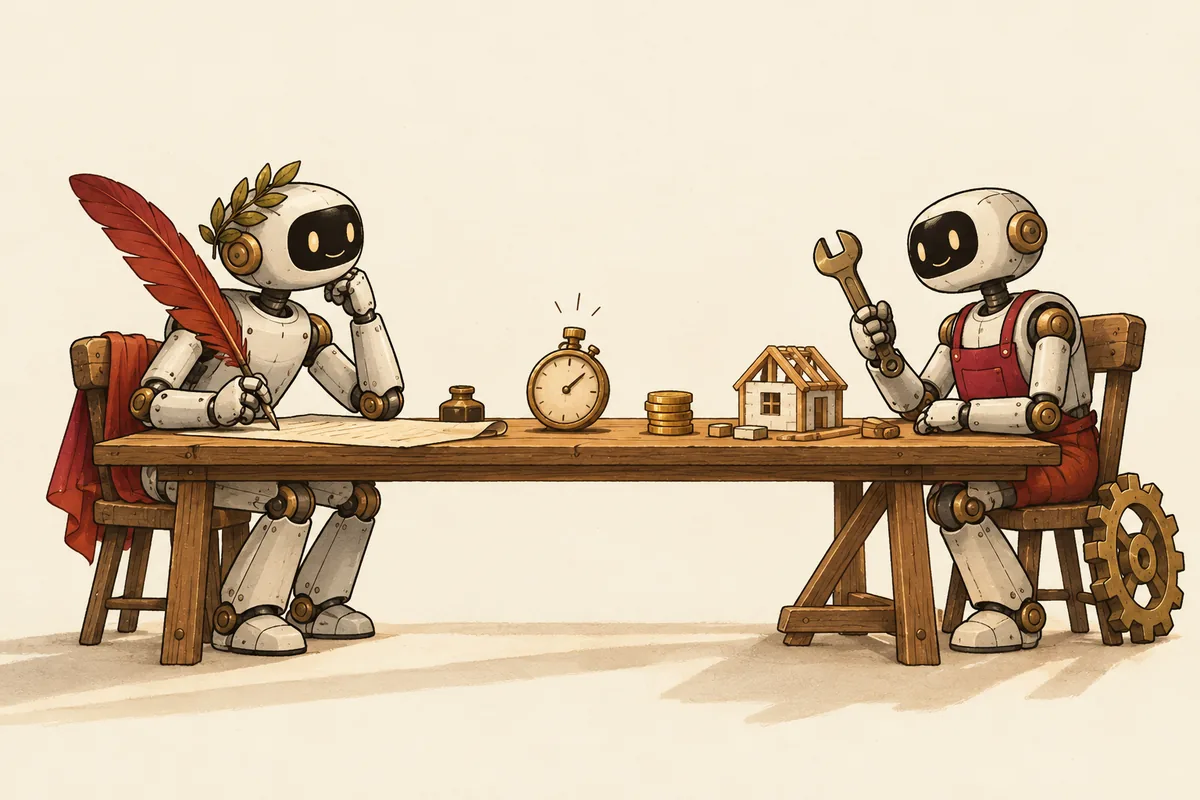
The brief
The post matters because it is not a benchmark press release. One person paid for the $50 plan, ran real projects in Muse Code at maximum reasoning, timed the rivals on the same 3D builds, and wrote down where it hurt. First impressions like that set the narrative a new model lives under.
Two of his claims survive contact with the vendors' own pages exactly as written. Two more are his alone: careful single-run measurements nobody else has reproduced. And the headline names a model, GPT-6 Astra, that his stopwatch never ran against; the tests in the article ran against GPT-6.1 Sol Ultra, Codex's top tier. This primer keeps all three kinds separate.
The sentence to remember: Wonder Full is a sprinter with a small tank, Codex is the cheaper marathoner, and the independent index still belongs to Opus.
Checked line by line, the post is half receipts and half one person's stopwatch, and the honest answer changes depending on which half you read.
Figure 1: one brief, two agents
Before the post's numbers, the same discipline applied at home. In October 2026 this workspace ran one written brief through both coding agents, no audio tool allowed: build the full sound pack for a tiny game called Coin Hop. Six files, specified exactly: a jump under half a second, a coin pickup, a two-second win jingle, a thirty-second music loop that wraps seamlessly, one spoken line from a friendly character, and a two-voice dialogue. Flip the switch to compare the two runs; every number was measured when the test ran.
Same brief, same six files, same constraints. The effects and music were a draw: both agents composed the loop so the seam could not exist. The voices were not a draw, and no prompting closes that gap, because it lives in the voice model, not the agent.
Provenance: run in this workspace on October 12 and 13, 2026, for a three-way comparison with Summer Engine's Game Audio Maker. The Summer arm never ran; its sign-in flow consumed three sessions and the run was skipped by decision, so Summer is not scored here. The comparison was published as a primer on October 13 and has since been taken down; these measurements are cited from the preserved test record.
How it works
Six mechanisms explain nearly every difference the post reports. Tap a card to open it.
Strip the branding and the two systems differ in four places: the harness around the model, the effort tier you pay for, the clock, and the meter.
Figure 2: the verified scorecard
Every row traces to a primary source: Artificial Analysis for the index, Meta's published model card for the task rows, all at maximum reasoning effort. Meta's own caveats travel with its table: rival runs were best-effort, and some coding rows used different tooling for different models.
Intelligence Index Artificial Analysis, independent, ten evaluations
DeepSWE 1.1, software engineering Meta's model card
SWE-Marathon, long-running coding Meta's model card
Terminal-Bench 4.0, terminal tasks Meta's model card
Bars are scaled to each row's leader. The smaller Wonder checkpoint scores 52 on the index and 53.1 on SWE-Marathon; it matters here because it is the one you can actually buy by the token.
On verified numbers the three flagships sit within five points of each other, and each one owns at least one row outright.
Figure 3: what the meter actually charges
Subscriptions hide the per-token truth, so here it is as arithmetic. Set the size of a job, in millions of tokens in and out, and the four published rate cards price it. Cached input is ignored; with cache hits at $0.20 or less per million on all four cards, long agent runs usually pay less than this on the input side.
Wonder Full is missing from this table on purpose: Meta publishes rates for both checkpoints ($4 in, $20 out) but sells only the smaller one by the token. SPAC89's claim that a Wonder run would have cost more than twice the Sol run checks out only halfway at list prices: per token, Wonder is exactly 2.00 times Sol Standard. Anything beyond that came from token counts only he saw.
At the sticker, Wonder and Opus cost the same, Sol costs half, Astra costs two and a half times more; the bill is decided by how many tokens the agent chooses to burn.
Timeline
Six weeks separate Meta's warm-up act from its flagship, and OpenAI replaced its own mid-tier model seven days after launching it.
Key voices
The loudest disagreement is not about quality. It is about what a run costs, and two honest testers got opposite answers.
Where leaders think this goes
Positions as of October 2026, each attributed to its source.
Where they agree
Where they split
Everyone agrees the race moved from answering to enduring; they split on how you will pay for the endurance.
Takeaways
Wonder Full is a real frontier model with a real frontier problem: it is fast, proactive, and rationed. On the verified scorecard it stands two index points behind Opus and ahead of Astra, first on long coding runs, last on nothing that matters. Codex's counter is not a better flagship; it is a cheaper meter and a speed lane. Pick by which failure you can live with.
- The index says Opus, the marathon says Wonder. 58 to 56 to 53 on Artificial Analysis; flip to SWE-Marathon and Wonder Full leads by eleven points. There is no scoreboard-free winner.
- The post's headline names the wrong rival. Its stopwatch ran against GPT-6.1 Sol Ultra, not Astra, and its times are one person's single runs: direction plausible, numbers unverified.
- Price is a tie at the top, a gap below. Wonder and Opus both list at $4 in and $20 out per million; Sol is half that; Astra is two and a half times it. Bills diverge because agents burn tokens at different rates, which is how two honest testers filed opposite cost reports.
- The subscription is the sharp edge. His measured burn: one full five-hour window eats about 37 percent of a Muse Code week, against about 14 percent of a Claude week. Same window design, very different tank.
- Watch the meter, not the launch. Six weeks took Meta from 48 to 56 on the index, and seven days was enough for OpenAI to replace Sol. Any verdict from launch week, this one included, has a short half-life.
Keep exploring
Sources
Honesty notes. SPAC89's timings, his burn figures (36 to 38 percent of a Muse Code week per full window; 13 to 15 percent on Anthropic's plans), and the two launch-week cost anecdotes (the $4.11 run and the $96 Pokemon run) are single-source reports; they are labeled as his or as anecdotes wherever they appear, and none of them is used as a verified number. The Coin Hop measurements in Figure 1 are this workspace's own, from October 12 and 13, 2026; the primer that first published them was removed on October 13, 2026, and the numbers are cited from the preserved test record. Wonder Full has no API price, so any dollar figure attached to it anywhere, including in the seed post, is a conversion rather than a rate.