What Is a FLOP?
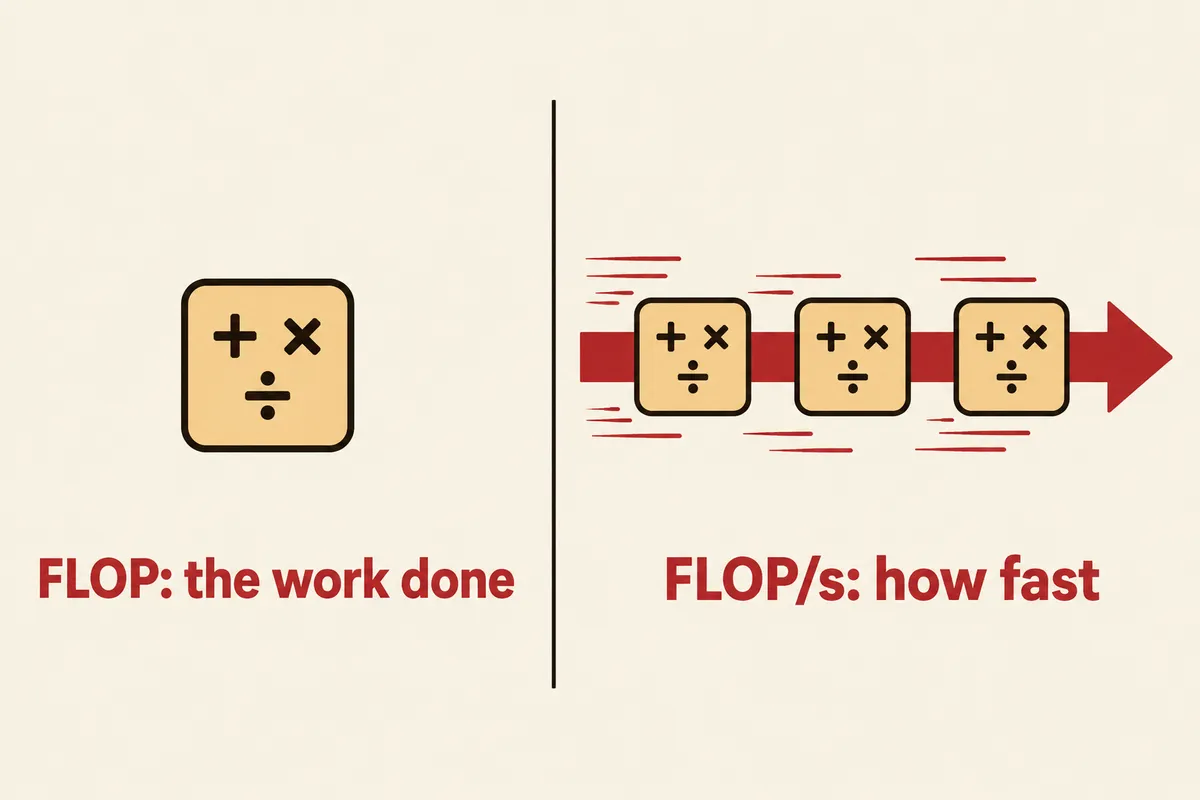
Every AI number you hear, training cost, chip speed, API prices, is the same unit wearing different clothes: the FLOP. One FLOP is one floating-point operation, a single piece of arithmetic. This primer covers what a FLOP is, why training is billed in hundreds of sextillions of them, why your phone does trillions per second without noticing, and why the whole industry is an argument about who gets to do the most of them. The sentence to remember: a FLOP counts the work done, FLOP/s measures how fast, and AI runs on both.
1. The brief
Open a GPU spec sheet and you will see TFLOPS. Read an AI paper and you will see training FLOPs. Listen to a lab CEO and you will hear about compute. All three are the same unit. A FLOP is one floating-point operation: one piece of arithmetic on numbers with decimal points, like multiplying 2.5 by 3.7. Neural networks are, underneath everything, enormous piles of exactly this kind of arithmetic, so the FLOP became the industry's unit of account.
Chip speed is measured in FLOP/s (operations per second). A training run's total bill is measured in FLOP (no slash). Confuse the two and every number in AI becomes nonsense; keep them straight and you can read a GPU spec, a training-cost headline, and a cloud price list like they are the same document, because they are. The sentence to remember: FLOP counts the work done, FLOP/s measures how fast it gets done.
2. How it works
Six mechanisms, from the single operation up to the industry that fights over it. Tap each card for the plain-language version, one concrete example, and what changed recently.
The powers-of-ten zoom
One tap, one rung up the ladder. The counter sweeps through every order of magnitude on the way. Start at your phone and end at a frontier training run.
Rung figures are peak or representative rates, rounded; the cluster rung is illustrative. Phone figure: A17 Pro-class GPU, about 2.1 TFLOPS FP32. H100 figures: NVIDIA's official spec, with sparsity.
3. The landmarks
Six moments that made the FLOP famous, 2020 to 2026. One tap per step, or use the arrow keys.
4. Key voices
Four people who are spending the compute, selling the compute story, tracking the compute, or betting the whole thesis is wrong. The collision is at the bottom.
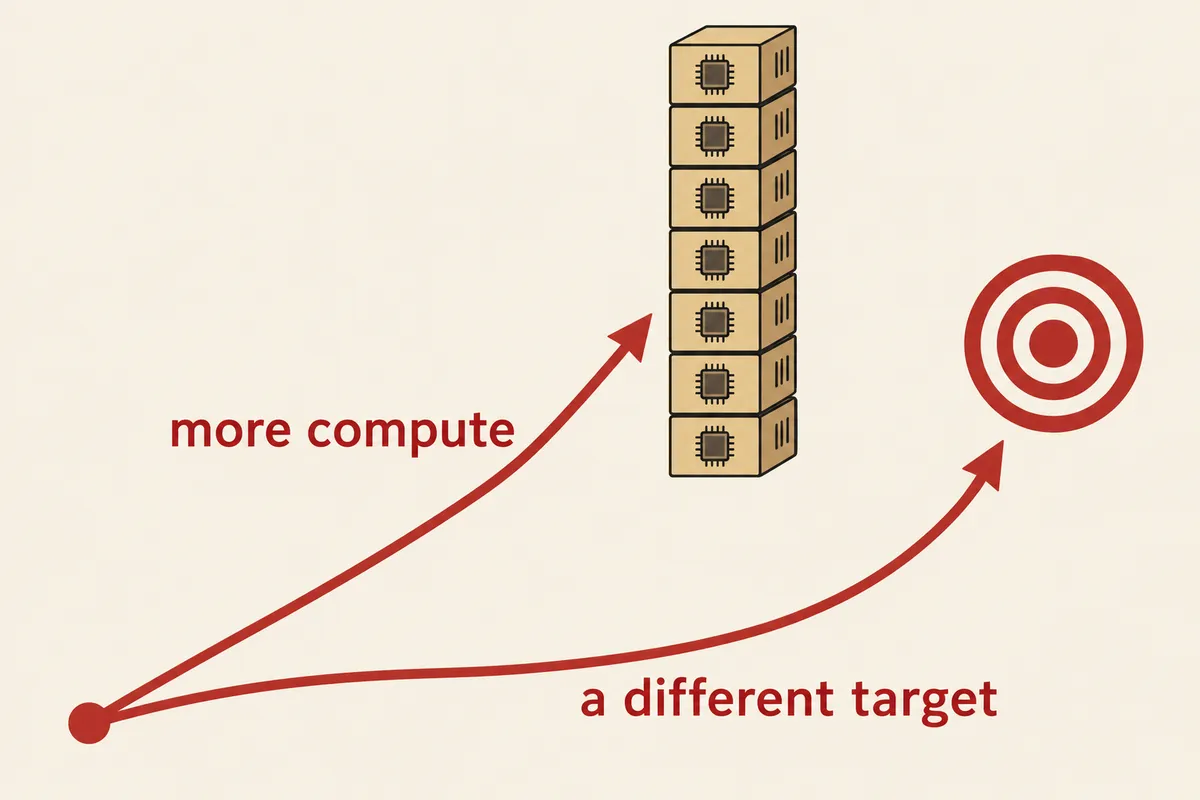
Amodei and Altman say the path is more compute, bought in ever-larger piles, because intelligence is the thing you can scale with money. LeCun says the pile is aimed at the wrong target: scaling text prediction to human-level intelligence is "simply false" (his words to MIT Technology Review), and his $1.03B AMI Labs bet is that the future belongs to world models that learn how reality behaves instead of predicting the next word. Epoch AI sits in the middle with a spreadsheet: the trend is 5x per year whether anyone likes it or not, but the fastest-falling number in AI is not the training bill, it is the price of running last year's model.
5. Where leaders think this goes
Every item below is attributed: who said it, where, when. These are the leaders' visions for where compute goes over the next 5-10 years, not my conclusions. Predictions go stale; this section is frozen as of October 2026.
Where they agree
Where they split
Takeaways
A FLOP is the smallest unit of AI's work, and the industry's biggest numbers are all just FLOPs counted at different scales. Speed is FLOP/s, the bill is FLOP, and nearly everything else follows from those two.
- Work vs pace. FLOP counts the work done; FLOP/s measures how fast. Training compute is always the first, chip specs the second. Confuse them and every AI number becomes nonsense.
- Training is 6ND. About 2 FLOPs per parameter per token on the forward pass, 4 on the backward. Inference is just the forward pass, so it costs about 2, a third of training.
- The ladder spans eleven orders of magnitude. Your phone at 10^12 FLOP/s, a frontier training run at 10^23 FLOP total. That gap is the entire reason the data centers exist.
- Training is paid once, inference is paid forever. Serving a popular model can cost more than training it, which is why labs deliberately overtrain smaller models that are cheap to serve.
- Compute is the currency, and the fight is over the pile. Frontier training compute is up 5x per year since 2020, and the constraint has moved from chips to gigawatts. LeCun's counter stands: more FLOPs aimed at the wrong target still miss.
The FLOP is the atom of AI economics. Everything else, the chips, the data centers, the trillion-dollar buildout, is just a fight over who gets to do the most of them.
Keep exploring
Sources
Every factual claim in sections 2 through 5 traces to one of these.
- arXiv paperLanguage Models are Few-Shot Learners (GPT-3)
- ExplainerFLOP for Quantity, FLOP/s for Performance
- ReferenceFloating point operations per second
- ExplainerWhere "backward is about 2x forward" and the 6ND rule come from
- NewsReflection AI Beam: How 100 Million RL Rollouts Changed The Open-Model Race
- CourseIntroduction to Inference (zero-to-sglang course)
- SpecsNVIDIA H100 Tensor Core GPU
- SpecsApple A17 Pro vs Apple M2 Pro: specs comparison
- SpecsNVIDIA GeForce RTX 5090 Laptop (140W) Full Specs
- InterviewDario Amodei (Anthropic CEO): $10 Billion Models, OpenAI, Scaling, and AGI in 2 Years
- EssayMachines of Loving Grace: How AI Could Transform the World for the Better
- TranscriptSam Altman: OpenAI, GPT-5, Sora, Board Saga, Elon Musk, Ilya, Power and AGI
- NewsYann LeCun World Models Bet: AMI Labs Stakes $1.03 Billion Against Large Language Models
- DataTrends in AI
- NewsEpoch AI: chips shipped through 2027 could run 30-170 million frontier agents at once
- NewsAI Is Getting 13x Cheaper Every Year: What Epoch AI's Numbers Mean
- NewsThe Impending, Inescapable Deluge of A.I.
- ExplainerCost of training (compute explainer)
- NewsFrontier AI training cost trajectory 2026