Primer
The Robot That Taught Itself Assembly
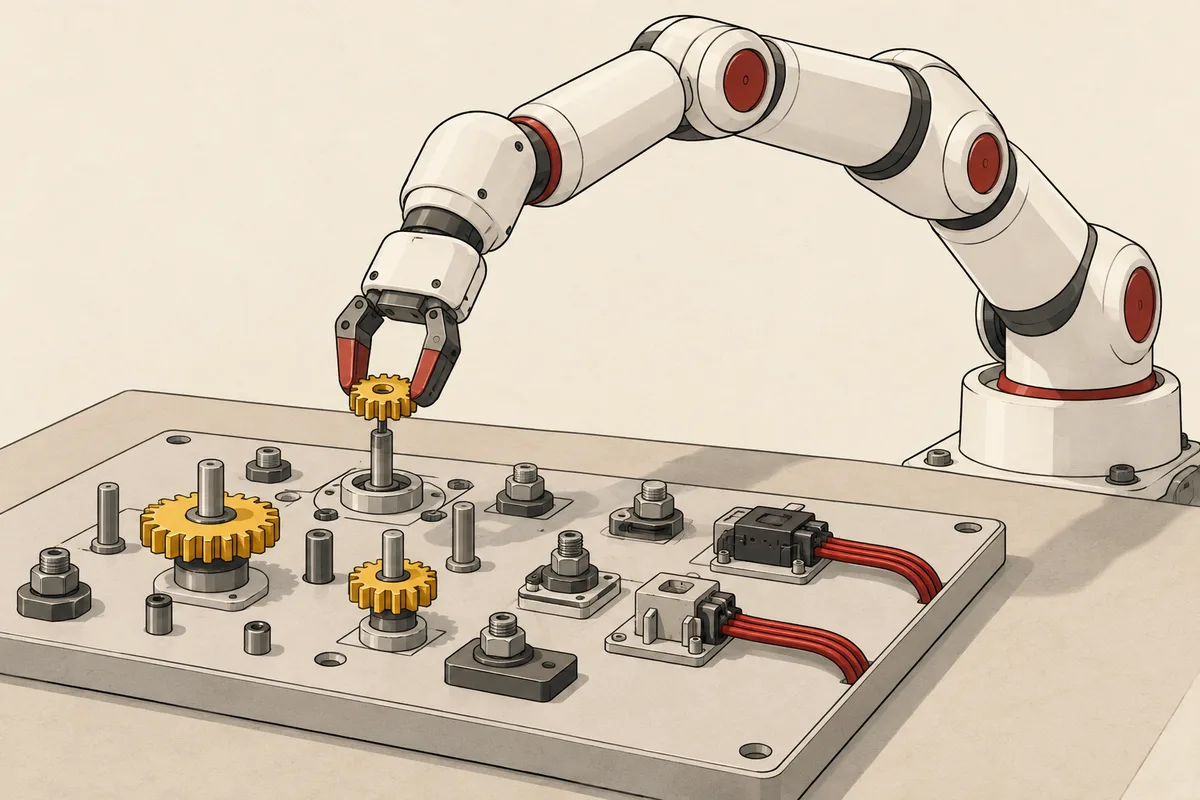
AlphaNIST is a robotics project from NVIDIA and the University of Washington, posted to arXiv on 9 October 2026. One shared reinforcement learning policy, a single neural network, was turned loose in simulation on the United States standards lab’s small-parts assembly test: twenty tasks of peg insertions, gear meshing, electrical connector insertions, and nut threading, with parts as small as four millimeters across and clearances as low as zero. Nobody demonstrated a single move. The policy scored one point when a part ended fully assembled and nothing for getting closer, and it was never told the job had stages. It reached 98.2 percent training success across all twenty tasks, and on the way it invented the tricks in the film below: dropping a badly held peg to grab it better, rolling a nut flat with the board’s help, tapping a tiny nut to start its thread, shoving clutter out of its own way, and leaving a job half done to finish another first.
One policy, a one-bit reward, twenty assembly tasks: show a learner only what finished looks like, at enough scale, and the technique becomes its own idea.
Watch it work
Four runs, ten parts each, no script
This is the project’s own film, streamed from the AlphaNIST page. Each run asks the policy to assemble ten components in whatever order it chooses. The moments the project flags are worth jumping to: parts carried across the board, clutter pushed aside, and at 1:34 a grasp that fails and gets recovered. The chip row under the player is theirs, grouped the way they group it.
Ten-component assembly.
Read the film honestly: these are four selected successful runs, chosen to show the behavior. Measured across all attempts at ten active pairs, this policy succeeds 84 percent of the time. The film shows what success looks like; the 84 percent is what it is worth.
The four runs use a policy trained separately from the single-policy result below. Film and poster stream from the project page; nothing is rehosted here, and the close-up inset is a zoomed view of the same footage.
Narrated overview · 4:36Watch the hands, not the parts. Nothing in the reward mentions regrasping, rolling, tapping, or tidying. Each of those is a means the policy found on its own, because the only end it was ever given was a finished assembly.
The test
A ruler for robot hands
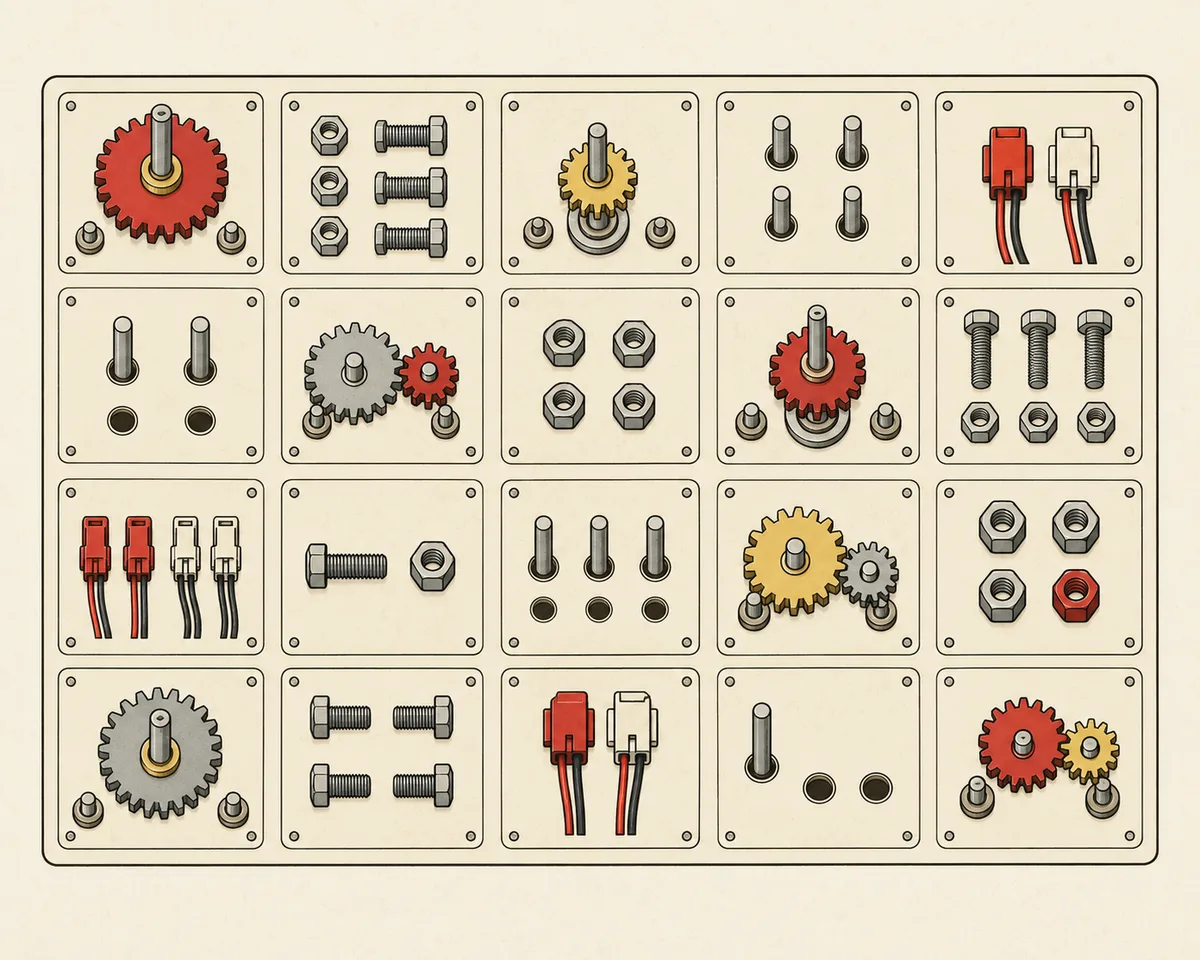
NIST built Assembly Task Board #1 to quantify small-parts assembly: can a robot insert the peg, mesh the gear, seat the connector, thread the nut? Kimble and co-authors published the benchmarking protocols in 2020, varying part size, shape, location, and type across the board. AlphaNIST uses twenty of its assembly pairs, each one movable part plus the fixed geometry it mates with.
Three things make the board a genuinely hard exam. First, order is not given: with several parts live at once, finishing one task can block access to the next. Second, each task is a long chain of contact-rich work with wide variation in starting poses, and parts slip, tilt, misalign, and jam along the way. A tilted nut can cross-thread, and then the only way forward is to back up and redo it. Third, the fits are tight: parts down to four millimeters, helical threads, and clearances the paper describes as low as zero between mating surfaces. There is no slack to hide sloppy control in.
How it works
No stages, one network, one bit of feedback
The standard way to build an assembly robot is a pipeline: a pick policy, a place policy, a screw policy, a planner on top. AlphaNIST deletes the pipeline. Five choices do the work instead. Tap a card to open it.
The robot is a simulated seven-axis Franka Emika Panda arm with a parallel-jaw gripper, running in Isaac Lab across thousands of parallel copies of the scene. The policy outputs a seven-dimensional relative joint-position target plus one gripper command, at 25 hertz (Hz). Separate actor and critic networks (SimBa architecture) are trained with plain PPO (proximal policy optimization), synchronously on multiple graphics processing units (GPUs). No task-specific value heads, no specialist pretraining, no per-task tuning.
The contrast is the point. Factory trained separate pick, place, and screw sub-policies. AutoMate combined disassembly-based imitation with curriculum reinforcement learning. ARCH put an imitation policy on top to select from a library of primitives. SGS, the closest predecessor, solved these board tasks one policy per task. AlphaNIST keeps none of that scaffolding: one network sees the scene and moves the arm, for all twenty tasks.
Its observations are surface point clouds of three things: the movable part, the fixed mating geometry, and the robot itself, combined with proprioception (its own joint state) and its previous action. There is no discrete task identifier anywhere in the input, and no label saying which stage of work it is in.
Concretely: the same network threads an M4 nut in one episode and meshes a medium gear in the next, not because it was switched or told, but because the clouds differ. Geometry is the task description. That is what lets one policy cover twenty tasks without a routing layer, and what forces it to actually look at the parts instead of memorizing twenty routines.
The reward fires once, when the part reaches its fully assembled pose, and the episode ends. On top of that sits a single small control cost, one coefficient shared across all tasks, penalizing action magnitude, joint velocity, and torque. The paper is explicit that this cost carries no progress information: it prices effort, it does not point toward the goal.
The control experiment is the warning label. When the team added the usual dense shaping rewards, small bonuses for reaching toward the part and aligning it, joint training collapsed to 17.8 percent success. Helpful-looking guidance, given to one policy learning twenty tasks at once, mostly taught it to chase the bonuses. The one-bit reward, harsh as it looks, is the version that works. The formula card below states it exactly.
Training episodes reset into cached states adapted from OmniReset: parts ungrasped on the table, mid-pickup, in transport, near mating, and partially assembled. A policy that cannot yet grasp a four-millimeter peg from the table can still practice the final insertion a thousand times, from starts near the end.
The nuance the authors insist on: the bank supplies starting states, not demonstrations. Nothing in a reset shows the arm what to do, and the policy is never told which family a start came from. It still has to discover every motion itself. The bank only decides where practice begins, which turns out to matter as much as how it is scored. That is the next card.
Each bank entry carries a recent success rate $\hat{p}$, and is sampled with weight $w = \varepsilon + \sqrt{\hat{p}(1-\hat{p})}$. The square-root term peaks at $\hat{p} = 0.5$ and shrinks toward both ends: states the policy always solves and states it never solves are both boring, one because there is nothing left to learn there, the other because success is too rare to learn from. The small $\varepsilon$ keeps every state reachable. The lab below walks the arithmetic and lands on what this bought: at the largest scale, 97.4 percent evaluation success with this sampling against 84.3 percent with uniform sampling.
r is the reward for the episode, paid once. d is the assembly distance: how far the part’s pose sits from its fully assembled pose, in meters. 0.001 m is one millimeter, the paper’s bar for calling a part assembled. When the condition first holds, the reward is paid and the episode ends.
Two honest footnotes. The threshold is about final pose, not about part clearance; some parts on this board fit with clearances near zero, which is a separate hardship. And the one control cost rides along with this reward, pricing effort. It never tells the policy it is getting warmer.
The practice schedule
Success-guided sampling, walked through
The reset bank decides where episodes start; this rule decides how often each start gets practiced. One tap per step, or use the arrow keys.
Steps 1 to 4 use example success rates to make the arithmetic visible; the state families are the paper’s. Step 5 is the paper’s measured evaluation, no illustration.
What nobody programmed
An eight-move repertoire, all improvised
The project’s gallery of emergent strategies. None of these appears in the reward, the observations, or any instruction. Each is a means the policy settled on because it ended, more often, in a finished assembly.
Picked up by its middle, an 8 mm peg cannot be inserted. The policy puts it down and takes it again near the end.
A waterproof connector arrives in a pose the gripper cannot use, so the policy rolls it against the board and nearby geometry until it can.
The D-sub connector gets released and re-taken at a working angle rather than forced in crooked.
A medium gear is pivoted in hand, caged against a fingertip on the way down, to meet its shaft squarely.
An M12 nut standing on its edge is rolled flat using the board, the way a person uses a tabletop.
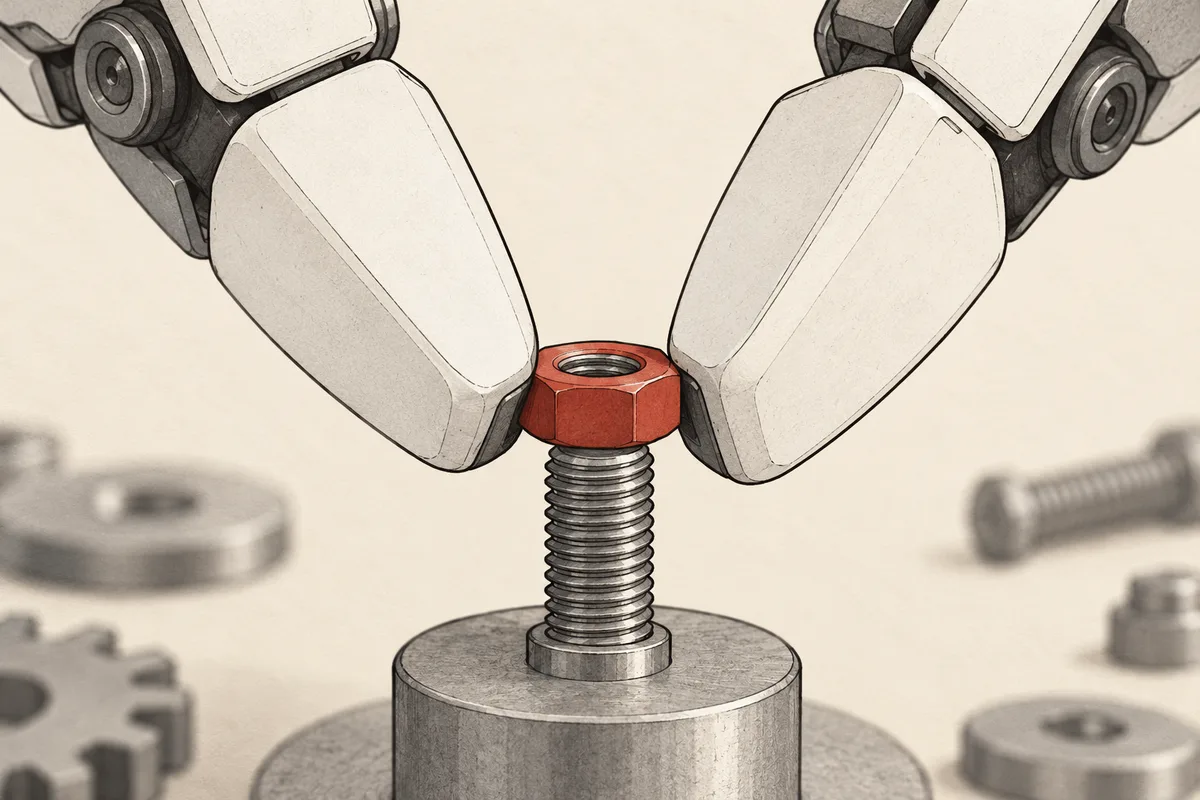
To start an M4 nut, too small to simply twist on, the policy taps it one-sidedly with a fingertip until the thread catches.
An 8 mm rod lying badly gets pushed and shoveled across the board into a spot where a clean pickup exists.
The big M16 nut is threaded by walking the fingertips around it in a full circle, a move nobody demonstrated because nobody was asked to.
The headline result, on film
One policy, twenty tasks, one part at a time
The second film is the single-component experiment: the same shared policy performs all twenty tasks, one component per run. The right half of the frame is the project’s own close-up camera. Jump by assembly family.
Same honesty rule as the first film: this is a demonstration reel. The measured claim behind it is the 98.2 percent training success across the twenty tasks, stated with its setup in the results below.
The numbers
Sharing beat specializing, by a lot
Every number in this section is author-reported, measured in simulation, and labeled the way the paper labels it. Training success and evaluation success are different measurements; the primer keeps them apart.
Why sharing helps is the paper’s implicit argument: grasping a peg and grasping a rod are cousins, and one network gets to reuse what it learns across all twenty tasks, including the tasks where a lone specialist, trained from random starts, could not get off the ground. On M4 nut threading, the 4 mm peg, and rod insertion, specialists scored at most 0.3 percent; the shared policy solves all three with no task-specific changes.
The multi-part experiment trains a separate policy for each count of simultaneously active assembly pairs, and tests it at that same count. Success means every active pair ends assembled at once, with fifteen seconds allowed per pair and no prescribed order. Pick a count:
The decay is gentle, roughly a point or two per added pair, which is itself the surprise: interference between tasks was the expected failure mode, and the policies mostly route around it, moving parts aside and sequencing themselves.
Timeline
From a ruler to a self-taught policy
Landmarks only. One tap per stop, or use the arrow keys.
Key voices
Who thinks what
The work is days old, so the record is thin and this primer says so: one paper, one project page, and one long Hacker News thread are most of what exists. The disagreements in that thread are real, though.
The AlphaNIST authors
Zhang, Akinola, Narang, Handa, and eleven co-authors · NVIDIA and the University of Washington · arXiv, 9 October 2026
The name is an explicit homage: AlphaGo and AlphaGo Zero showed that a sparse terminal reward could produce discovered strategy in Go, and the paper asks whether the same holds for physical assembly. Their claim is narrow and they keep it narrow: one end-to-end policy, all twenty tasks, in simulation. Hardware transfer is listed as future work in their own limitations, not promised anywhere.
Source: Zhang et al., “AlphaNIST: Emergent Assembly Skills from Binary Task Rewards,” arXiv HTML
An AlphaNIST author, replying on Hacker News
Hacker News thread, October 2026
Pressed on the name, an author answered that it honors David Silver’s DeepMind group of 2016 to 2018, not that the work is theirs. The same replies concede the paper shows no transfer to real hardware yet, and stress the unglamorous groundwork: computer-aided design (CAD) level asset accuracy and a real understanding of motor and controller dynamics, credited to Narang and Akinola over several years, are what make results like these possible at all.
amluto
Commenter · Hacker News, October 2026
The thread’s most substantive skeptic praised the work overall, then doubted the fingertip nut-tightening in particular would survive contact with a real board, and pointed at the logistics nobody films: hundreds of thousands of physical rollouts mean worn parts, breakage, and cleanup. It is the authors’ own limitation, argued from the other side: simulation numbers, however clean, are not robot numbers.
jasonjmcghee and dpe82
Commenters · Hacker News, October 2026 · jasonjmcghee also submitted the story
Several readers objected that an “Alpha” prefix reads as Google DeepMind branding, whatever the intent, and that a NVIDIA and university project wearing it invites confusion. The authors’ homage defense, in the voice above, is the genuine disagreement: tribute to a research lineage, or a name that trades on someone else’s.
Kimble and co-authors, NIST
IEEE Robotics and Automation Letters 5(2), 883 to 889 · 1 April 2020
The board exists because assembly skill was unmeasurable: plenty of demos, no shared yardstick. Their protocols quantify capability at peg insertions, gear meshing, electrical connector insertions, and nut threading, with part size, shape, location, and type as the design factors. Every later claim in this primer, including AlphaNIST’s, is legible only because the ruler came first.
Where leaders think this goes
Everyone agrees on the caveat. They split on the sequel.
Researched October 2026. The source base is one paper and one discussion thread, so the camps below are exactly as wide as the evidence, no wider.
Where they agree: no physical robot has done this
The AlphaNIST authors (limitations, October 2026) · amluto (Hacker News, October 2026)
Builders and skeptic state the same fact in the same terms: every result is simulation-only, hardware-matched limits in the simulator do not establish robustness to perception error, latency, or contact-model mismatch, and physical-board transfer is future work. On the current state of the evidence there is no daylight between the camps at all.
Split: do the tricks survive the real world?
Side A, transfer is an engineering problem: the AlphaNIST authors (paper and Hacker News, October 2026)
The stated plan is sensor-derived observations on a physical board, with randomized contact and latency models in training. The author replies add that the asset engineering underneath, accurate part models and understood motor dynamics, took years and is precisely the groundwork transfer stands on.
Side B, contact is where simulators lie: amluto (Hacker News, October 2026)
The doubt targets the most impressive move specifically: fingertip nut-tightening is exactly the kind of fine contact behavior a simulator can flatter. And even perfect transfer leaves the practical bill: real rollouts at training scale mean part wear, breakage, and cleanup that simulation never charges.
Split: the name
Side A, borrowed glory: jasonjmcghee, dpe82 (Hacker News, October 2026)
“Alpha” is DeepMind’s prefix in the public mind; using it invites a misreading of who did the work, whatever the footnote says.
Side B, declared homage: an AlphaNIST author (Hacker News, October 2026)
The name points at the idea’s lineage, sparse rewards discovering strategy, and the debt is stated openly in the paper’s framing rather than hidden.
One team’s bet, marked as theirs alone
The AlphaNIST authors (paper, October 2026)
That the AlphaGo Zero pattern transfers: give a learner a binary terminal reward, a rich bank of starting positions, and enough parallel practice, and technique gets discovered rather than taught, in robotics as in Go. Their own stated next test is the harder one: a single terminal-reward policy trained on all twenty parts at once, up from the current ten. Nothing outside the team’s own paper endorses the bet yet.
Takeaways
What to carry away
AlphaNIST is a scope claim with receipts, all of them simulated. One shared policy, trained by plain reinforcement learning on a one-bit reward, covers the whole NIST board and invents recognizable technique along the way, while twenty specialists with thirty-nine times the compute do worse. Whether any of it survives a physical board is openly unanswered, by the authors’ own statement.
- One policy beat twenty specialists. 98.2 percent training success against 81.4, at 410 GPU-hours against 16,100: sharing tasks taught more than isolating them.
- The reward was one bit. Assembled within a millimeter, one point; anything else, zero. Adding helpful dense shaping collapsed joint training to 17.8 percent.
- Practice design did the quiet work. A bank of starting states from everywhere in the job, sampled toward the half-solved ones, was worth about 13 evaluation points at the largest scale.
- The technique was never taught. Regrasping, board-rolling, fingertip tapping, tidying, and task-switching all emerged; none was specified, demonstrated, or rewarded.
- Selected films are not rates. The hero video shows chosen successes; the measured rate at ten active pairs is 84 percent, and every number here is simulation-only.
Keep exploring
Related pieces
What Is Reinforcement Learning?
Learning from the score instead of the answer key: the training loop AlphaNIST runs, with the arithmetic worked through.
Move Like a Thing
Motion that feels right because the physics is real: spring solvers and overshoot, the software cousin of contact-rich control.
How a CNN Sees
How a network turns raw sensor input into structure: the perception side of the same problem AlphaNIST solves with point clouds.
Transformer vs. Neural Network
One sentence, three wirings: how different network shapes move information, the background for reading any policy architecture.
Sources
Primary sources
Every claim above traces to one of these. Links go to the exact page, paper, or post, not a homepage.
Full paper, HTML · arXiv:2610.13354 · submitted 9 October 2026. Method, training setup, all results, limitations.
Abstract page · arXiv:2610.13354 [cs.AI, cs.RO] · October 2026.
NVIDIA and University of Washington · the films, the timestamp groupings, Figure 5, and the code release status.
The project’s own keyframe labels and episode boundaries for the hero film, 50 frames per second, 8,050 frames.
National Institute of Standards and Technology · what Task Board #1 measures.
NIST publication record · IEEE Robotics and Automation Letters 5(2), 883 to 889 · 2020.
Hacker News · October 2026. The naming homage, the no-hardware-yet concession, the asset engineering credit.
Hacker News · October 2026. The fingertip-threading doubt and the physical rollout logistics.
Hacker News · October 2026. jasonjmcghee, dpe82, and others on the “Alpha” prefix.
Zhang et al., 2026 · the per-task predecessor whose sampling rule AlphaNIST borrows for one shared policy.