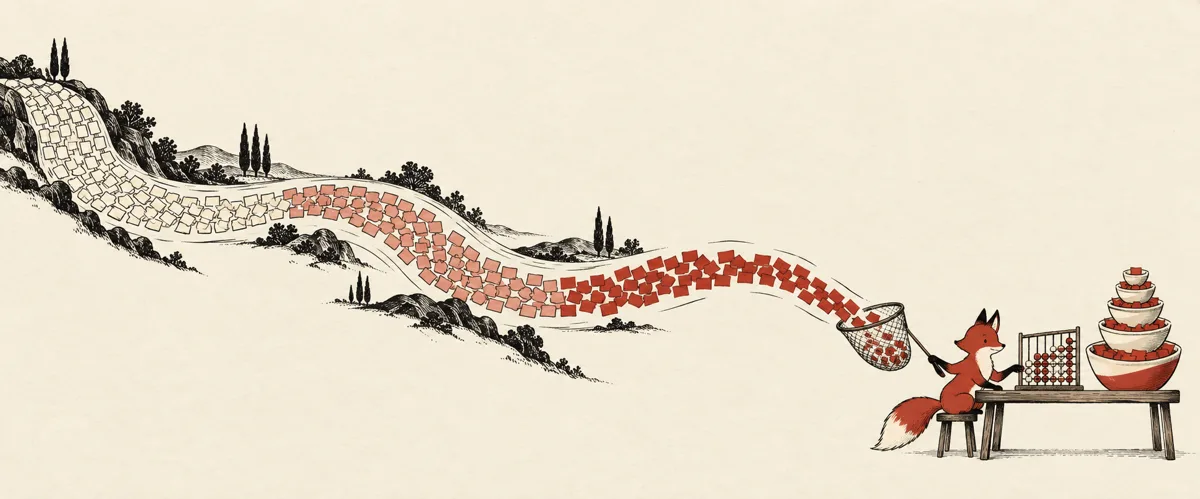
Softmax was not invented for neural networks. It is the Boltzmann distribution from statistical mechanics: the probability of finding a system in a given state falls off exponentially with that state's energy, with temperature in the denominator from birth.
What the letters mean: $p_i$ is the probability of state $i$. $\varepsilon_i$ is the energy of state $i$. $k_B$ is Boltzmann's constant, a fixed conversion factor between energy and temperature. $T$ is temperature. The $\propto$ symbol means "is proportional to": divide by the sum over all states and you get exact probabilities. Read negative energy as score and this is softmax, temperature included.
Choice theory found the same function independently: if each option's utility is perturbed by independent Gumbel noise, the probability of picking option $i$ is exactly softmax of the utilities, the multinomial logit model. And optimization needs it for a third reason: softmax is smooth and differentiable everywhere, the gradient of the log-sum-exp function, so it can stand in for the hard argmax during training. Where it appears: attention weights, the output distribution over the vocabulary, mixture-of-experts routing, RL policies, and inside the cross-entropy loss.
What the letters mean: $Q$ is the matrix of query vectors, one per position, each asking what it is looking for. $K$ is the matrix of key vectors, one per position, each advertising what it contains. $V$ is the matrix of value vectors, the content actually copied forward. $QK^{\top}$ is every pairwise dot-product score between queries and keys, the small T meaning transpose, $K$ flipped so the multiplication lines up. $d$ is the dimension of each key vector, and dividing by its square root keeps dot products from growing with dimension, a fixed temperature. Softmax runs row by row, and multiplying by $V$ forms each output as a weighted average of values.