The SaaS you no longer need
On October 11, 2026, Pieter Levels, the solo founder behind PhotoAI and Nomad List, posted that he had cancelled almost every SaaS subscription his business had. What is left on his card: AI inference, a Hetzner server, Cloudflare storage, Backblaze backups, and taxes. Everything else he now builds himself with AI coding tools or runs as open source. He predicts a tidal wave of cancellations, and says the only businesses that keep the money are content, data centers, power plants, and governments. This primer checks that claim category by category, at real list prices, and finds it about a third right: the top layer of a normal stack really is replaceable now, and the bottom layer is exactly the part he still pays for.
Cancelled almost all of it. What survives: content, data centers, power plants plus water, and governments.
Pieter Levels, summarizing his October 11, 2026 post, mirrored on levels.io
How it works
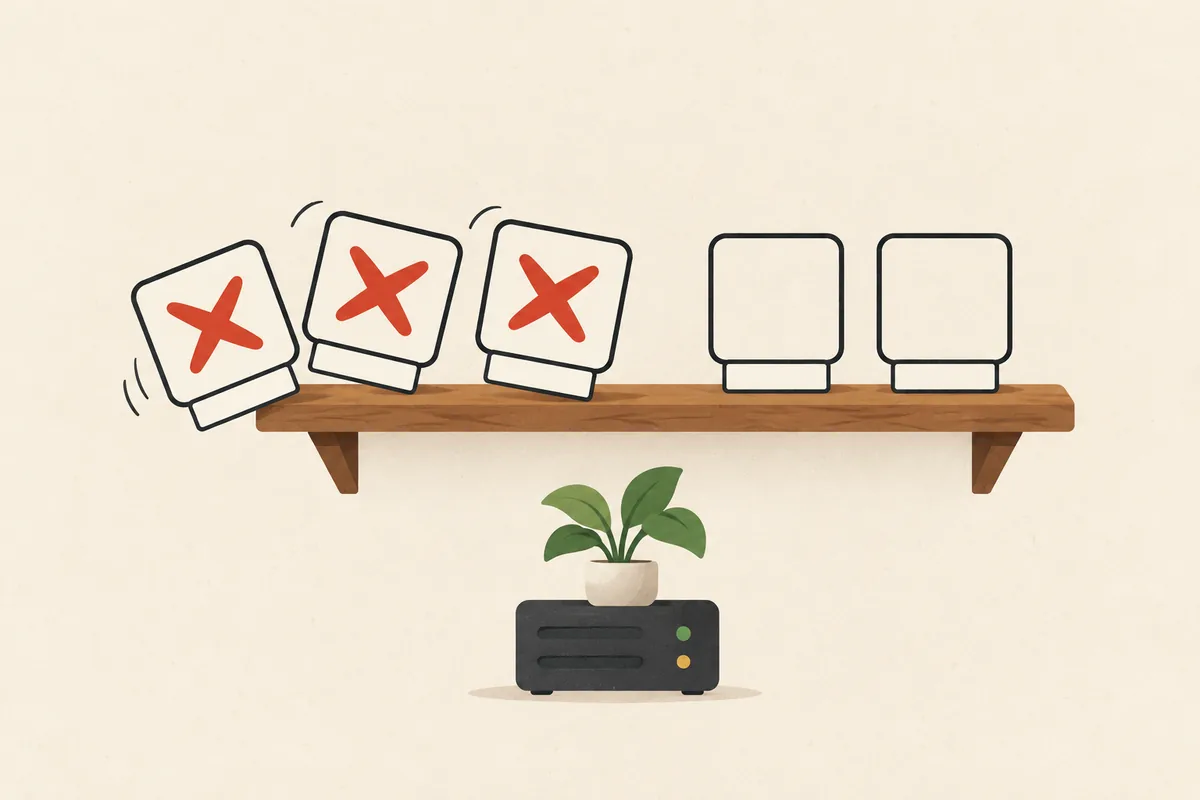
Five forces decide what you can cancel
The cancellation wave is not one force, it is five, and they do not all point the same way. Tap a card to open it.
Satya Nadella made the structural version of this point on the BG2 podcast in December 2024: business applications are, in his words, essentially CRUD databases with a bunch of business logic, and the logic is the part that moves to agents. Strip the quote down and it is the whole story of the replaceable layer. A form builder, a booking page, an uptime checker, a simple analytics dashboard: each is a table, some screens, and a few rules. That used to be a company. It is now a weekend.
Example: Typeform charges $39 a month for its Basic plan, which includes only 100 responses a month. The thing being rented is mostly a pretty form and a results table.
Umami does web analytics in a fraction of the footprint of the tools it replaces. Formbricks covers forms, Cal.com covers scheduling, Chatwoot covers the helpdesk, Listmonk covers the newsletter, Uptime Kuma covers monitoring, Plane covers issue tracking, Penpot covers design files. None of these are toys; they are the default choice in their niches for technical teams. What changed recently is the second half of the equation: an AI coding tool can install, configure, and customize them for you, which was the part that used to send everyone back to the paid version.
Example: one writer documented cancelling five subscriptions, including Google Drive and 1Password, after a weekend of self-hosting replacements, while stressing that the backups, HTTPS, and update burden are now theirs. Both halves of that sentence are the trend.
Every cancelled subscription converts a bill into a responsibility: updates, security patches, backups, deliverability, and the 3 a.m. breakage. Whether that trade is smart depends entirely on what your hour is worth and how much you enjoy the work, which is why the same move is obvious for a solo founder and dubious for a team. The capability data cuts both ways, too. Stack Overflow's 2025 survey of more than 49,000 developers found Cursor at 18 percent adoption and Claude Code at 10 percent in their first year, and in the same survey 72 percent said they are not vibe coding and 66 percent named AI output that is almost right, but not quite, as their top frustration.
The honest version: practitioner Cassidy Williams, in a 2026 talk titled "Is SaaS actually dead? (no)", argues the counter in one line: consider maintenance costs, who you are building for, and scope. Personal tools are not products.
Payments carry PCI scope, fraud, disputes, and payout law. Payroll and tax carry filing deadlines that change by country and year. Email sending carries a reputation system run by the receiving providers, where one blacklisted server costs more than a year of Mailchimp. When Klarna announced it was dropping Salesforce and Workday in 2024, Salesforce CEO Marc Benioff's public response was a list of questions, not about features: where is the data being managed, how is compliance and governance achieved, what preserves institutional memory. Those questions are the product in the categories that survive.
Example: Stripe charges 2.9 percent plus 30 cents per charge and no monthly fee. There is no subscription to cancel. What looks like a software bill is a liability and conversion bill, which is why nobody credible proposes building it.
Watch what the incumbents do rather than what the posts say. Intercom sells human seats at $29 to $132 a month and its AI agent, Fin, at $0.99 per resolved outcome. HubSpot told its September 2026 analyst day it is moving to a hybrid of seats and credits, with more than 2.5 million paid seats. Atlassian's Mike Cannon-Brookes defends seats as still the best proxy for value in collaboration software, while running consumption items like AI credits beside them. The surviving vendors are repricing around agents instead of dying, which is what a layer shift looks like from inside an earnings call.
Example: Bank of America's 2026 Salesforce thesis is literally named seat compression, and Salesforce's counter is that seven of its ten largest deals in a recent quarter added seats. Both sides are measuring the same migration.
A representative stack for a one to five person online business, one tool per category at entry paid tiers, at US list prices checked October 12, 2026. Flip the switch to rebuild it the Levels way: keep the liability and infrastructure lines, replace the interface lines with open source on one small server, and see what is actually left.
| Line | What replaces it | Per month |
|---|---|---|
| Total | ||
The verdicts
What to cancel, what to keep
Category by category, for a small online business in 2026. Prices are entry paid tiers checked October 12, 2026, and the full price table is in Sources.
Timeline
How build versus buy flipped, 2024 to 2026
Nine moments that moved the argument from talk to evidence. One tap per step.
Key voices
The people arguing it out
Eight named positions, including the founder of the canonical case study arguing against his own headline.
Where leaders think this goes
Three camps, named
Positions as stated in October 2026. Nobody serious is predicting zero software spending; the fight is over which layer keeps the money.
Where they agree
The interface layer gets repriced
Nadella expects the application layer to collapse into agents; HubSpot and Atlassian are rebuilding pricing around credits and outcomes; Intercom already meters resolutions. Even the defenders are moving the meter.
The record and liability layer survives
Mensch, the loudest replacement voice in enterprise, exempts the systems that store and structure company data. Evans makes audit, security, and accountability the reason institutional software exists. Benioff's whole counterattack is a governance argument.
Total software spending keeps growing
Gartner forecasts worldwide software spending up about 15 percent in 2026, to roughly 1.43 trillion dollars. Whatever is being cancelled, the aggregate bill is still rising; the money moves layers more than it disappears.
Someone still maintains the replacement
Levels prices his own time at zero and enjoys the work. Klarna priced quality at zero for a quarter and reversed. Every named voice, including the cancellers, concedes the maintenance is real; they disagree about who should carry it.
Where they split: how much of the stack gets rebuilt per user
Side A: most of it (Levels, Mensch, Raji)
Levels predicts a tidal wave of cancellations, with only content, data centers, power, and governments keeping the money. Mistral CEO Arthur Mensch told CNBC in February 2026 that more than half of current enterprise software could be replaced by AI, with customers building custom workflow apps in days. OpenAI's Vijaye Raji, March 2026: everyone is going to be a builder.
Side B: the top of it (Nadella, Evans)
Nadella's collapse is aimed at the application layer specifically: CRUD screens and their logic move to agents, while data and the agent tier win, and Microsoft intends to own both. Evans argues AI produces more software, not less: existing apps expand, new vertical apps appear, and a new ephemeral category of one-off tools takes share, while institutional software persists wherever a task carries risk.
Where they split: whether seats survive
Side A: seat compression (Bank of America, the market)
Bank of America's 2026 Salesforce thesis is named seat compression: if agents do the work, companies need fewer humans logged in, and per-seat revenue compresses. The February 2026 software selloff, somewhere between 285 billion and a trillion dollars of market value depending on the index and window, was this thesis priced in a hurry.
Side B: seats are the value proxy (Cannon-Brookes, Benioff)
Atlassian's Mike Cannon-Brookes told investors that how many people are collaborating remains the best proxy for value, and that customers prefer predictable seat pricing. Benioff counters the compression thesis with Salesforce's own numbers: Agentforce revenue passing 1.5 billion dollars of annual recurring revenue by mid 2026, with top deals adding seats.
The skeptic camp: consolidation, not death
Bersin, and Siemiatkowski against himself
Analyst Josh Bersin warned in 2024 that systems like Workday hold decades of accumulated workflows, and rebuilding them in-house risks a black hole of features. Klarna CEO Sebastian Siemiatkowski then became his own best critic: in March 2025 he said he does not think other companies should replace Salesforce the way Klarna did, and by May 2025 Klarna was rehiring humans after cost-first AI support produced lower quality.
One person's bet: Huang
Nvidia CEO Jensen Huang has publicly contested the replacement thesis, arguing, as reported in secondary coverage, that the market is misreading what AI does to software tools. Flagged as one leader's position, reported secondhand; his company's business sells the picks to both camps.
Takeaways
The cancellation wave is real and narrower than its headline. What AI actually made cheap is the top of the stack: screens, forms, dashboards, and glue. What it did not make cheap is the bottom: payments, records, compliance, deliverability, and other people's collaboration. Levels, the wave's loudest voice, still pays for exactly the bottom. The argument worth having is not whether SaaS dies, it is which layer of your own bill is screens.
- Cancel the screens. Analytics, forms, scheduling, uptime monitoring, and solo tracking have maintained open source replacements and near-zero switching risk. For a small business this is roughly a third of the bill.
- Keep paying for liability. Payments, backups, storage, accounting, and OTP are priced on risk and trust, not code. Stripe has no subscription to cancel; the fee is the product.
- Price your own hour honestly. The modeled saving on a typical small stack is about 240 dollars a month. If maintaining the replacements takes you two hours a month, the trade only wins if your hour is worth less than that, or you enjoy the work, which for Levels is precisely the point.
- Klarna is the whole debate in one company. It consolidated about 1,200 tools, claimed the equivalent of 700 support agents from AI, then rehired humans when quality fell, and its CEO told everyone not to copy him. Cite it carefully, in both directions.
- Follow the pricing, not the posts. Seats plus credits plus outcome fees is the incumbents' actual answer, already shipping at Intercom, HubSpot, and Atlassian. The per-seat era is ending; the software bill is not.
Keep exploring
Related primers
Sources
Sources
Primary sources first. Prices are US list prices from the vendors' own pricing pages, checked October 12, 2026.