Marathon Fusion, Checked
On October 21, 2026, the San Francisco startup Marathon Fusion posted three record claims in three sentences: gold made from mercury at ten times CERN's rate, a plasma centrifuge beating a Soviet record that stood for 40 years, and a fusion reactor being built to reach record power density.
This primer checks each claim against the primary record: CERN's own paper, Marathon's own paper, the company's August 2026 announcement, and the 104-second video attached to the post, watched and transcribed in full.
The video covers only the reactor. It publishes no gold rate, no separation number, and no Soviet benchmark, so those two records rest on the post's words alone.
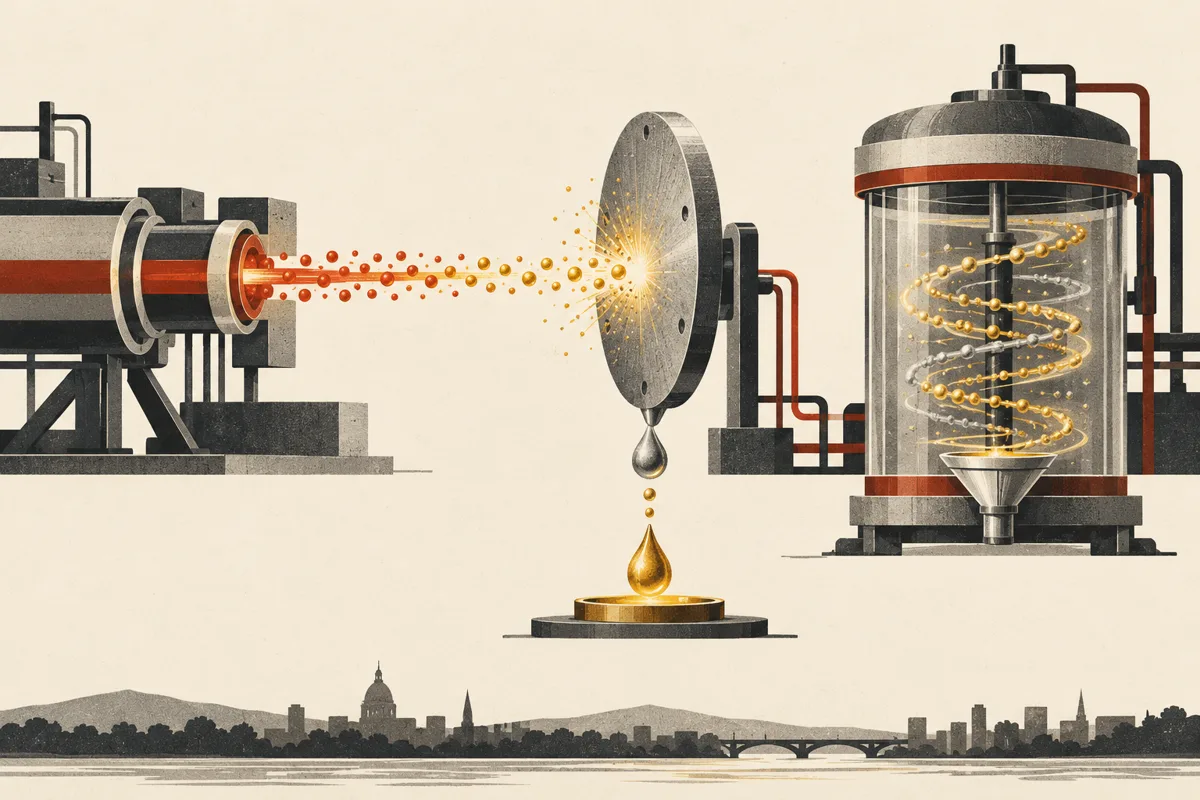
The brief: three claims, three different answers
“Last month, we demonstrated high-rate alchemy: turning mercury into real, stable gold, beating CERN’s record by a factor of 10.”
“Last week, we enriched isotopes in the world’s most powerful plasma centrifuge, beating the Soviet record that stood for 40 years.”
“Now, we’re building a fusion reactor in San Francisco to achieve record power density.”
@MarathonFusion · X · October 21, 2026
- 2023Marathon founded in San Francisco to build fusion fuel-cycle technology.
- Jul 2025Gold method published as a simulation paper (arXiv:2507.13461). No experiment.
- Aug 2026Plasma centrifuge enrichment of hydrogen and lithium isotopes announced.
- Sep 2026Gold demonstration and two medical-isotope preprints, per the company. The gold claim carries no numbers.
- 2027First reactor promised to partners, for medical isotopes and materials testing. A plan, not a result.
The closer a claim sits to hardware Marathon has already shown in public, the better it checks out.
Claim 1: mercury into gold, at ten times CERN
The method is real physics, published by Marathon's own scientists in July 2025. A deuterium-tritium (D-T) fusion reaction throws off a neutron at 14.1 megaelectronvolts (MeV), fast enough to knock a second neutron out of a mercury-198 nucleus.
That reaction, written (n, 2n), is the whole trick, and it doubles as neutron multiplication, which a fusion blanket needs anyway to breed its own tritium fuel.
The product, mercury-197, is unstable. Over about 64 hours it captures one of its own electrons, turns a proton into a neutron, and becomes gold-197, the only stable isotope of gold. Gold made this way stays gold.
One neutron’s work: mercury-198 to gold-197
One tap per step, swipe, or use the arrow keys.
So what is the CERN record being beaten? In May 2025 the ALICE collaboration at CERN (the European Organization for Nuclear Research) published the first systematic measurement of gold production at the Large Hadron Collider (LHC).
When two lead nuclei miss each other at 99.999993 percent of light speed, the electromagnetic pulse can knock three protons out of one nucleus, leaving gold.
CERN's numbers are precise. The LHC makes gold at a maximum rate of about 89,000 nuclei per second at the ALICE detector. Across all of Run 2 (2015 to 2018) it made about 86 billion gold nuclei, totaling 29 picograms.
Those nuclei are gold-203, not gold-197: they fly into the beam pipe and fragment within a fraction of a second. CERN's gold is a measurement, never a material.
First, check CERN's own arithmetic. One atomic mass unit is 1.66 × 10⁻²⁴ grams, so one gold-203 nucleus weighs 203 × 1.66 × 10-24 = 3.37 × 10⁻²² grams.
Times 86 billion nuclei: 2.9 × 10⁻¹¹ grams, which is 29 picograms. CERN's number checks out exactly.
Now the claim. Ten times CERN's maximum rate is 890,000 gold atoms per second.
Marathon's gold is gold-197, so each atom weighs 197 × 1.66 × 10-24 = 3.27 × 10⁻²² grams. At 890,000 atoms a second, running nonstop for a year (31.6 million seconds), the total is about 9 nanograms of gold a year. One gram would take about 109 million years.
The same arithmetic run the other way shows why the bar is low: at the plant scale Marathon simulated, about 2 tonnes of gold per gigawatt of thermal power per year, beating CERN's rate by 10x is trivial. The 10x claim is a claim about a benchtop demonstration, and its size depends entirely on a rate Marathon has not published.
Weigh the record: what a multiple of CERN’s rate actually yields
Illustrative arithmetic on CERN's published rate, not a measurement of Marathon's device. Marathon has published no rate at all for its September 2026 demonstration, so the slider explores the claim's wording, not its hardware.
Two honest complications. First, the comparison mixes kinds: CERN never tried to make gold, and its nuclei self-destruct, while Marathon's claimed gold is stable and collectable, which is genuinely the more useful trick.
Second, the 2025 paper is simulation only, and it carries real hurdles the post does not mention: the feed mercury must be enriched in mercury-198 (about 10 percent of natural mercury), and the product needs a cooling period, because a trace contaminant, gold-195, has a half-life of 186 days.
The physics is published and sound; the demonstration is not. As of October 21, 2026, no preprint, press release, or dataset reports Marathon's gold rate, yield, or detection method.
Independent coverage the same day (RuntimeWire) notes the thread supplies no experimental data. The 10x figure cannot be checked until a rate exists in public.
CERN's record is 89,000 gold nuclei a second that destroy themselves on contact; beating it ten times over would still yield only about 9 nanograms of gold a year.
Claim 2: the plasma centrifuge and the Soviet record
On August 27, 2026, Marathon announced it had enriched hydrogen and lithium isotopes in a proprietary plasma centrifuge, work funded by the United States Department of Energy through the Advanced Research Projects Agency-Energy (ARPA-E) VISION OPEN program.
A centrifuge separates isotopes by mass: spin a mixture fast and the heavy fraction drifts outward. Doing it in a plasma, with fields instead of a rotor, is an old idea that nobody has commercialized for these light elements.
A gas centrifuge hits a materials wall: the rotor cannot spin faster than its own strength allows, and light gases like hydrogen move thermally so fast that useful separation needs extreme rotor speeds. A plasma centrifuge has no rotor. Crossed fields drive the charged fraction of the gas around at supersonic speed, and collisions drag the neutral majority with it.
Marathon runs the device partially ionized: only a fraction of atoms carry charge, which the company says keeps temperatures low enough that the separation survives. Heavier isotopes migrate to the wall, lighter ones stay near the axis. Tap an isotope to see where it lands:
Marathon's hydrogen tests used protium and deuterium as stand-ins. Tritium itself is radioactive and tightly regulated, so it has not been run.
A D-T reactor burns only a small fraction of its tritium per pass. The rest leaves in the exhaust, mixed with helium ash and protium impurities, and every atom of it is rare, radioactive, and needed back as fuel. Marathon's pitch is to separate the heavy fuel inside the exhaust line, before downstream processing.
The company's stated objective is to cut tritium flow rates, and the size of the processing plant behind them, by a factor of ten or more. That figure is a design objective from the announcement, not a measured result.
Dennis Whyte of the Massachusetts Institute of Technology (MIT), whose research quantified selective tritium pumping, called the separation results impressive and important for exactly this reason.
A fusion blanket breeds tritium by hitting lithium-6 with neutrons. Natural lithium carries only about 7.5 percent lithium-6, so blanket materials like the molten salt FLiBe (lithium fluoride and beryllium fluoride) need the lithium enriched first.
Today the world makes less than a tonne of enriched lithium a year, with a mercury-based chemical process used only in Russia and China, per Berkeley's Per Peterson, a Marathon advisor quoted in the announcement.
100 lithium atoms as nature supplies them: about 8 are lithium-6 (shown in red). Enrichment is the work of raising that count.
This is the claim with outside support: the materials testing lab Covalent certified Marathon's lithium-6 enrichment, Heatmap News reported on August 27, 2026. The hydrogen separation carries no equivalent certification, and neither result publishes a separation factor or before-and-after abundances.
Now the record itself. The post says the centrifuge beat “the Soviet record that stood for 40 years.” Forty years before 2026 is about 1986, deep in the era when Soviet and Western labs both published plasma centrifuge experiments.
But no public source names the benchmark: not Marathon's announcement, not its coverage, not the video, and not any paper the company has posted.
A separative claim is normally stated as a separation factor, the ratio of isotope ratios between the enriched stream and the feed, sometimes converted into separative work units (SWU). Marathon has published neither number for either element. Without the benchmark's isotope, value, and source, there is nothing to check the record against.
The enrichment is real: an August 2026 announcement, an outside lab certification for lithium-6, and named experts on the record. The “world's most powerful” title and the Soviet record are company framing with no published measure behind them. What was enriched is documented; by how much, nowhere.
The enrichment happened, and the lithium half carries an outside lab's certification; the Soviet record it supposedly beat is named nowhere public.
Claim 3: a fusion reactor with record power density
The video is this claim's evidence, and it is refreshingly concrete. The reactor is not a tokamak and confines no plasma.
It is a beam-target device: a radio-frequency (RF) plasma source ionizes deuterium, an electric field accelerates the ions to kiloelectronvolt (keV) energies, and they slam into a solid plate coated with lithium loaded with hydrogen isotopes. Fusion happens in the plate, at the impact spot.
The reactor, step by step: beam meets target
One tap per step, swipe, or use the arrow keys.
This architecture has a distinguished ancestor.
Lawrence Livermore National Laboratory ran the same idea in the 1980s as the Rotating Target Neutron Source II (RTNS-II): 400 keV deuterons at 150 milliamperes onto a rotating titanium-tritide target, a design strength of 4 × 10¹³ neutrons per second and a peak flux of 1.3 × 10¹³ neutrons per square centimeter per second, operating from 1979 to 1987 as a materials-testing source.
The video credits the Livermore machine with over 25,000 operating hours; the facility records consulted for this primer confirm the 1979 to 1987 run but do not state that total.
Marathon's own published specs for its device: fusion power 1 kilowatt, neutron flux 1012 neutrons per square centimeter per second, and the headline figure, power density 20 kilowatts per square meter.
The video adds the growth plan: doubling fusion power density every month for the next year, and first partner machines in 2027 for medical isotope production and materials qualification, not electricity.
Power density is where the record lives or dies, because the field's standard ruler is fusion power per cubic meter of plasma. By that ruler the record class belongs to compact tokamak designs. Flip the ruler below and watch the ranking change:
Power density, two rulers
Terms locked across both views: fusion power only, never input power. Marathon publishes no plasma volume, because a beam-target device has no confined plasma volume in the tokamak sense. Its 20 kilowatts per square meter is power per area of target, a third ruler that neither view above uses.
The honest summary is about denominators. A beam-target device concentrates all of its fusion into a coin-sized spot, so any per-area or per-volume figure at the spot is enormous by construction, while total power stays at 1 kilowatt and the accelerator consumes far more electricity than the fusion produces.
That is not a criticism of the device: RTNS-II was valuable for four decades of materials science on exactly those terms, and Marathon's first market, isotopes, pays for neutrons, not watts.
The reactor exists, its architecture and specs are public, and the 2027 partner plan is stated plainly in the video.
“Record power density” is company-reported and definition-dependent: true on a per-square-meter-of-target ruler that Marathon alone uses, not comparable on the per-cubic-meter ruler where SPARC's design point, about 7 megawatts per cubic meter, is the record class. The monthly doubling is a projection, stated as a plan.
The reactor is a beam and a target, not a power plant: 1 kilowatt of fusion in a coin-sized spot makes power density mean whatever the denominator chooses.
What would settle it
Each claim is one published number away from being checkable. The voices around the company show why the underlying work matters even while the records stay unproven.
Gold: publish the rate
A production rate with a detection method: atoms or grams per hour, how the gold-197 was assayed, and the neutron source's strength during the run. With that, the 10x comparison against CERN's 89,000 nuclei per second becomes arithmetic anyone can redo, the way this page redid CERN's 29 picograms.
Centrifuge: publish the separation factor
The before-and-after isotope ratios for lithium and hydrogen, plus the Soviet benchmark's isotope, value, and citation. The enrichment itself is already the best-documented claim here; the record framing needs the same treatment.
Reactor: publish the denominator
State the power density's basis next to the number: per square meter of target, per cubic meter of reaction zone, or whole-device. On a stated basis, “record” becomes a comparison instead of a headline.
“Selective tritium pumping can improve plant performance while dramatically reducing the required tritium inventory.”
Dennis Whyte · MIT professor of nuclear science and engineering · Marathon announcement, August 27, 2026
Whyte's endorsement is about the fuel cycle, not the records: the centrifuge's value is that it attacks a bottleneck every D-T plant shares.
“The world makes less than a tonne of enriched lithium each year, with a mercury-based process now used only in Russia and China.”
Per F. Peterson · UC Berkeley professor of nuclear engineering, Marathon advisor · Marathon announcement, August 27, 2026
Peterson, an advisor to the company, names the supply gap the centrifuge aims at: terawatt-scale fusion would need hundreds of thousands of tonnes of enriched lithium in service.
“As far as the science is concerned, we feel like it is at the point where we are ready to make those kinds of commitments.”
Kyle Schiller · Marathon Fusion CEO · Heatmap News interview, August 27, 2026
Schiller's case is sequencing: build the fuel-cycle supply chain now, at pilot scale by 2029, instead of waiting for the reactors. His gold work, Heatmap notes in the same piece, remains theoretical, based on simulations.
Every open claim on this page closes with the same move: publish the rate, the separation factor, and the denominator.
Takeaways
Marathon Fusion is doing real, needed fuel-cycle engineering, and its October post wraps that work in record claims that outrun its published evidence. The centrifuge enrichment happened and is partly certified. The gold demonstration and the two records exist, so far, only as sentences in a post.
- The gold physics is published, the gold result is not. Mercury-198 plus a 14.1 MeV neutron makes mercury-197, which decays in about 64 hours to stable gold-197. The 2025 paper is simulation only, at about 2 tonnes per gigawatt-thermal-year.
- CERN's record is smaller than it sounds. About 89,000 nuclei per second at peak, 29 picograms across four years, in nuclei that fragment instantly. Ten times that rate is still only about 9 nanograms a year.
- The centrifuge is the strongest claim. Hydrogen and lithium enrichment demonstrated in August 2026, lithium-6 certified by an outside lab, hydrogen not independently verified, and no separation factor published for either.
- The Soviet record cannot be checked. No public source names its isotope, value, or paper. A record without a benchmark is a slogan.
- Power density is a denominator choice. Marathon's reactor makes 1 kilowatt of fusion at a target spot and quotes 20 kilowatts per square meter; the field's per-cubic-meter record class is SPARC's design point of about 7 megawatts per cubic meter.
Marathon's pattern is real engineering under record-sized words.
Keep exploring
Sources
- X post + videoThe post under check, with its 104-second reactor video
- Institution releaseALICE detects the conversion of lead into gold at the LHC
- Journal paperProton emission in ultraperipheral Pb-Pb collisions at 5.02 TeV
- PreprintScalable Chrysopoeia via (n, 2n) Reactions Driven by Deuterium-Tritium Fusion Neutrons
- Company releaseMarathon Fusion Demonstrates Lithium and Hydrogen Isotope Enrichment Using Proprietary Plasma Centrifuge Technology
- ReportingExclusive: Marathon Fusion Achieves Reactor Fuel Breakthrough
- ReportingMarathon Fusion says it made stable gold from mercury
- Company siteMarathon Fusion: building the world's highest power density fusion reactor
- Lab archiveRotating Target Neutron Source
- Journal paperOverview of the SPARC tokamak
- Project FAQITER frequently asked questions