Derivatives, the mastery sheet
Everything about derivatives on one page: the one idea, four derivations from scratch, the secant that becomes a tangent, the power-rule shortcut, and where derivatives break.
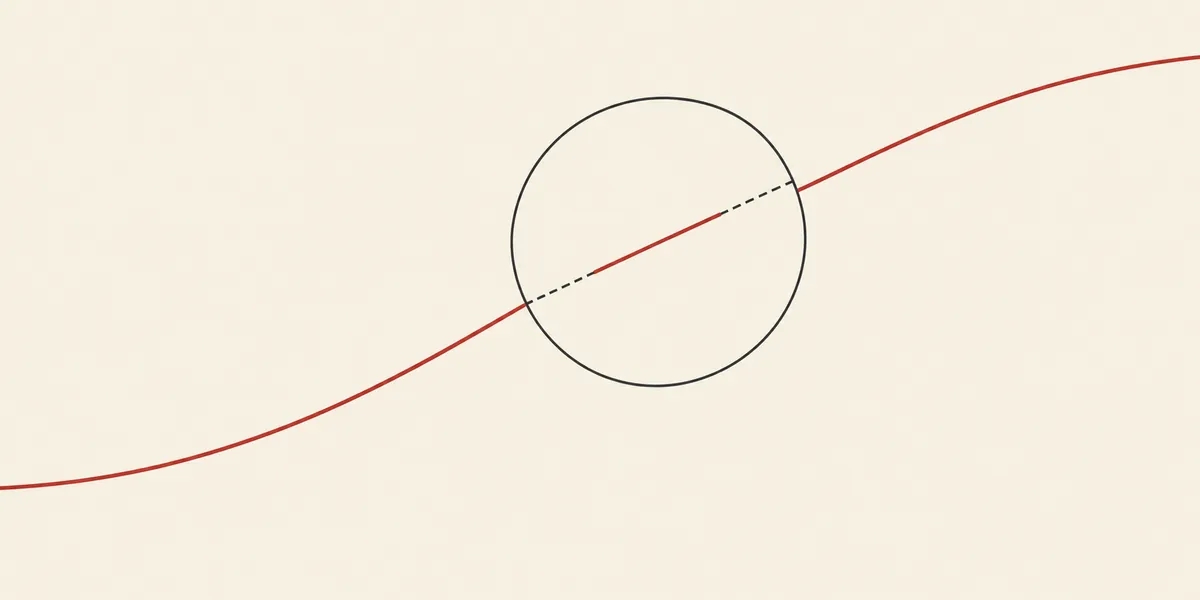
1. The one idea
A derivative is the slope of a curve at a single point. Not between two points, that is just an average. At one point, exactly, right now. Speedometers, hill steepness under your feet, how fast a rumor is spreading this minute: all derivatives.
The definition
Read it as: take the slope between two points $h$ apart, then crush $h$ to zero. Whatever the slope settles on is the derivative. The whole sheet is this one sentence, unpacked.
2. The core set, from scratch
Four derivations, no shortcuts yet. Each one runs the definition and watches the leftover $h$ terms die. Tap each card for the full working and a sparkline of the function with its tangent.
3. Shrink the gap
This is the moment the definition stops being symbols. Take $y = x^2$ at $x = 2$. The slope between two points is easy. Now drag the second point closer and watch the average slope settle. Step through it, then play with it:
The secant becomes the tangent
The algebra behind the readout: $\frac{(2+h)^2 - 4}{h} = \frac{4h + h^2}{h} = 4 + h$. Every term except the 4 carries an $h$, so as $h \to 0$ the slope has nowhere to go but 4. That limit is the derivative: $f'(2) = 4$.
4. The shortcut: the power rule
After the third derivation you stop doing limits by hand. The pattern is always the same, so it gets a name:
Bring down the power, subtract one
Why it works in one line: $(x+h)^n$ expands to $x^n + n \cdot x^{n-1} \cdot h +$ terms with $h^2$ or more. The $x^n$ cancels, dividing by $h$ leaves $n \cdot x^{n-1}$ plus terms still holding an $h$, and those vanish as $h \to 0$. Sections 2 and 3 were this sentence, four times, with numbers.
That last one: $1/x = x^{-1}$, so the rule gives $-1 \cdot x^{-2}$. The rule does not care that the power is negative.
5. When to use it
Three jobs. Speedometers, hilltops, and the entire Taylor sheet run on this one idea.
Motion: velocity is the slope of position
If your position over time is $p(t) = t^2$ meters, your speedometer reads the derivative: $v(t) = 2t$. Drag time and watch the tangent's slope match your speed.
Optimization: the flat tangent finds the peak
Throw a ball: height $h(x) = -(x-2)^2 + 4$. Where is it highest? Exactly where the tangent goes flat, slope zero. Drag x and find it.
The move has a name: set the derivative to zero and solve. $h'(x) = -2(x-2) = 0$ gives $x = 2$. Every "find the best" problem in ML, economics, and engineering is this move wearing a costume.
Understanding: Taylor series run on derivatives
A Taylor series is derivatives repackaged: each term matches one more derivative at a single point. No derivatives, no series. The mastery sheet is the prequel to this one, or this one is the prequel to that one. Either way, they connect.
Open the Taylor mastery sheet6. Where it breaks
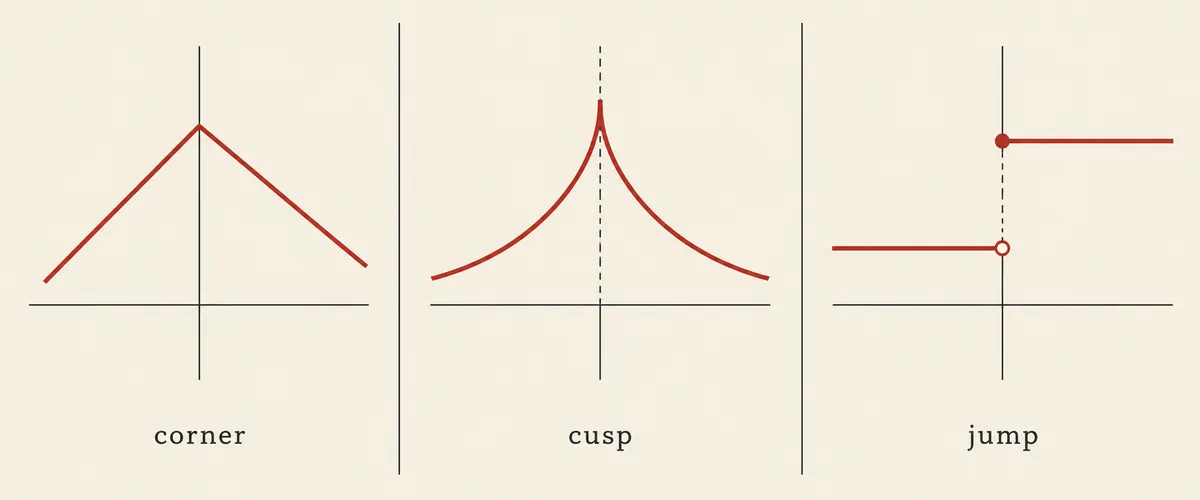
Derivatives need the curve to be smooth at the point. Three ways a curve can refuse. Tap each card: the plot shows the secant never settling on one slope.
Takeaways
The whole sheet is one idea, unpacked: the derivative is the slope of a curve at a single point, found by taking an average slope and shrinking the gap to zero. Four derivations, one shortcut, three jobs, three failure modes. That machinery runs motion, optimization, and Taylor series.
- One idea, one definition. The derivative is the slope at a single point, not an average between two points. Take the slope between two points h apart, then crush h to zero. Whatever it settles on is the derivative.
- Every derivation is the same move. For x, x squared, x cubed, and sin x: expand the definition, divide by h, watch the leftover h terms die. Sin x only needs two famous limits: sin h over h goes to 1, and (cos h minus 1) over h goes to 0.
- The power rule is the shortcut. Bring down the power, subtract one: d/dx of x to the n is n times x to the n minus 1. It handles negative powers too, so d/dx of 1/x is minus 1 over x squared.
- Three jobs. Velocity is the slope of position, so p(t) = t squared means v(t) = 2t. Set the derivative to zero and solve to find peaks, which is every "find the best" problem in ML, economics, and engineering. Taylor series are derivatives repackaged: each term matches one more derivative at a point.
- It breaks where the curve is not smooth. The corner: left slope minus 1, right slope plus 1, they never agree. The cusp: slopes explode with opposite signs and the tangent goes vertical. The jump: the function teleports, so there is no slope to ask about. Zoom test: a corner stays a corner.
A derivative is a microscope for change. Zoom in far enough and every smooth curve looks straight. The slope of that straight line is the derivative.