Birds of a Feather, playable
Birds of a Feather is a word-sorting puzzle: every card is a bird carrying a word, every flock is a theme with an exact quota, and your job is to send each bird home. The twist is ambiguity. Words like orange, bat, and crane honestly belong to two or three flocks at once, so a level is not a vocabulary test, it is a deduction: the quotas leave exactly one consistent assignment, and a solver proves that before the level is allowed to ship. This primer is the game, explained from the inside, and it starts with a level you can actually play, with the same knobs the design turns: how much ambiguity, how many feathers, whether the stock pile deals your cards, and whether the Oracle may whisper.
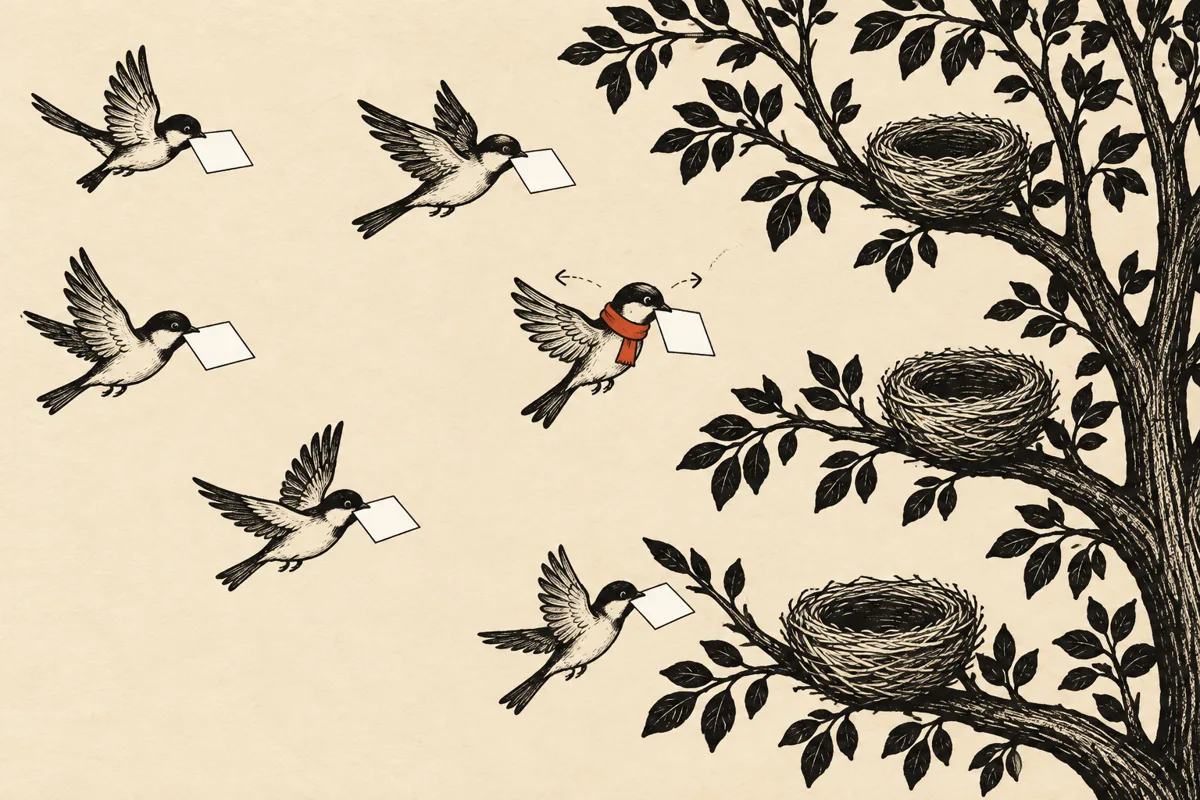
Ambiguity is only fair when the constraints eliminate it: every level of this game is dealt, then proven uniquely deducible by two elimination rules before a player ever sees it.
Researched October 2026, from the game's own build records and QA notes. The playable level below is a miniature: it uses the game's real word pools and runs the same two-rule elimination check on every deal before showing it to you.
Play a level first
Twelve birds, four flocks, three homes each. Tap a bird, then tap the flock you think it belongs to. A wrong nest costs a feather.
The knobs are the design's real dials, turned down to demo size. Ambiguity sets how many birds fit more than one flock. Feathers are your mistakes budget. Stock mode hides four birds in a draw pile, Klondike style, with one redeal. The Oracle button names one guaranteed-correct home per tap, and it counts against your stars.
Moves 0 · Feathers 3 · Homed 0 of 12
A fresh deal, already proven deducible by the two rules in Figure 2.
How it works
The deduction engine first, then the difficulty curve the campaign climbs.
A five-card teaching board: Fruits needs 2, Colors needs 3. Apple and banana only fit Fruits; red and blue only fit Colors; orange fits both, and its intended home is Colors. Watch the rules, not intuition, force every assignment.
Tap the arrows to step through
Two hundred Journey levels, five bands. The numbers are the build's own measurements: average cards and ambiguous cards per band, plus feathers and the proven par range. Par is the optimal move count, computed by an A* search and certified per level.
The road here
Five days of building, October 2026: from a locked direction to a certified 200-level campaign.
Tap the arrows to step through
The design's own voices
This game has no outside experts; its authorities are its two solvers, its QA record, and the genre it borrows from.
Two rules, run to a fixed point: a card with exactly one viable flock goes there, and a flock whose remaining quota equals its remaining candidate cards claims them all. A deal ships only if the rules assign every card to its intended home. Across the shipped campaign that is 200 of 200 Journey levels and 90 of 90 sampled daily seeds, a certificate that every level is solvable by deduction alone, with no guessing step anywhere.
Fairness says a level can be finished; par says what finishing well costs. An A* search computes the optimal move count for every level (8 moves for level 1, 35 for the endgame), the results are baked into a certified table with a content hash, and stars are scored against it. Drawing from the stock and redealing count as moves, which keeps the scoreboard honest about the Klondike half of the game.
A full curation pass removed more than 60 weak links before the expansion shipped: stretch memberships (sail as a vehicle), unfair homophones (mussel as body, on sound alone), tasting adjectives padding out Drinks, a spider filed under insects. The lesson the review teaches: an ambiguity is only a good puzzle when both memberships are honestly defensible, because the player who loses a feather to a stretch learns to distrust every later clue.
The published rules of the genre: word cards on a tableau with only the top cards accessible, category piles to fill, limited mistakes, clear the board to win, ambiguity rising with difficulty. Birds of a Feather matches on all five points and streamlines deliberately: no moves inside the tableau, no jokers, and feathers plus the Call button in place of lives and hints.
Every word in the game has a pixel-art portrait in the field guide, dealt out as the collection reward: homed birds show their portrait, locked ones wait as mystery silhouettes. It gives the sorting a second, slower game (complete the guide) whose progress is the campaign itself, 478 birds across 34 themes.
Where the design agrees with itself
The player is told, implicitly, you will never need to guess. The two provers are how the game keeps that promise at scale: deduction certified at deal time, par certified by search, daily seeds held to the same standard as hand-tuned levels.
Remove the multi-flock words and the game is a matching exercise for children. The quotas are what convert ambiguity from confusion into information: every placement everywhere else narrows what an ambiguous word can still be.
Where it argues with itself
The proving camp. If every level is deducible, help systems only train players not to deduce. Feathers already price mistakes; the Call button (one feather, and the correct nest pulses) is as much assistance as the contract allows.
The shipped camp. The game as built includes five earnable consumables anyway: Oracle, Undo, X-ray, Scramble, and a feather refill. The defense is that they are earned and finite, so using one is itself a resource decision; the purist reply is that the Oracle, which reveals the optimal next move, spends the very deduction the game exists to create. Both positions are live in the design, and the demo above lets you feel the trade: stars dock you for asking.
The certificate position. If the two rules close the board, the level is fair by construction, and human difficulty testing is polish, not a gate. Two hundred levels is a lot of playtesting to demand.
The QA notes' own caveat. A deduction that exists but that no human finds in time reads as a guess, and a guess that costs a feather reads as rigged. This is why the teaching curve (zero ambiguity, then one friendly word, then the long ramp) carries weight the certificate cannot. The endgame's human fairness is, by the project's own record, still an open question.
Takeaways
So, Birds of a Feather, in one paragraph: a Klondike-shaped word puzzle whose entire personality is honest ambiguity under exact quotas. Its design lesson generalizes well past birds: if your game (or your test, or your interface) contains items that legitimately fit two categories, fairness is not a vibe, it is a theorem you owe the player, and the cheapest way to owe it is to check, at deal time, that the constraints alone force a unique reading. Everything else in the design, feathers, par, power-ups, the field guide, is a way of pricing, pacing, or rewarding the deduction that theorem guarantees.
- Ambiguity needs elimination, not apology. Orange belongs in two flocks; the quotas are what make that a puzzle instead of an argument. A wrong-feeling answer in your own designs usually means the constraints underdetermine the item, not that the item is bad.
- Prove at deal time, not at complaint time. The two-rule prover runs before a level ships, on campaign and daily deals alike. Any procedurally dealt puzzle can adopt the same gate: generate freely, ship only what the checker certifies.
- Par turns finishing into playing well. An A*-proven optimum gives stars something real to measure and gives the designer a difficulty readout that is independent of vibes: par climbs from 8 to 35 across the campaign.
- Mistakes should be priced, not hidden. Feathers make error a currency with a visible balance, and the Call button sells certainty at the same price as a mistake, which quietly teaches players exactly what a guess is worth.
- Help is a design position, not a feature list. The Oracle spends the game's core pleasure; making it earned, finite, and star-taxed is the compromise the shipped game chose, and the demo's knobs let you set your own line.
- A collection gives sorting a memory. The 478-portrait field guide turns each homed bird into progress that outlives the level, which is why a word game can hold a 200-level campaign: every level pays into the same album.
Keep exploring
Sources
The game itself, its build records, and the genre reference.