Already Clean: The Neurons Were Readable All Along
On October 15, 2026, Nick Cammarata, a founding researcher at the interpretability company Goodfire, published an essay claiming the neural networks the field spent a decade calling tangled were never tangled. The famous evidence that neurons mix unrelated jobs was, he argues, an artifact of weak tools, cramped small models, and one misread neuron.
Re-examined with modern agentic tools, most neurons in models up to trillions of parameters have one legible job. The essay, “Neural Networks Are Already Clean”, labels itself an informal research essay and a working hypothesis, not a peer-reviewed result. This primer rebuilds the claim, the arithmetic under it, and the case against it.
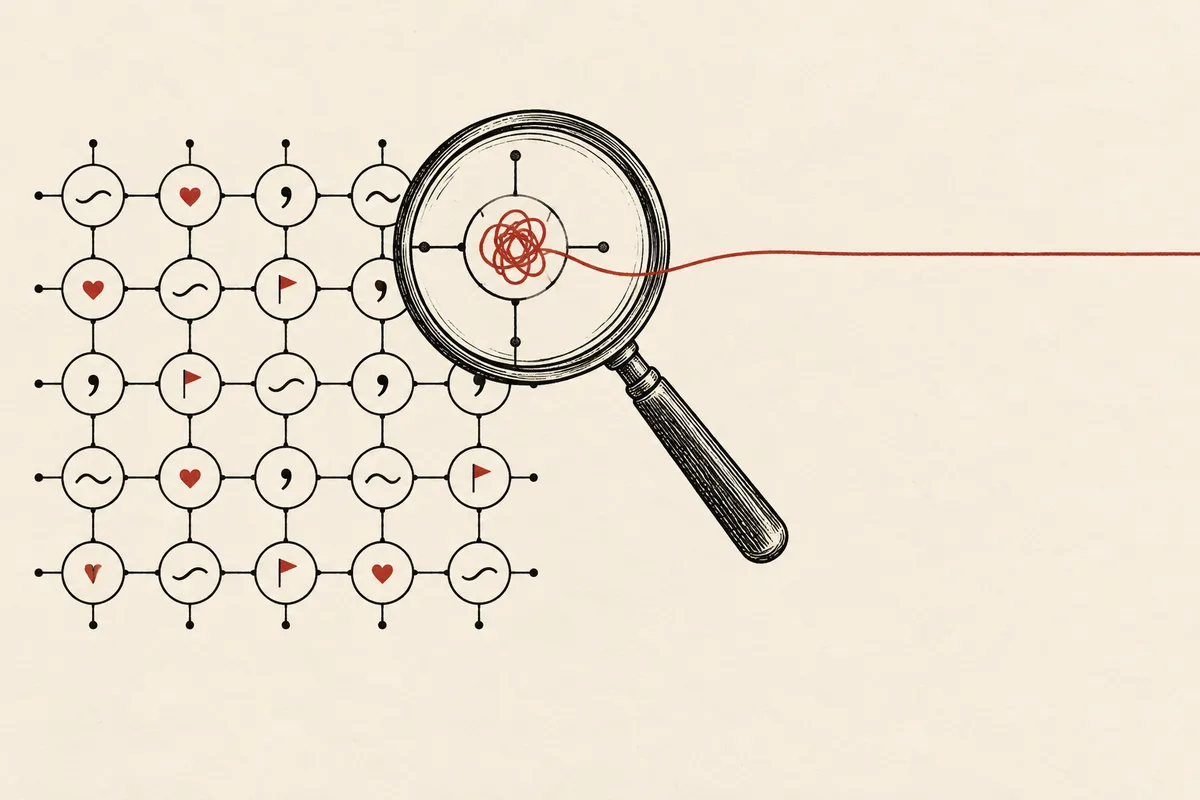
The brief
For a decade, the founding observation of mechanistic interpretability was that neurons are polysemantic: one neuron fires for many unrelated things, because networks pack more features than they have dimensions (superposition). That picture justified a decade of decomposition work, most famously sparse autoencoders (SAEs).
Cammarata helped build that field and ran its biggest early measurement: OpenAI’s 2023 automated interpretability project, which explained about 2 percent of neurons. His new essay says the measurement was the problem: the explainers could not test their guesses, and the scoring rewarded plausible stories over correct ones.
With agents running the full conjecture-and-test loop, the same kind of audit finds one main job for about 90 percent of neuron poles in a 32-billion-parameter model, two related jobs for about 7 percent, and a few percent not yet understood.
The tangle was in the microscope, not in the specimen.
Figure 1: the legibility census
One hundred dots, one per neuron or pole. Switch between the three measurements: what the best 2023 pipeline could explain, and what the same audit finds now, in a retrained vision network and in a large language model (LLM).
The low number was a property of small, cramped networks and tools that could not check their own work.
Two pieces of arithmetic
Capacity was never the binding constraint.
The superposition story starts from a geometric fact: a space can hold vastly more nearly-orthogonal directions than it has dimensions, and the packing bound grows exponentially in the dimension. Run at Qwen3-32B’s residual width (n = 5,120, from its published configuration) with pairwise overlap at most ε = 0.1, the exponent is 5,120 × 0.01 / 4 = 12.8, and e to the 12.8 is about 362,000 distinguishable directions in one layer’s width. The live question was always what gradient descent actually does with the room.
The second piece is a census: the essay’s headline percentages are about the multilayer perceptron (MLP) neurons of Qwen3-32B, whose total is fixed by the model’s published shape:
So N = 64 × 25,600 = 1,638,400 neurons. Each SwiGLU neuron has two poles, a positive and a negative side that can do different jobs, so the audit counts 3,276,800 poles.
At the essay’s rates, about 90 percent with one main job is roughly 1,474,560 neurons’ worth of poles; a few percent not yet understood is still about 49,152 units. “Mostly legible” leaves tens of thousands of unexplained units in one model.
How it works
An audit is a loop, not a lookup, and understanding compounds like a crossword.
Worked example: audit one neuron
The essay’s method, on one of its example neurons. At first glance this neuron looks like a punctuation detector: it fires hardest on commas. First glances are exactly what misled the field for a decade. Tap through the checks.
The historical case runs the same way. The InceptionV1 neuron catalogued as 4e:55 was Exhibit A for polysemanticity: it seemed to fire for cat faces and car fronts. Re-examined closely, what its strongest inputs share is a V shape: two lines meeting at a point, which cat whiskers and car grilles both contain.
One shape detector, misread for years as a tangle.
Timeline
Every era’s picture of the neuron matched its instruments.
Tap the card, swipe, or use the arrows.
Key voices
One claim, three roads: read the neurons, decompose them, or train the network sparse.
Where leaders think this goes
The 2023 tools were the bottleneck.
Positions as of October 2026, each attributed to its source.
Where they agree
Where they split
Takeaways
The polysemantic tangle was largely a measurement artifact.
The field spent a decade building instruments to decompose a tangle that, on this account, was substantially an artifact of its first microscopes: small models, blind metrics, and explainers that could not test their guesses.
Whether the strong claim survives replication is now an empirical race. What is already hard to unsee is the method: conjecture, test, steer, trace, and let understanding compound, neuron by neuron.
- The claim. Most neurons in modern models have one legible job, often with small related offshoots. The tangle was largely a measurement artifact.
- The mechanism. Recursive generalization: neurons grow by sprouting into adjacent territory, so their groupings track meaning instead of mixing unrelated features at random.
- The evidence. A retrained InceptionV1 reads 99 to 100 percent legible in its last layer; preliminary Qwen3-32B audits find one main job for about 90 percent of poles.
- The counterweight. The percentages are preliminary, threshold-dependent, and unreviewed; Anthropic's decomposition program continues, and its critics have shown reconstruction scores do not prove understanding either.
- The stakes. If the claim holds under replication, interpretability becomes normal science run at agent scale, not a search for a clever decomposition.
Keep exploring
Sources
Honesty notes. The essay calls itself a working hypothesis; it is not peer reviewed, and its companion paper was not yet published as of October 15, 2026. Its Qwen3-32B percentages come from preliminary audits and move with the activation thresholds and with what counts as one job. The 2023 and 2026 percentages were produced on different models with different tools and rubrics: bookends, not one measurement improving. No independent lab had published a replication or a rebuttal as of publication day. The author is a founding researcher at Goodfire, a company that sells interpretability tooling, which is a commercial interest in the claim being true. The census numbers on this page were recomputed here from Qwen3-32B’s published configuration.